Guide
What to Fix First in SEO: Technical, Content, or Authority?
Updated September 2026
If your site has technical warnings, weak pages, missing internal links, content gaps, and few backlinks, which one should you fix first?
The useful answer is not:
“Technical SEO always comes first.”
It is not:
“Content is king.”
And it is not:
“You just need more backlinks.”
The right first move depends on what is currently constraining the site most.
A practical way to think about it is:
Technical → Content → Internal support → Authority
But that is not a rigid checklist.
It is a diagnostic order.
You check each layer and stop when you find the first constraint strong enough to explain why progress is limited.
If search engines cannot reliably crawl or index an important page, fix the technical problem first.
If the page is technically sound but does not match search intent or answer the query well enough, content comes first.
If the page is useful but isolated from the rest of the site, strengthen internal support.
If the page is technically sound, satisfies intent, is well supported internally, and still cannot compete with stronger sites, authority may be the real constraint.
That is how you decide what to fix first in SEO.
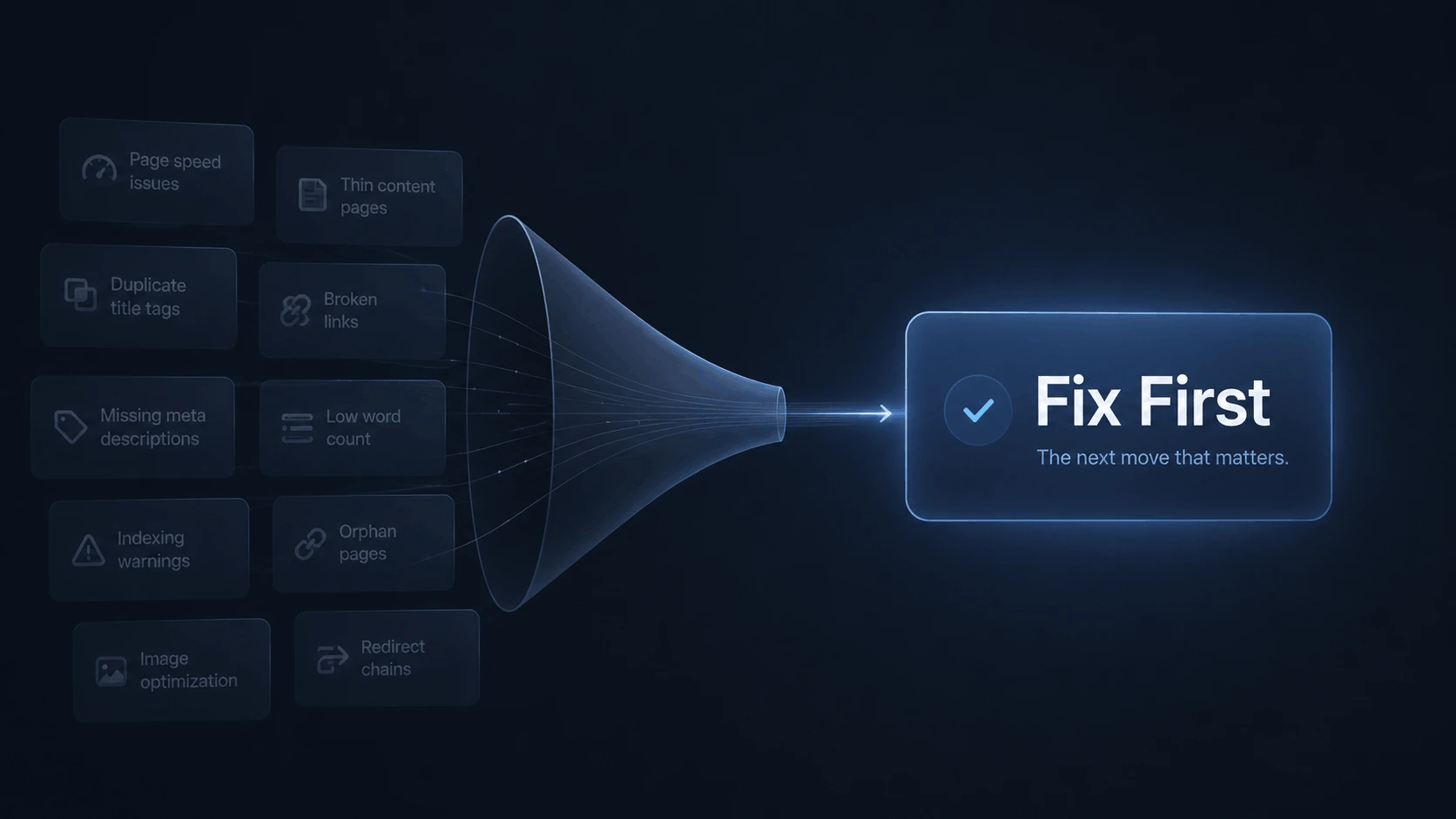 The first fix is not the loudest issue. It is the issue that most clearly blocks progress.
What “fix first” actually means
The first SEO fix is not automatically:
- the largest issue count
- the easiest task
- the warning marked “critical”
- the task with the highest estimated traffic
- the oldest item in the backlog
It is the change that removes the current limiting constraint.
A constraint is something that makes other SEO work less useful, premature, or harder to evaluate.
For example:
- If an important page is
noindex, rewriting the copy is premature. - If the wrong page type is targeting the query, adding more words may strengthen the wrong asset.
- If a useful page has almost no internal support, creating another similar page may increase fragmentation.
- If the site has strong pages and clean architecture but competitors have substantially stronger authority, another on-page rewrite may not solve the gap.
The question is not:
Is this issue real?
The better question is:
Is this the issue most clearly limiting progress right now?
For the broader decision framework behind this, see SEO Prioritization: How to Decide What to Fix First.
The four SEO constraint layers
When several kinds of SEO work compete for attention, inspect them in this order:
- Technical accessibility and indexation
- Content and search-intent fit
- Internal support and site structure
- Authority and external signals
Why this order?
Because each layer depends partly on the ones before it.
There is little value in building links to a page that cannot be indexed.
There is little value in increasing authority to a page that fundamentally misses the query.
And publishing more content does not automatically help if the existing site does not connect related pages coherently.
The sequence is not dogma.
It is a way to avoid solving a later-stage problem before an earlier-stage constraint is under control.
1. Fix technical SEO first when access or indexation is the constraint
Technical SEO should come first when search engines cannot reliably access, process, select, or discover the pages that matter.
Typical examples include:
- important pages blocked by
robots.txt - important pages marked
noindex - redirect loops
- broken internal links preventing discovery
- widespread incorrect canonical behavior
- important URLs returning the wrong status
- sitemap/discovery problems that materially affect important pages
- rendering problems that prevent meaningful content from being available
These issues have priority because they can make later optimization irrelevant or difficult to measure.
If a page cannot participate reliably in search, content polishing and authority building are downstream work.
Technical does not mean “fix every technical warning”
This distinction matters.
A crawler may report:
- missing meta descriptions
- long title tags
- minor redirect chains
- low-priority duplicate pages
- performance warnings
- hundreds of URLs you do not actually care about
Those are not automatically first.
Technical SEO comes first when the technical condition is a real constraint on important pages or site behavior.
Google's documentation on how crawling and indexing work reinforces the underlying principle: pages must be discoverable and processable before they can meaningfully compete.
So the question is not:
“Do we have technical issues?”
Almost every site does.
Ask:
“Is a technical issue preventing an important page or section from performing as intended?”
If yes, start there.
2. Fix content first when the page can rank but should not rank well yet
Once technical access is sound, inspect the page itself.
Content becomes the first priority when the real problem is that the page:
- has a search intent mismatch
- uses the wrong page format
- gives an incomplete answer
- lacks important decision-making information
- is outdated
- overlaps another page
- targets a query the page is not actually designed to satisfy
- is thin in ways that make it less useful than competing results
This is where “just fix the technical SEO” stops helping.
A technically perfect page can still be the wrong answer.
Start with search intent
Suppose you want to rank for a query where the search results are dominated by:
- practical guides
- comparison pages
- templates
- product category pages
- tools
But your page is a generic company landing page.
The problem may not be:
“The page needs more optimization.”
The problem may be:
“This is the wrong kind of page for the intent.”
That is a content decision.
Then check whether the page is complete enough
Once the format and intent are right, ask:
- Does the page answer the main question quickly?
- Does it cover the important subquestions?
- Does it help the reader make the decision they came to make?
- Does it demonstrate enough subject knowledge?
- Does it have useful examples?
- Is anything important missing because the page was written around a keyword rather than a reader problem?
Not every page needs to be long.
It needs to be sufficient for its job.
When an existing page should be improved instead of creating a new one
Content should also come first when Google is already testing an existing page for the right topic.
For example:
- the page receives relevant impressions
- it ranks around page two
- the query clearly matches the business
- the content only partially satisfies intent
That can be a stronger opportunity than publishing another nearby article.
Creating a second page may split the signal instead of strengthening the page already earning visibility.
This is one reason SEO prioritization needs context rather than a content calendar.
3. Fix internal support when the page is good but isolated
Sometimes the technical foundation is fine.
The content is good.
The page matches intent.
But the rest of the site barely supports it.
This is where internal linking and content architecture become the first meaningful constraint.
Look for:
- important pages with few contextual internal links
- orphaned or nearly orphaned pages
- supporting guides that do not link back to the pillar
- a pillar with no supporting cluster
- multiple related pages that do not reinforce one another
- navigation that makes important content difficult to discover
- pages competing in isolation instead of functioning as a topic system
This is not merely “add some links.”
The question is whether the site itself communicates:
This page matters, this is what it is about, and these other pages belong around it.
Internal support sits between content and authority
Internal links are not external authority.
But they help distribute internal importance, improve discovery, and establish relationships between pages.
That makes them a useful diagnostic layer before you jump to backlinks.
If a priority page has one internal link from an obscure page, asking for external links first may be premature.
You may already have unused support inside your own site.
Content systems matter too
Internal support also includes the question:
Does this page have enough surrounding content to make its role clear?
A product page may be strong on its own but poorly reinforced.
A category pillar may exist but have no supporting guides.
A supporting guide may exist but not feed authority/context back into the pillar.
In those cases, the first fix may be structural content support, not rewriting the main page again.
This aligns with RankQuest's content architecture: related guides should operate as a semantic graph, where pillar and supporting pages reinforce one another through contextual internal links rather than behaving like isolated posts. fileciteturn0file8
4. Fix authority when the on-site system is already strong
Authority becomes a more plausible first constraint when:
- important pages are crawlable and indexable
- canonical/indexation behavior is correct
- the page fits the search intent
- the content is competitive
- the page is supported internally
- the site's topic coverage is coherent
- stronger competitors still consistently outperform you
At that point, external authority may be the limiting factor.
Authority work can include:
- earning relevant backlinks
- digital PR
- expert contributions
- citations and mentions
- partnerships
- original research or assets people have a reason to reference
- distribution that increases the chance of natural links
Do not use “we need backlinks” as the default diagnosis
Backlinks matter.
But they are also an easy explanation for almost any ranking problem.
That makes them dangerous as a first assumption.
If a page:
- misses intent
- is thin
- is poorly linked internally
- has canonical problems
- is not the best page for the query
then authority work may amplify a weak asset rather than fix the core problem.
Authority is often a later-stage constraint, not because it is unimportant, but because you usually want the destination to be worth strengthening first.
Technical vs content vs authority: a quick diagnostic table
Use this as a fast first pass:
| What you observe | Most likely first area to inspect |
|---|---|
| Important page blocked, noindexed, redirecting incorrectly, or canonicalized wrongly | Technical |
| Page is indexable but wrong for the query or incomplete | Content |
| Page is useful but has weak internal support or no surrounding cluster | Internal support |
| Page is technically sound, useful, well linked internally, but competitors remain much stronger | Authority |
| Several layers are weak | Start with the earliest meaningful constraint |
The last row is important.
Real sites often have more than one problem.
You are not trying to prove that only one layer matters.
You are deciding which layer should be fixed first.
Worked example: technical vs content vs authority
Imagine a small SaaS site with these observations:
- several filtered URLs have inconsistent canonicals
- the primary comparison page ranks around position 12
- that page has only one contextual internal link
- the guide section has little supporting content
- competitors ranking above the site have more referring domains
- several old blog posts have weak titles
- homepage performance could be improved
Everything is real.
Now diagnose the constraint.
Scenario A: technical is first
Suppose the comparison page itself canonicalizes incorrectly to another URL.
Stop.
Do not start link building.
Do not rewrite the article first.
Fix the canonical behavior because the page's participation in search is not reliable.
Scenario B: content is first
Now suppose the canonical is correct and the page is indexable.
But the query is dominated by detailed comparison pages, while yours barely compares the alternatives and reads mostly like a product pitch.
The content/intent mismatch is the stronger constraint.
Fix the page.
Scenario C: internal support is first
Suppose the comparison page now matches intent well and already gets meaningful impressions.
But only one internal page links to it, and the surrounding guides are disconnected.
The next move may be internal linking and cluster reinforcement.
Scenario D: authority is first
Now suppose the technical setup is correct, the comparison page is strong, the supporting cluster exists, and contextual links reinforce it.
Yet significantly stronger competitors continue to dominate the query.
At that point, authority is a more credible limiting factor.
Same site.
Same page.
Different first fix depending on what is already true.
That is why generic checklists cannot make the decision for you.
Where performance fits
Performance can be a technical constraint.
But “site speed” should not automatically outrank everything else.
Ask:
- Is performance meaningfully poor on important pages?
- Is the experience actually degraded?
- Is the problem broad or isolated?
- Is there a realistic fix?
- Is another issue more directly preventing search visibility?
A modest performance improvement on an already usable page may be less important than fixing indexation or repairing the page's intent.
On another site, severe rendering/performance problems may absolutely deserve the first slot.
Again, diagnose the constraint.
Where internal linking fits
Internal linking is sometimes treated as a minor on-page task.
That understates its role.
Internal linking can be:
- a discovery problem
- a site architecture problem
- a priority-page support problem
- a content-cluster problem
If a strategically important page is almost isolated, internal support can become the first meaningful fix even when the page itself is technically indexable.
This is why “technical vs content vs authority” is useful as a mental model, but the practical diagnosis benefits from a fourth layer:
internal support
It sits between page quality and external authority.
Why one fix first reduces SEO noise
When every layer has problems, teams often create a giant parallel backlog:
- technical ticket
- content rewrite
- new article
- internal-link project
- link-building campaign
- performance cleanup
All at once.
That feels comprehensive.
It also makes it harder to understand what actually changed.
A more useful approach is:
Diagnose the current constraint → execute the fix → validate it → re-evaluate
 Clarity usually comes from narrowing focus, not expanding dashboards.
This does not mean the other problems vanish.
It means they do not all become active work simultaneously.
For the backlog-level version of this process, see SEO Task Prioritization: How to Prioritize Your SEO Backlog.
For the complete operating loop, see SEO Workflow: How to Turn SEO Data Into Action.
What not to fix first
Some work is valid but often premature.
Be cautious about:
- building backlinks before fixing a broken or mismatched destination page
- publishing more content when the existing cluster is disconnected
- rewriting every title tag before identifying priority pages
- chasing keyword ideas while important pages are blocked from indexing
- cleaning cosmetic audit warnings while a template-level problem remains
- optimizing minor performance issues while the wrong page is targeting the query
- adding more words when the real problem is search intent
- creating a new page when Google is already testing the right existing page
The common pattern is:
Later-stage optimization before earlier-stage constraints are resolved.
A practical “what should I fix first?” framework
When you are unsure whether technical, content, internal support, or authority should come first, ask these questions in order.
1. Can the important page reliably participate in search?
Check:
- crawlability
- indexability
- status
- canonical
- rendering
- discovery
If no, start with technical.
2. Is this the right page for the search intent?
Check:
- page type
- query intent
- SERP format
- target topic
- overlap with another page
If no, start with content/intent.
3. Is the page genuinely strong enough for its job?
Check:
- completeness
- clarity
- usefulness
- freshness
- differentiation
- decision-supporting information
If no, start with content quality.
4. Does the rest of the site reinforce this page?
Check:
- contextual internal links
- supporting pages
- pillar relationships
- orphaning
- architecture
If no, start with internal support.
5. Is external authority now the clearest remaining gap?
Check whether the page and site are strong on the earlier layers but consistently lose to more authoritative competitors.
If yes, authority becomes a credible next focus.
That sequence is deliberately diagnostic.
It avoids the trap of fixing what is easiest to measure rather than what currently constrains progress.
How this differs from SEO task prioritization
This guide answers:
Which kind of SEO problem is currently limiting the site — technical, content, internal support, or authority?
SEO Task Prioritization answers a narrower backlog question:
I already have several concrete SEO tasks. Which one should move to the top?
They are related but different.
One diagnoses the constraint layer.
The other ranks the tasks inside the backlog.
How RankQuest approaches “what to fix first”
RankQuest is built around this diagnostic problem.
It continuously observes the site, derives signals from current evidence, and surfaces at most one active SEO decision when something deserves action.
The system is designed so that a blocking condition can override lower-level optimization work, and an active decision can then move into a bounded Implementation Room for execution. That mirrors the same principle used in this guide: earlier constraints should not be buried underneath a pile of later-stage tasks. fileciteturn0file6
Depending on the decision, the Implementation Room can provide:
- scoped execution guidance
- deterministic outputs
- generated implementation material
- AI-agent-ready prompts
After implementation, the site can be observed again instead of assuming the original backlog is still correct.
Growth is handled separately because:
“What should I fix next?” and “What should I build next?” are different questions.
That separation is part of RankQuest's Growth architecture rather than mixing remediation and expansion into one backlog. fileciteturn0file14
Find the constraint before you add more SEO work
RankQuest continuously observes your site, identifies what deserves action, and gives you a bounded path to implement it.
Start with your site →
What to read next
If you want the broader framework for deciding what deserves attention, read SEO Prioritization: How to Decide What to Fix First.
If you already have a long list of tasks and need to sort it, read SEO Task Prioritization: How to Prioritize Your SEO Backlog.
If you want to organize the selected work through ownership, execution, and validation, read SEO Task Management: How to Organize and Execute SEO Work.
If you want the full evidence-to-action operating loop, read SEO Workflow: How to Turn SEO Data Into Action.
If you suspect lower-value work is consuming your time, read How to Stop Wasting Time on Low-Impact SEO Work.
The first fix depends on the constraint
There is no universal rule that says technical SEO, content, or authority always comes first.
The useful order is:
Technical accessibility → Content and intent → Internal support → Authority
Then stop at the first layer that is clearly limiting progress.
Sometimes the answer is a canonical fix.
Sometimes it is rewriting the page.
Sometimes it is building the missing supporting structure.
Sometimes it is strengthening authority.
The discipline is not choosing the same category every time.
It is choosing the first constraint that current evidence can justify.
Fix that.
Validate the result.
Then look again.