Guide
SEO Decisions vs SEO Tools
Updated May 2026
Most SEO tools are built to help you observe things like...
- Traffic changes
- Ranking fluctuations
- Crawl data
- Performance metrics
- Backlinks
- Keywords
- Technical issues
But observation is not the same as prioritization and prioritization is not the same as decision-making That distinction is where many SEO workflows quietly break down
People often assume they need:
- better dashboards
- more monitoring
- more metrics
- more SEO reports
- more alerts
when what they actually need is:
clearer judgment about what matters next.
SEO becomes exhausting when every issue feels equally important and the problem is rarely lack of information anymore.
Usually, it is:
- too many possible actions
- too many competing signals
- too much uncertainty
- too much constant monitoring
That is why modern SEO often feels overwhelming even with "better tools"
If you have not yet read the main framework behind this philosophy, start with How to Prioritize SEO Work.
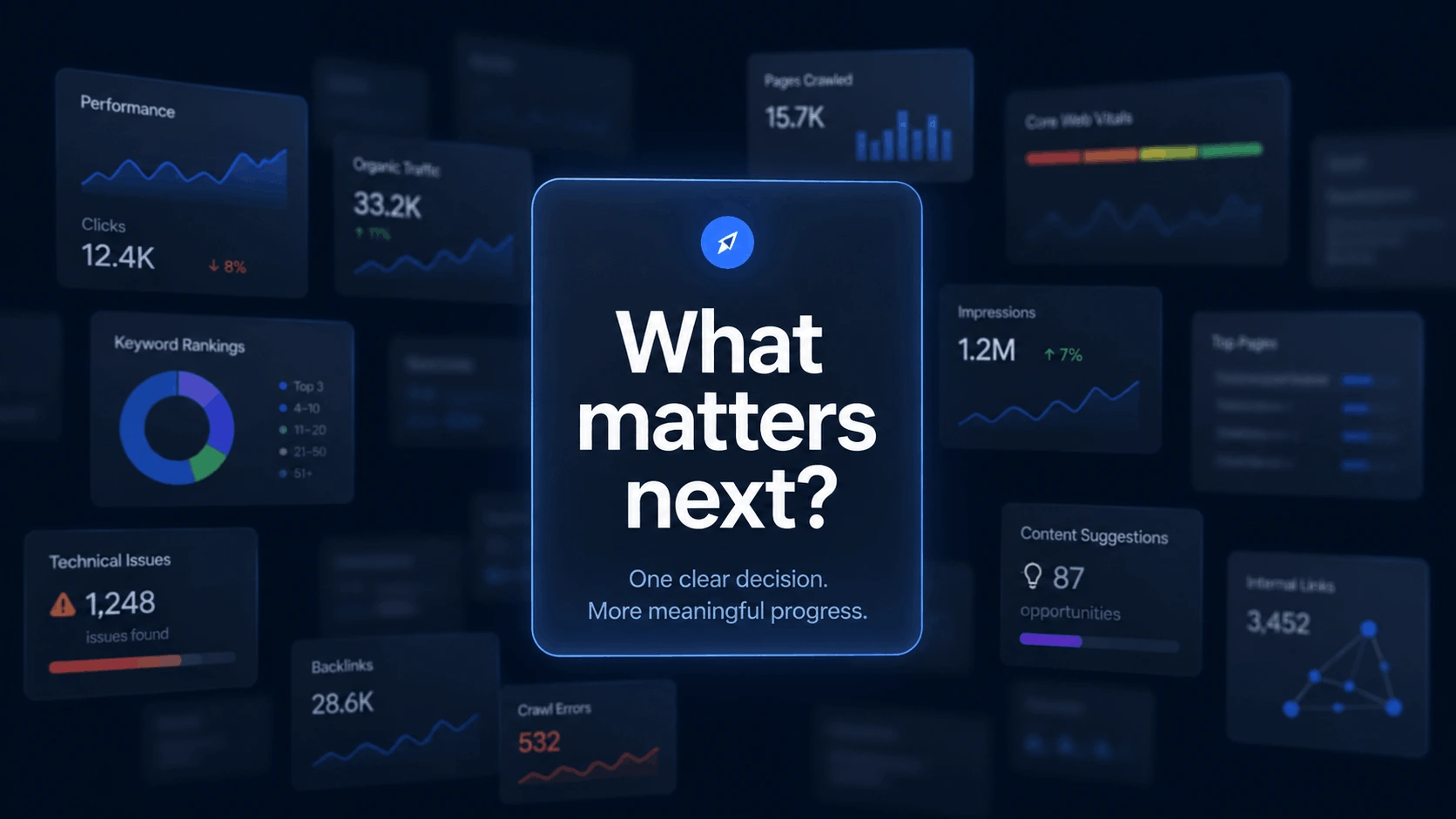 More SEO data does not automatically create better SEO decisions.
SEO Tools Are Observation Systems
Most SEO software is fundamentally designed around observation.
They answer questions like:
- What changed?
- What declined?
- What improved?
- Which pages moved?
- Which errors appeared?
- Which keywords lost visibility?
Those are useful inputs but inputs are not decisions. This distinction matters more than it sounds
Because once a system focuses mostly on observation, the user becomes responsible for:
- interpreting the data
- evaluating importance
- comparing tradeoffs
- choosing priorities
- sequencing work
- deciding what to ignore
That cognitive burden quietly shifts onto the user and that is where overwhelm starts.
Why More SEO Data Often Creates More Confusion
More data does not automatically create more clarity but in many cases, it creates the opposite.
Imagine opening five SEO tools in one morning:
- one reports technical warnings
- another shows ranking drops
- another recommends internal links
- another flags page speed
- another highlights keyword opportunities
All of those may technically be correct, but they do not answer the most important question:
What actually matters first?
Without prioritization, SEO becomes reactive and everything feels urgent and everything competes for attention.
The workflow slowly becomes:
Observe → React → Observe → React
Instead of:
Observe → Decide → Execute → Re-evaluate
That difference is extremely important, because one creates constant motion. The other creates progress.
The Hidden Problem With Dashboard-Centered SEO
Dashboards are optimized for visibility, not restraint.
Most dashboards encourage:
- constant checking
- endless monitoring
- metric fragmentation
- simultaneous priorities
- perpetual activity
But SEO improvements rarely happen because someone checked more graphs.
They usually happen because someone made:
- one good decision
- at the right time
- with focused execution
This is one reason why many teams stay busy without feeling clear and the system encourages observation loops instead of decision loops.
If this feels familiar, you may also relate to Why SEO Dashboards Overwhelm Teams.
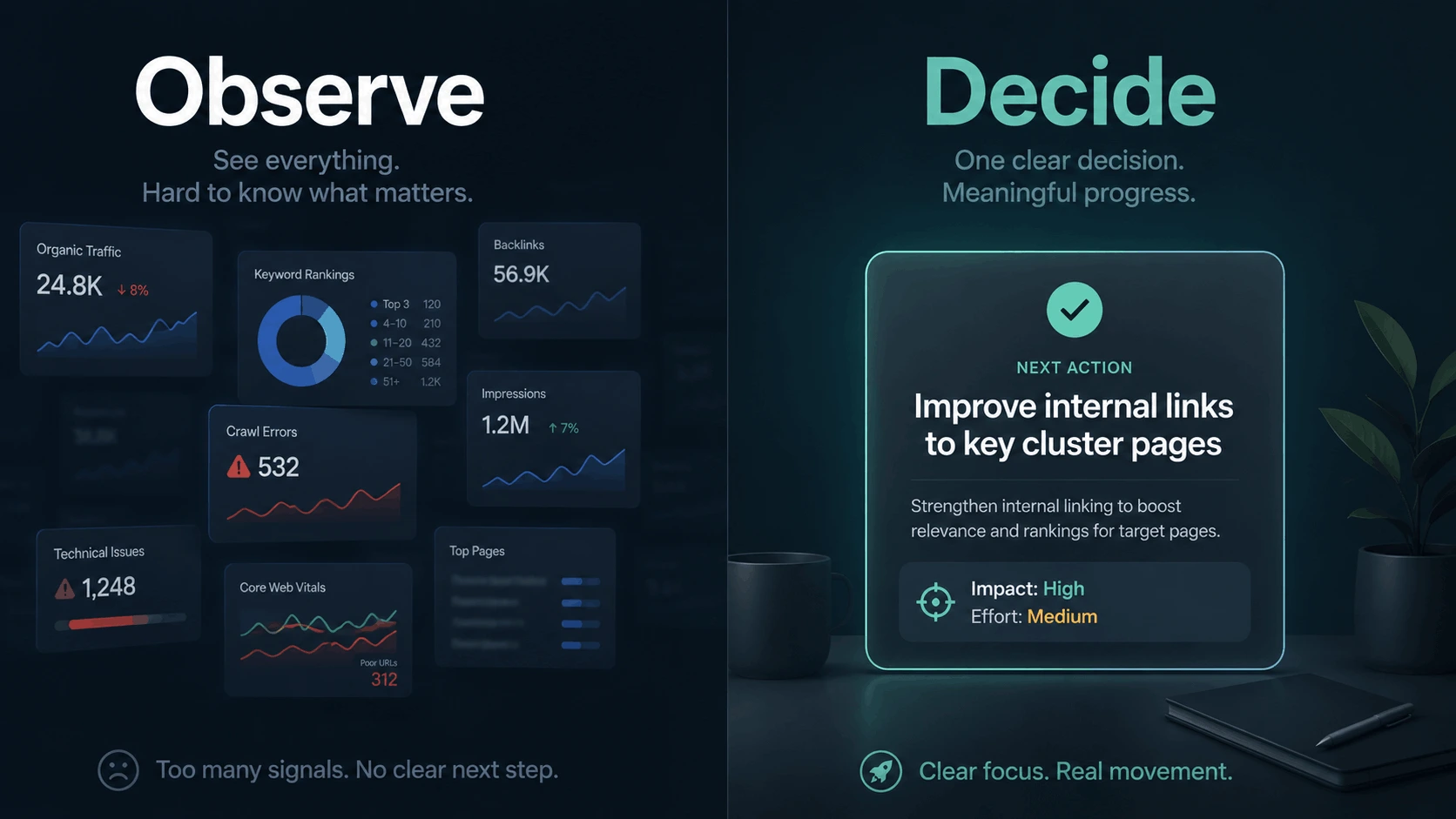 Observation creates awareness. Decisions create movement.
Tools Are Inputs... Not Priorities
This does not mean SEO tools are bad but far from it.
Tools are extremely valuable for:
- crawling websites
- discovering technical problems
- monitoring visibility
- collecting evidence
- identifying patterns
- validating assumptions
But tools should behave like instruments, not authorities. An SEO crawler can identify 4,000 issues
That still does not answer:
- which issue matters most
- which issue blocks growth
- which issue should wait
- which issue changes rankings materially
- which issue is merely noise
The real leverage comes from interpretation and interpretation requires prioritization.
This is why RankQuest positions itself differently... Not as another dashboard.
But as:
a calm decision system for SEO.
The goal is not to show more data and is to reduce uncertainty.
That philosophy exists throughout the entire product architecture. RankQuest intentionally operates through a single-decision workflow rather than stacked task queues or competing priorities.
The Difference Between Observation and Judgment
Observation answers:
“What exists?”
Judgment answers:
“What deserves action?”
Those are not the same skill and modern SEO already has abundant observation systems and the shortage is judgment systems, which is especially visible in technical SEO.
A crawl may surface:
- canonical inconsistencies
- internal link problems
- missing metadata
- duplicate titles
- pagination issues
But experienced SEO professionals know something important:
Not every issue deserves immediate action but some issues matter deeply,while others barely change outcomes and some only matter after a different bottleneck is resolved first and this is why sequencing matters more than issue volume.
SEO Progress Usually Comes From Constraint Removal
Strong SEO workflows often look surprisingly calm but not because there are fewer issues, but because there is clearer prioritization.
Instead of trying to improve everything simultaneously, effective systems usually focus on:
- the primary bottleneck
- the highest-leverage constraint
- the most meaningful next improvement
One meaningful decision often unlocks many downstream effects, that is why fixing the right thing matters more than fixing many things.So if you are unsure how to identify the right bottleneck, read What to Fix First in SEO.
Why "One Decision at a Time" Matters
Many SEO workflows fail because they attempt parallel optimization everywhere at once.
- Technical fixes
- Content updates
- Internal linking
- Authority building
- Performance improvements
- Metadata cleanup
All simultaneously
The result is usually:
- scattered execution
- context switching
- unclear ownership
- partial implementations
- decision fatigue
Bounded execution is calmer and usually more effective and this is why RankQuest deliberately centers around one active decision at a time instead of endless active task stacks.
That philosophy also shapes the product’s interface itself:
Observation
→ Decision
→ Implementation
→ Re-evaluation
The goal is not maximum activity and at the same time is a meaningful movement.
If this concept resonates with you, continue with One SEO Decision at a Time.
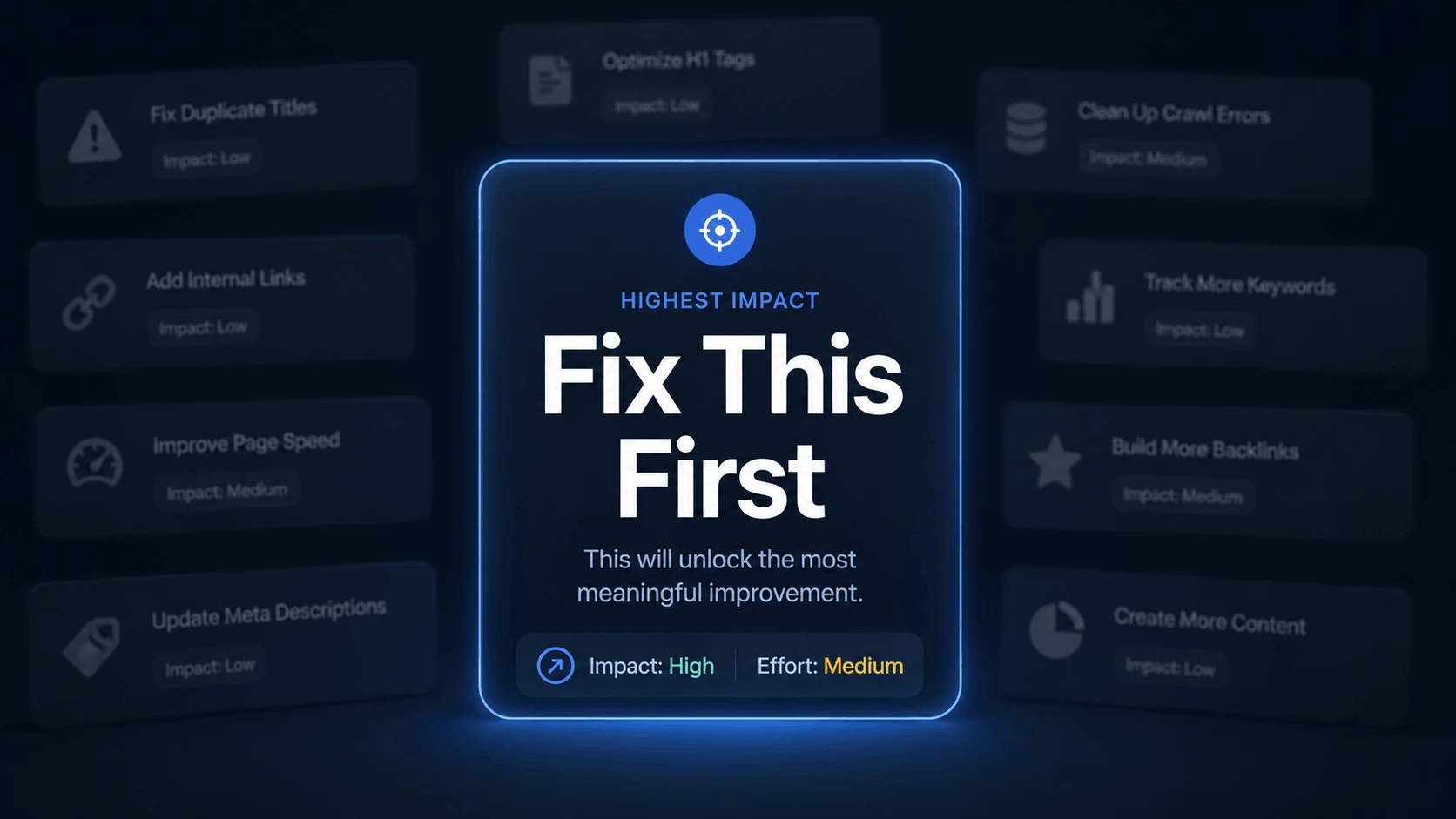 Clarity usually comes from narrowing focus, not expanding dashboards.
Calm SEO Usually Wins Long-Term
One of the least discussed problems in SEO is cognitive overload.
Too many tools create:
- fragmented thinking
- fragmented priorities
- fragmented workflows
People begin optimizing whatever tool surfaced most recently instead of what matters most strategically and this creates reactive SEO instead of deliberate SEO.
Calmer systems tend to improve decision quality because they reduce:
- urgency
- fragmentation
- simultaneous priorities
- unnecessary monitoring pressure
That is why the RankQuest philosophy intentionally favors:
- clarity over dashboards
- prioritization over monitoring
- bounded execution over endless activity
The system itself is designed around this principle and decisions exist as a single active state rather than a growing backlog
What Better SEO Systems Actually Need
Most teams do not need:
- more dashboards
- more alerts
- more SEO scores
- more competing recommendations
They usually need:
- clearer prioritization
- calmer workflows
- stronger sequencing
- fewer simultaneous priorities
- confidence about what deserves action now
That is fundamentally a decision problem and NOT a visibility problem.
Google itself provides extensive documentation for understanding crawling, indexing, and technical behaviors. Google Search Central
The challenge for most teams is not access to information anymore. It is deciding which information deserves action first.
Related Guides
If this article resonated with you, continue with:
You can also return to the main framework:
A Different Way to Think About SEO Software
The future of SEO software probably is not more graphs, while it is likely... better judgment systems
Systems that help users:
- narrow focus
- reduce uncertainty
- sequence work
- understand tradeoffs
- act with clarity
That is the direction RankQuest is intentionally built around and not more observation BUT better decisions. And often, that changes everything.
Waiting is a valid state and ignoring low-leverage noise is also a valid state. Clearer thinking usually creates better SEO than constant monitoring ever will.