SEO issue
XML Sitemap Problems: Missing and Invalid Sitemaps
Updated September 2026
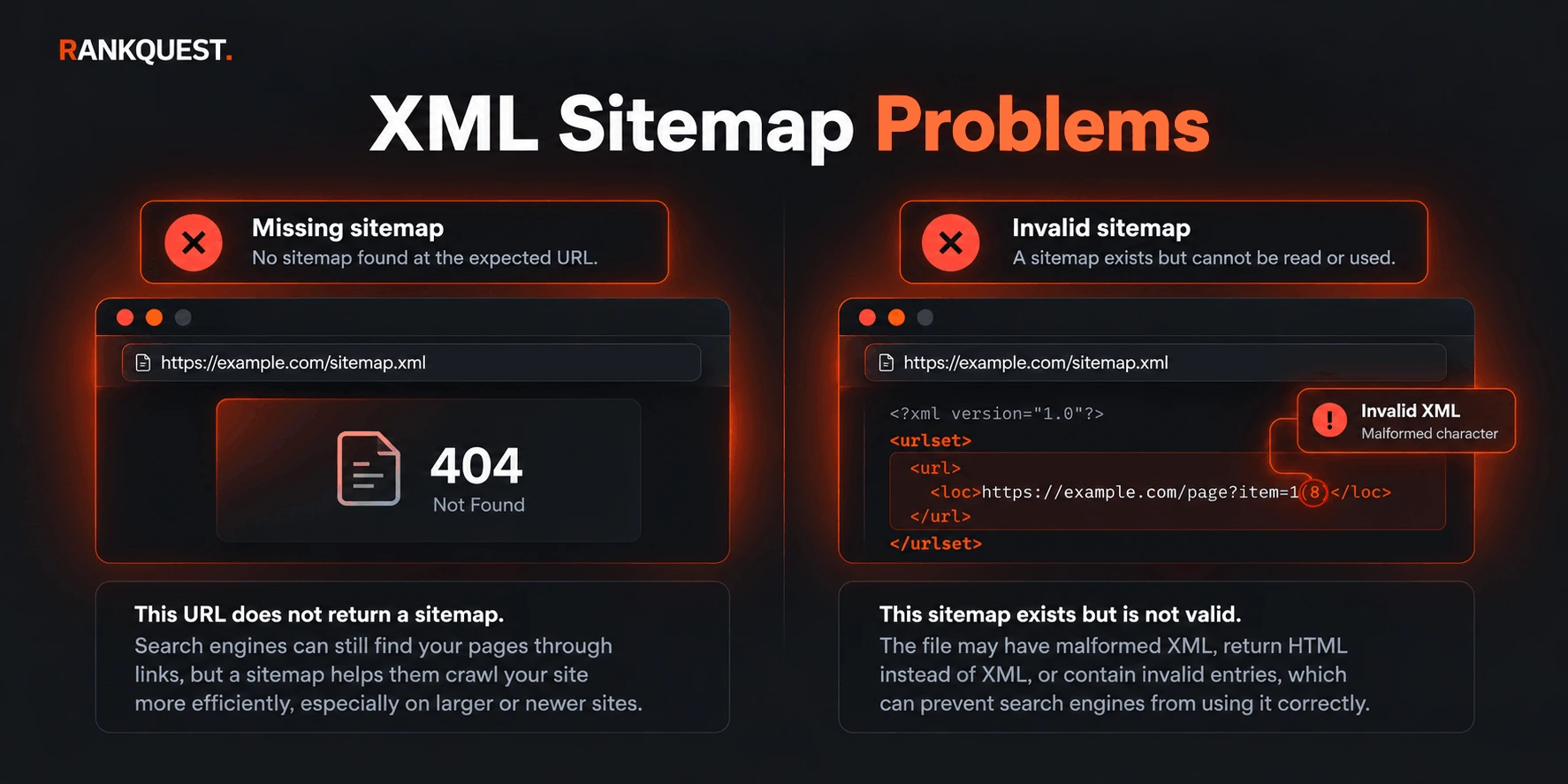 Missing vs Invalid XML Sitemap
An XML sitemap problem means crawlers do not have a usable list of the URLs you intend them to know about. Either that list was not found, or a file is there and cannot be read as a sitemap.
Search engines can still discover pages by following links. A sitemap does not replace that. It adds an explicit list: these are URLs this site means to expose. When the list is missing, or the file is not valid sitemap XML, that extra path is weak or absent. The rest of the site can still be crawled.
What is an XML sitemap?
An XML sitemap is a file, or a small set of files, that lists URLs. A normal sitemap is a urlset: each entry has a <loc> with a page URL. A sitemap index is a sitemapindex whose entries point at other sitemap files, which then list the pages.
Crawlers often learn the address from a Sitemap: line in robots.txt, or from a conventional path such as /sitemap.xml or /sitemap_index.xml. Those paths are common. They are not the only legal locations. What matters is a stable URL that returns real sitemap XML.
The file is a hint about which URLs you consider part of the site. It is not a command to index them, and it is not a ranking input by itself.
What counts as an XML sitemap problem?
Two failures belong together.
The sitemap is missing: observation never reads a usable list of page URLs from sitemap XML.
The sitemap is invalid: a sitemap URL responds, but the body is not readable sitemap XML, so the list cannot be trusted.
A third situation should stay separate. The XML parses, and one entry is stale, redirected, or a page you no longer want indexed. That is coverage hygiene. Fix the bad URL. Do not treat the whole file as missing or unreadable.
A missing lastmod, a priority value, or a changefreq you never set are not this problem. Those fields are optional, and they do not decide whether the file can be read.
Missing sitemap vs invalid sitemap
Missing means no trustworthy sitemap was found. On a typical check, /sitemap.xml or /sitemap_index.xml returns 404, or robots.txt names a sitemap URL that returns 404, and no page URLs were collected from sitemap XML.
Invalid means something sitemap-shaped was fetched, and it still could not be read as a sitemap. The usual sign is a response with no <urlset, no <sitemapindex, and no <loc> entries. An HTML error page, a plain-text file, or broken markup with none of those roots all land here. A sitemap index that parses, then points at a child file with the same problem, is an invalid sitemap too: the index exists, and part of the list does not.
They are one family because both remove the explicit URL list. They are different jobs because the fix is different. A missing sitemap needs a file and a way for crawlers to find it. An invalid sitemap needs the existing URL repaired so the response is sitemap XML again.
A timeout, a 403, or a 500 is neither of those conclusions. The fetch failed. You do not yet know whether a good sitemap is sitting behind the error.
What sitemap problems look like
/sitemap.xml returns 404. robots.txt contains Sitemap: https://example.com/sitemap.xml, and that URL 404s as well. The site has normal pages and internal links. There is simply no sitemap file to read. That is a missing sitemap.
/sitemap.xml returns 200 and the body is your HTML homepage, or a styled "not found" template that is still HTML. A browser may show a page. A sitemap parser finds no urlset and no locations. That is an invalid sitemap.
The file starts like XML and then breaks: an unescaped & in a URL, a tag left open, or bytes that do not match the encoding. If nothing readable remains — no urlset, no sitemap index, no <loc> — crawlers have no list.
/sitemap_index.xml is valid and lists /sitemaps/pages.xml. That child returns HTML. The index did its job. The child did not, so every URL that belonged in the child is missing from discovery.
A different picture: /sitemap.xml is valid XML, lists fifty live pages, and also lists /old-offer, which now 404s. The sitemap works. One entry is wrong. Remove or replace that URL. Do not describe the whole file as invalid XML.
Why sitemap problems matter
Links remain the main way crawlers move through a site. A sitemap is the place you state the set of URLs you want considered, including pages that are new, deep, or poorly linked.
That matters more when the site is large, new, changing often, or thin on internal links. A new URL with no in-links can wait a long time if the only discovery path is "someone linked to it." A sitemap can put that URL on the list the next time the file is fetched.
It matters less as a ranking tactic. Putting a URL in a sitemap does not make it rank, and it does not force indexing. A noindex page, a blocked URL, or a page with nothing to rank for will not be saved by a <loc> line.
A broken sitemap also wastes the signal. If the file cannot be parsed, the careful list you meant to publish is ignored, in whole or in part, and discovery falls back to links.
When a sitemap problem is NOT actually a major SEO problem
A small site with a clear homepage, navigation, and internal links can be crawled without a sitemap. Missing /sitemap.xml is not the same sentence as "Google cannot find this website." If the important pages are already linked and already indexed, publishing a sitemap is housekeeping, not an emergency.
A sitemap should not be asked to compensate for a site that does not link its own pages. If key URLs are orphans, add internal links. Listing them only in XML leaves people, and often crawlers, with a worse path than a normal link.
One retired URL inside an otherwise valid sitemap is a smaller job than a 404 on the sitemap itself, or XML that will not parse. The file is still a usable list.
Tool warnings that do not stop parsing are lower priority than a file that returns an error or HTML. Cosmetic fields are not why a sitemap fails.
And a complete, valid sitemap can still leave pages unindexed. Indexing depends on whether the URL should be indexed and whether it earns a place, not on whether it appeared in XML.
If you are choosing among a pile of real issues, weigh this one the same way you weigh the rest: what it blocks, and whether the important URLs are already being found. SEO prioritization is that comparison, not a rule that every sitemap warning goes first.
How to find XML sitemap problems
Open the sitemap URL directly. Check the status code and the body, not only the browser tab title. You want XML, with a urlset or a sitemapindex, and <loc> values that are real URLs on your host.
If you are not sure of the path, read robots.txt for Sitemap: lines, then try /sitemap.xml and /sitemap_index.xml on the canonical host. A declaration that points at a 404 is a missing sitemap even when you thought the file existed somewhere else.
Confirm the response is XML. A 200 with text/html, or a body that is a web page, is not a working sitemap.
If you have an index, open each child URL the same way. A healthy index with a broken child is still a sitemap problem.
Search Console's Sitemaps report is useful after you submit a URL. It can show whether that sitemap was fetched and how many URLs were read. It does not grade the rest of the crawl, and it says nothing about a file you never submitted.
Do not treat a failed fetch as a verdict. A timeout or a 403 means you could not read the file this time. Retry, or look at the server, before you delete a sitemap that might be fine.
How to prioritize sitemap problems
Raise the priority when the sitemap URL itself is broken, or the XML cannot be parsed at all, especially if a sitemap index is the only path to many child files. Raise it on a large site, a new site, or a site whose important pages are hard to reach by links. A missing list is a bigger gap there than on a ten-page site with a complete menu.
Lower the priority when the site is small and already well linked, when the important URLs are indexed, or when the only defect is a single stale URL in a file that otherwise parses. A warning that does not stop the file from being read can wait behind problems that block crawling or mislead indexing.
Do not invent a score for this. Ask whether discovery of URLs you care about is actually impaired.
How to fix a missing sitemap
Generate sitemap XML for the URLs you want crawled: usually the canonical, indexable HTML pages, not parameter junk, feeds, or noindex URLs. Escape characters that are special in XML. An ampersand in a query string has to be & inside <loc>.
Publish that file at a stable URL. /sitemap.xml is the usual choice. Another path is fine if robots.txt declares it and the URL keeps working.
Add a line to robots.txt on the canonical host:
Sitemap: https://example.com/sitemap.xml
Use your real sitemap URL. Submit that URL in Search Console if you want fetch errors reported there. Submission does not replace a file that returns 200 and valid XML.
If the site is large enough to need several files, publish a sitemap index and make every child return valid XML. A single urlset is enough for many sites.
How to fix an invalid sitemap
Keep the URL crawlers already use, and replace the body with valid sitemap XML. If /sitemap.xml is the known address, fix that response. Pointing robots.txt at a second, healthy file while the old URL still returns HTML leaves the broken address in place for anyone who already has it.
The response should be XML, with a urlset or sitemapindex root, UTF-8 that matches the file, and every <loc> escaped and absolute. Include the indexable URLs you mean to expose. Drop URLs that 404, and drop URLs you do not want indexed.
When the failure is a child of an index, fix that child, or remove it from the index. Repairing only the index file does nothing if the listed sitemap is still unreadable.
Then fetch the URL again. A page that "looks like" a sitemap in a text editor and an HTTP response that is actually HTML are different outcomes. Check the response.
How to validate the fix
Request the sitemap URL. You want a successful status, an XML content type, and a body that parses. Spot-check <loc> values against pages you know should be included, and against pages that should stay out.
If you use an index, request every child you list. One broken child is still a broken list.
Confirm robots.txt names the URL you just fixed, on the canonical host.
In Search Console, submit or recheck that sitemap and see whether it can be read. A successful read means the file was fetched and parsed. It does not mean every URL in it will be indexed.
Recrawl the site, or wait for the next observation, and confirm the sitemap is found and readable. If the old 404 or the old HTML body is still what comes back, the deploy did not land on the URL you think it did.
How RankQuest handles sitemap problems
RankQuest keeps this as two decisions inside one problem.
A missing sitemap means the crawl read no page URLs from sitemap XML, and the absence is conclusive: /sitemap.xml or /sitemap_index.xml returned 404 on the canonical host, or a sitemap named in robots.txt returned 404 there. Timeouts, forbidden responses, and server errors stay inconclusive. They do not become "no sitemap." If a sitemap already yielded page URLs, this decision is not raised.
An invalid sitemap means a sitemap URL came back with a body that is not readable sitemap XML: no urlset, no sitemap index, and no <loc> entries. That includes an HTML page served at the sitemap URL, and a child sitemap that fails the same way. A file that still contains <loc> URLs is not labeled invalid merely because one entry is stale.
For a missing sitemap, the Implementation Room has two steps. Generate sitemap.xml builds a urlset from indexable HTML pages in the crawl, with XML escaping, and leaves out noindex URLs. Generate robots.txt entry then produces a Sitemap: line aimed at /sitemap.xml on the site origin. The robots step stays locked until the sitemap step is done.
For an invalid sitemap, the room asks you to publish a corrected file at the sitemap location you already use. When the broken object is a sitemap file, Generate corrected sitemap produces a replacement urlset. When the scope is the broader discovery structure rather than one file, the action is sitemap fix guidance instead of a generated file.
Neither action chooses which URLs deserve to rank, and neither promises indexing. The next observation checks whether a readable sitemap is actually there.