Guide
Low-Impact SEO Busywork Is Slowing You Down
Updated May 2026
Most SEO work does not fail because teams lack effort. It fails because effort gets scattered across dozens of low-impact activities that feel productive but rarely move rankings, traffic, or visibility in a meaningful way.
SEO today often becomes:
- endless audits
- spreadsheet maintenance
- checking scores
- tweaking metadata
- monitoring dashboards
- publishing disconnected articles
- fixing random warnings
The result is not progress -> It is exhaustion.
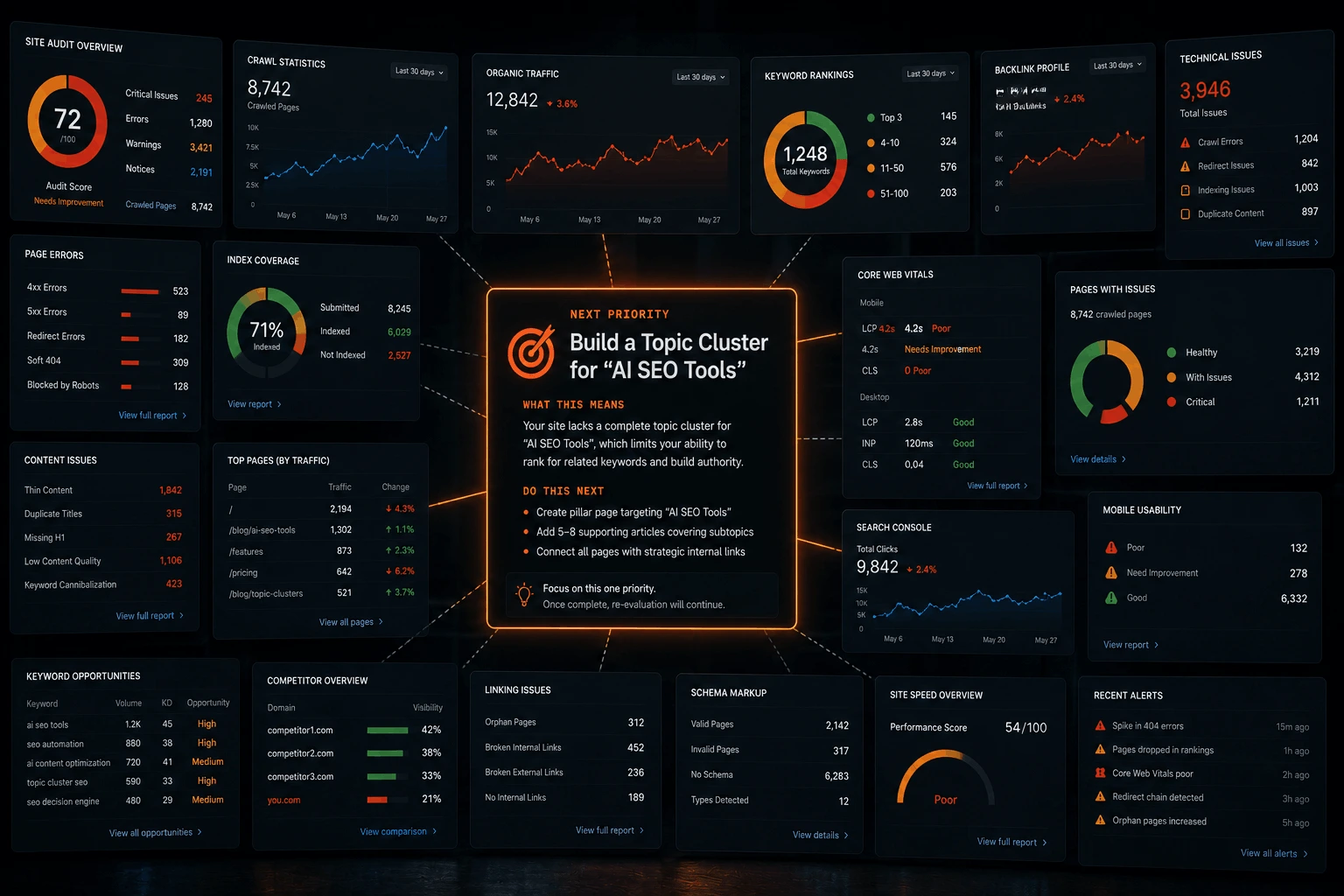 Too many disconnected SEO tasks create noise instead of momentum.
The problem is rarely:
“You are not doing enough SEO.”
More often, the problem is:
“You are spending energy on things that are not the current bottleneck.”
That distinction changes everything.
SEO Has Quietly Become Operational Noise
Modern SEO tools generate enormous amounts of information.
Technical audits alone can produce:
- hundreds of warnings
- dozens of categories
- template-level recommendations
- “optimization opportunities”
- automated checklists
None of this tells you what matters most right now.
This is one of the core ideas behind our guide on SEO decisions vs SEO tools.
Most systems answer:
“What exists?”
Very few answer:
“What should actually be addressed next?”
That difference is where most SEO overwhelm begins.
Busywork Feels Safe
Low-impact SEO work is attractive because it feels measurable.
Examples include:
- changing title tags repeatedly
- chasing Lighthouse scores from 92 → 95
- publishing low-quality AI articles daily
- fixing tiny accessibility warnings unrelated to rankings
- endlessly reorganizing internal spreadsheets
- tweaking metadata on pages with no traffic
- monitoring dashboards every hour
- checking rankings without acting on them
These tasks feel productive because they are visible and repeatable. But visibility is not impact.
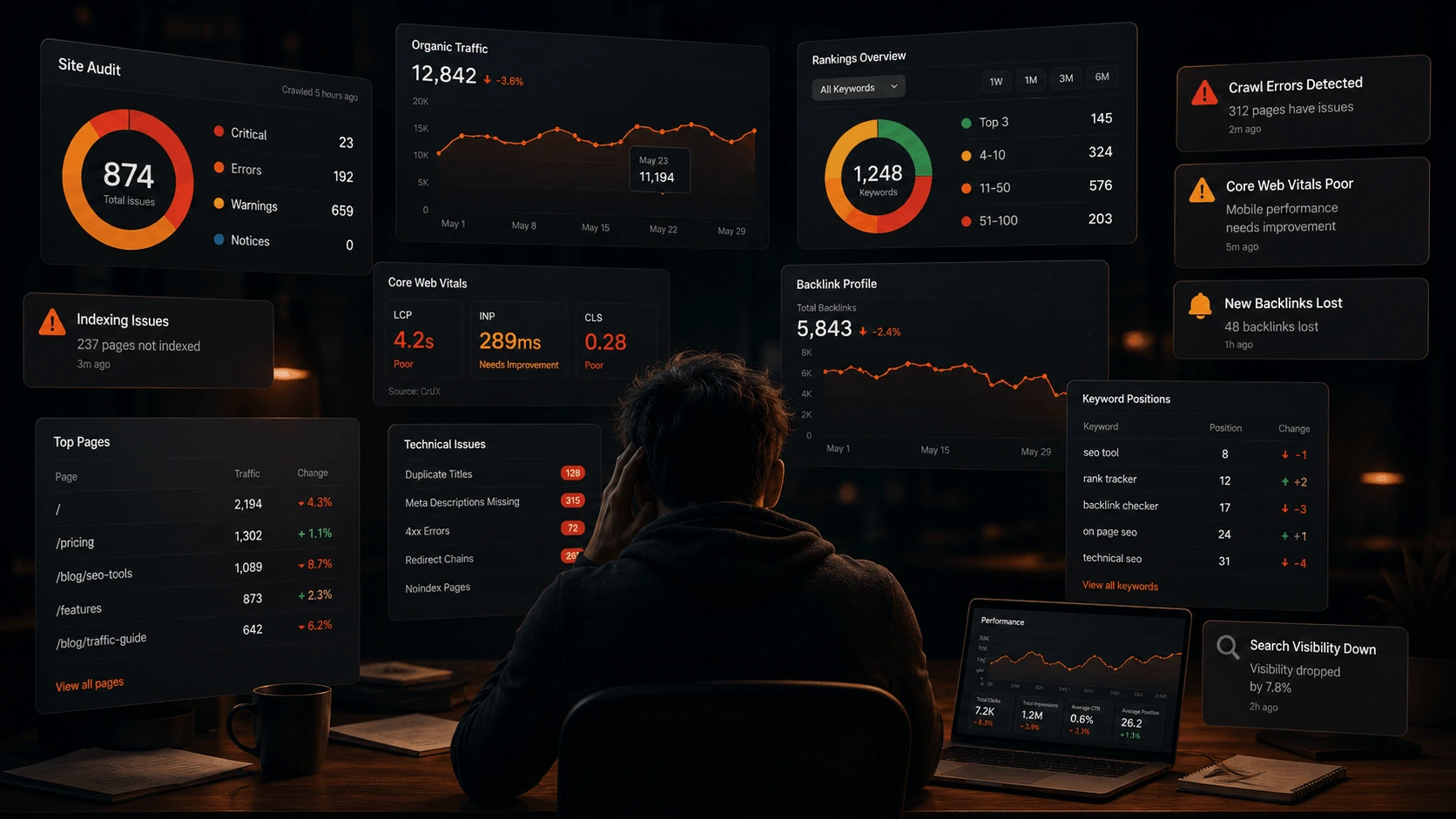 SEO overwhelm often comes from too many disconnected tasks competing for attention.
Most SEO Gains Come From Bottlenecks
SEO systems behave more like infrastructure than checklists.
Usually:
- one issue limits growth
- one page blocks visibility
- one missing cluster weakens authority
- one crawl issue suppresses indexing
- one intent mismatch prevents rankings
Everything else becomes secondary until that bottleneck changes and this is why prioritization matters far more than volume.
As explained in How to Prioritize SEO Work, SEO progress usually comes from identifying the highest-leverage constraint first.
Not from doing more things simultaneously.
Activity Is Not Momentum
One of the biggest traps in SEO is confusing movement with progress.
A team can spend weeks:
- fixing minor issues
- updating dozens of pages
- publishing more content
- generating reports
while rankings remain unchanged. That happens because SEO systems are interconnected.
If the actual problem is:
- poor topical authority
- missing supporting pages
- crawl inefficiency
- weak internal linking
- intent mismatch
then unrelated optimizations rarely matter.
This is also why many founders eventually feel overwhelmed by dashboards and the dashboard keeps changing while the underlying bottleneck does not.
Why SEO Dashboards Often Make This Worse
Dashboards are useful for observation, but many SEO workflows accidentally turn observation into constant task generation.
Instead of clarity, users receive:
- notifications
- warnings
- issue counts
- scores
- alerts
- suggestions
The brain interprets this as:
“Everything matters.”
But everything cannot matter equally and that is one of the central problems discussed in Why SEO Dashboards Overwhelm Founders.
Without prioritization, information becomes cognitive load.
High-Impact SEO Usually Looks Boring
Ironically, the highest-impact SEO work often feels less exciting.
Examples:
- improving a single strategic landing page
- building one strong content cluster
- fixing canonical problems sitewide
- improving internal linking to a priority page
- resolving indexing blockers
- aligning content with search intent
These changes are often:
- slower
- more focused
- less flashy
- harder to automate
But they compound.
 High-impact SEO usually comes from focused execution, not endless task switching.
The “One Decision” Model
One of the biggest mental shifts in SEO is understanding that:
You do not need to solve everything simultaneously.
You need to identify:
The most meaningful next decision.
That idea is explored deeply in One SEO Decision at a Time.
Most SEO systems fail because they create parallel urgency, but search engines do not reward anxiety, they reward clarity and relevance over time.
Questions That Reveal Busywork
A useful exercise is asking:
“If we stopped doing this task entirely, would rankings realistically change?”
Many recurring SEO activities fail this test.
Another useful question:
“Is this task addressing the current bottleneck?”
If the answer is unclear, the task may simply be operational noise, this does not mean every low-impact task is useless.
It means:
timing matters.
Some tasks only matter after foundational problems are resolved.
SEO Without Guessing
The goal is not to eliminate work. The goal is to eliminate unnecessary uncertainty.
Effective SEO systems reduce:
- scattered execution
- reactive optimization
- random task switching
- metric obsession
And increase:
- prioritization
- clarity
- bounded execution
- focused iteration
What to Do Instead
A calmer SEO workflow usually looks like this:
- Observe reality
- Identify the current bottleneck
- Execute one meaningful change
- Re-evaluate
- Repeat
This creates momentum without chaos and it also aligns more closely with how search systems actually evolve over time.
Final Thought
Most SEO burnout is not caused by lack of effort. It is caused by too many disconnected actions competing for attention simultaneously
The solution is rarely work harder
Usually, the solution is:
“remove low-impact noise and focus on what matters most next.”
That shift changes SEO from a constant stream of activity into a deliberate decision process and that is where meaningful progress usually begins.
Further Reading
- How to Prioritize SEO Work
- SEO Decisions vs SEO Tools
- Why SEO Dashboards Overwhelm Founders
- One SEO Decision at a Time
External References
- Google's documentation on Search ranking systems
- Google's guide on Creating helpful, reliable, people-first content
- Ahrefs article on search intent