Guide
One SEO Decision at a Time
Updated May 2026
One SEO Decision at a Time
Most SEO systems quietly encourage fragmentation.
You open a dashboard and immediately see:
- technical warnings
- keyword movement
- traffic drops
- performance scores
- backlink reports
- content gaps
- audits
- recommendations
- “opportunities”
Everything competes for attention at the same time and the result is rarely clarity. Usually, it becomes cognitive overload and SEO starts feeling less like decision-making and more like permanent monitoring.
The problem is not that modern SEO lacks data. But the problem is that very little of that data is helping you decide what actually matters right now.
A calmer workflow begins by narrowing scope. Not expanding it.
Why Most SEO Workflows Become Mentally Exhausting
A typical SEO workflow often looks like this:
- investigate rankings
- open analytics
- compare competitors
- review crawl issues
- export keyword reports
- check performance metrics
- review content gaps
- look at backlinks
- revisit older tasks
Then repeat the cycle tomorrow. Nothing is technically “wrong” with these activities, but they create a dangerous pattern:
everything feels important simultaneously.
When every signal competes equally, prioritization collapses and that is usually where SEO overwhelm begins.
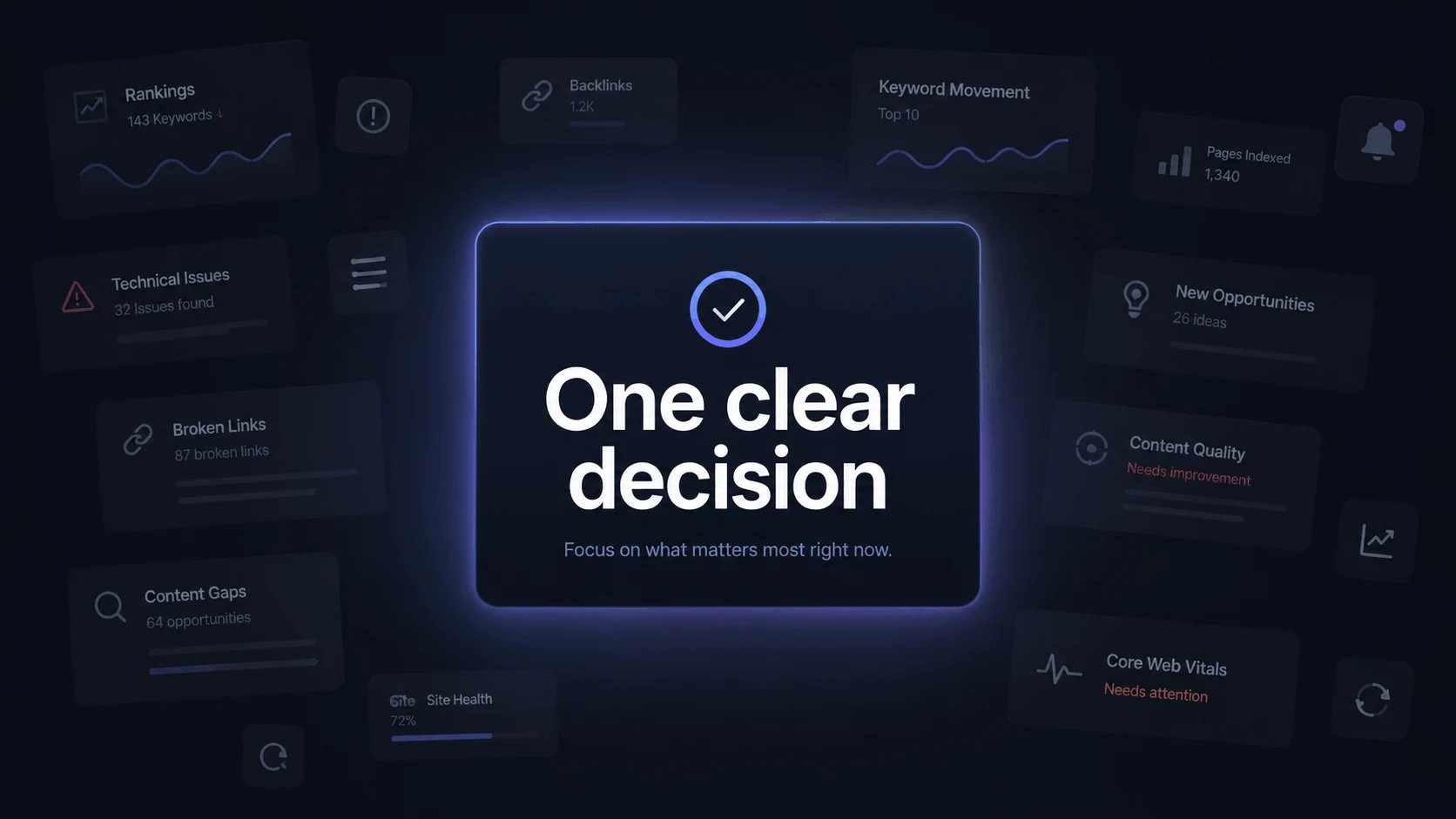 Clarity begins when SEO stops competing for your attention.
The Hidden Cost of Constant Context Switching
SEO work becomes dramatically harder when attention is fragmented across too many prioritie and a founder might begin the day trying to improve internal links.
Then switch into:
- Core Web Vitals
- metadata cleanup
- keyword clustering
- content refreshes
- crawl debugging
- competitor analysis
By the end of the day, several things were touched, but nothing meaningful was fully resolved. This creates the illusion of productivity while reducing actual progress and the deeper issue is psychological.
Your brain never gets to settle around a single bounded problem, and there is no closure. Only constant reorientation.
What “One SEO Decision at a Time” Actually Means
This idea does not mean:
- ignoring other issues forever
- pretending SEO only has one problem
- refusing to monitor the site
- simplifying reality artificially
It means something much more practical:
Only one issue should dominate execution focus at a given moment.
A calm SEO workflow usually looks more like this:
- Observe the current state
- Identify the highest-leverage issue
- Resolve that issue fully
- Re-evaluate the system
- Move to the next decision
This reduces:
- cognitive overload
- fragmented execution
- random task switching
- low-impact busywork
More importantly, it creates directional clarity.
Why Bounded Execution Matters
One reason SEO often feels endless is because most tasks are not clearly bounded.
Examples:
- “Improve content quality”
- “Build authority”
- “Optimize internal linking”
- “Fix technical SEO”
These are not decisions, these are categories. Good execution usually requires narrower scope, instead of:
“Improve internal linking”
A bounded decision might be:
“Add internal links to the pricing page from high-authority commercial pages.”
... and that changes everything.
The task becomes:
- understandable
- measurable
- finishable
- cognitively manageable
This is one of the core differences between monitoring systems and decision systems.
Calm Systems Reduce Noise
A calmer workflow intentionally suppresses unnecessary urgency, and that matters more than many people realize.
A lot of SEO anxiety comes from interface design itself:
- red warnings
- infinite recommendations
- noisy dashboards
- movement everywhere
- dozens of competing metrics
The system constantly signals:
“something else also needs attention.”
But most sites do not improve because someone reacted to 40 things simultaneously.
They improve because the right issue received concentrated focus.
That distinction matters.
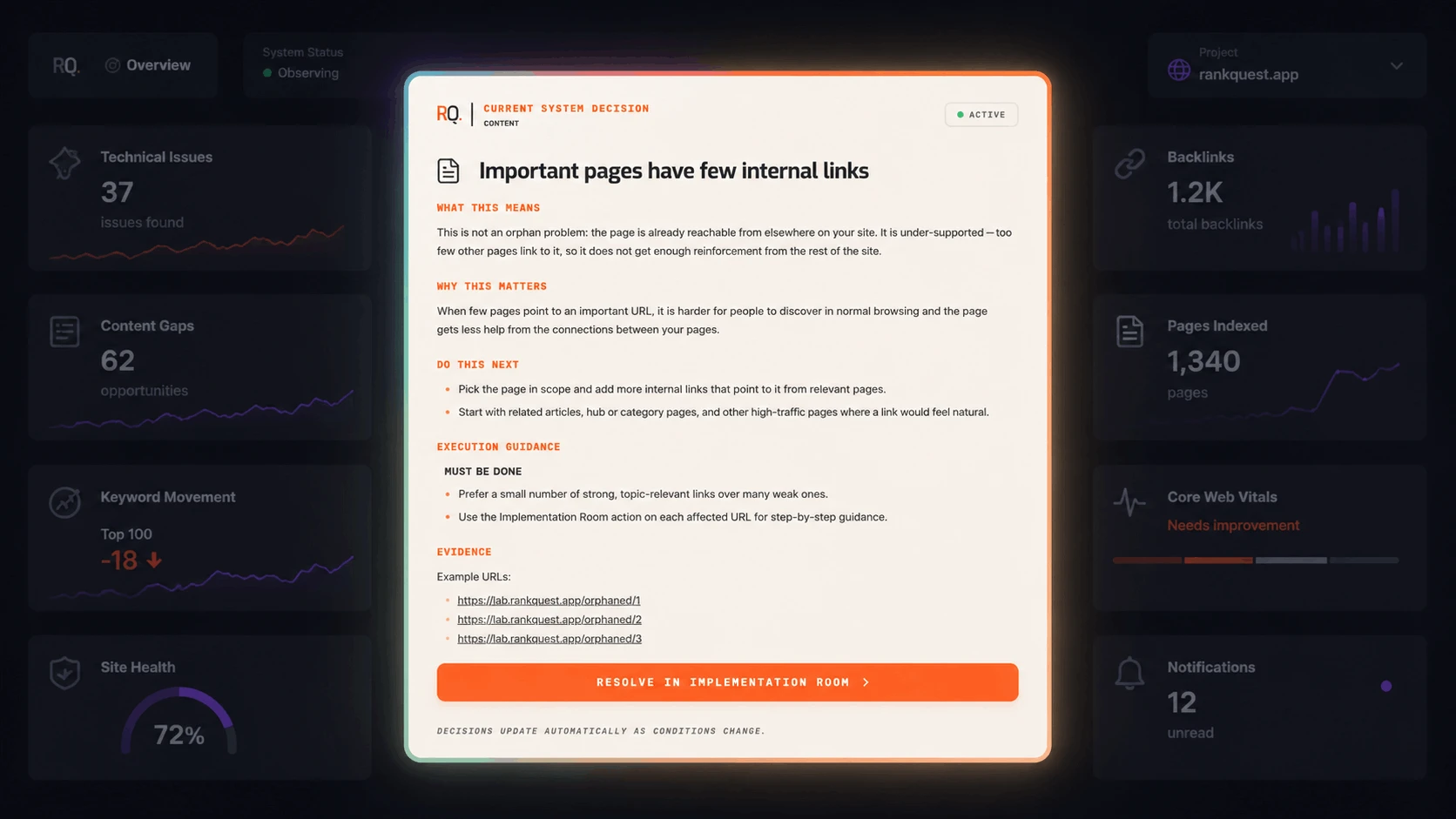 A calmer SEO workflow reduces noise instead of amplifying it.
One Decision Does Not Mean One Metric
This is also important.
A decision-first workflow is not about obsessing over a single metric.
It is about identifying:
which constraint currently matters most.
Sometimes that is technical.
Sometimes it is content.
Sometimes it is internal linking.
Sometimes the correct decision is simply to wait and observe.
The goal is not tunnel vision.
The goal is reducing unnecessary competition between priorities.
Practical Example
Imagine a small SaaS site with the following issues:
- homepage loads slowly
- 120 broken internal links
- thin blog articles
- poor internal linking
- missing schema
- declining rankings
A dashboard-centric workflow treats these as parallel streams.
A decision-first workflow asks:
Which issue is most meaningfully constraining progress right now?
That changes the order completely.
Maybe fixing the homepage performance issue has the highest leverage.
If so:
- focus there first
- resolve it properly
- re-evaluate afterward
Not because the other problems disappeared.
But because execution quality improves dramatically when focus narrows.
SEO Feels Better When the Scope Is Smaller
This is one of the least discussed parts of SEO systems.
Smaller scope creates psychological relief.
You stop feeling permanently behind.
You stop carrying dozens of unresolved priorities mentally.
You stop wondering constantly whether you are working on the wrong thing.
That clarity has real value.
Especially for founders and small teams.
Prioritization Is Really a Cognitive Problem
A lot of SEO advice treats prioritization as a spreadsheet problem.
But in practice, it is often a cognitive-load problem.
Too many active priorities create:
- hesitation
- reactive work
- shallow execution
- constant switching
- unfinished systems
A calmer workflow reduces those costs.
This is why guides like How to Prioritize SEO Work and Low-Impact SEO Busywork matter so much together.
The goal is not doing more SEO.
The goal is making better decisions with less fragmentation.
SEO Is Usually Slower Than the Interface Suggests
Most dashboards create the feeling that every issue requires immediate action.
Reality is usually calmer.
Search systems evolve slowly.
Authority compounds slowly.
Content matures slowly.
Technical fixes take time to propagate.
Trying to react instantly to every signal often creates worse decision-making.
A better workflow creates enough space to think clearly.
Where RankQuest Fits Into This
RankQuest was designed around this exact problem.
Not around showing more metrics.
And not around creating larger dashboards.
The system operates around a simpler principle:
identify what matters most, then narrow execution around that decision.
Instead of forcing users to manage dozens of competing priorities simultaneously, RankQuest focuses on bounded decision-making and calmer execution flows.
That philosophy also shapes guides like:
All of them reinforce the same idea:
SEO becomes more manageable when attention narrows.
A Better SEO Workflow Usually Feels Quieter
That may sound strange at first.
But it is true.
The best workflows are often less noisy:
- fewer active priorities
- fewer simultaneous tasks
- fewer interruptions
- fewer dashboards
- fewer reactive loops
More clarity.
More deliberate focus.
More bounded execution.
And usually, better decisions.
Conclusion
Most SEO overwhelm is not caused by lack of information.
It is caused by too many unresolved priorities competing for attention simultaneously.
A calmer workflow does not try to eliminate complexity entirely.
It simply narrows focus enough for meaningful execution to happen again.
One decision.
One bounded scope.
Then re-evaluate reality afterward.
That is often enough to make SEO feel manageable again.