Guide
Why SEO Dashboards Overwhelm Teams
Updated May 2026
SEO is supposed to create clarity, but for many teams, it creates the opposite.
Too many tabs
Too many reports
Too many alerts
Too many competing priorities
One tool says rankings dropped or another flags technical issues. One more recommends internal links while another highlights backlinks To add one more to the list that suggests content opportunities
All of these systems are trying to help.
But together, they often create a different problem:
fragmented attention
Modern SEO workflows rarely suffer from lack of visibility anymore but they suffer from too much simultaneous visibility without prioritization. And that is one reason SEO increasingly feels mentally exhausting even when teams have better software than ever before.
If you have not yet read the broader framework behind this philosophy, start with How to Prioritize SEO Work.
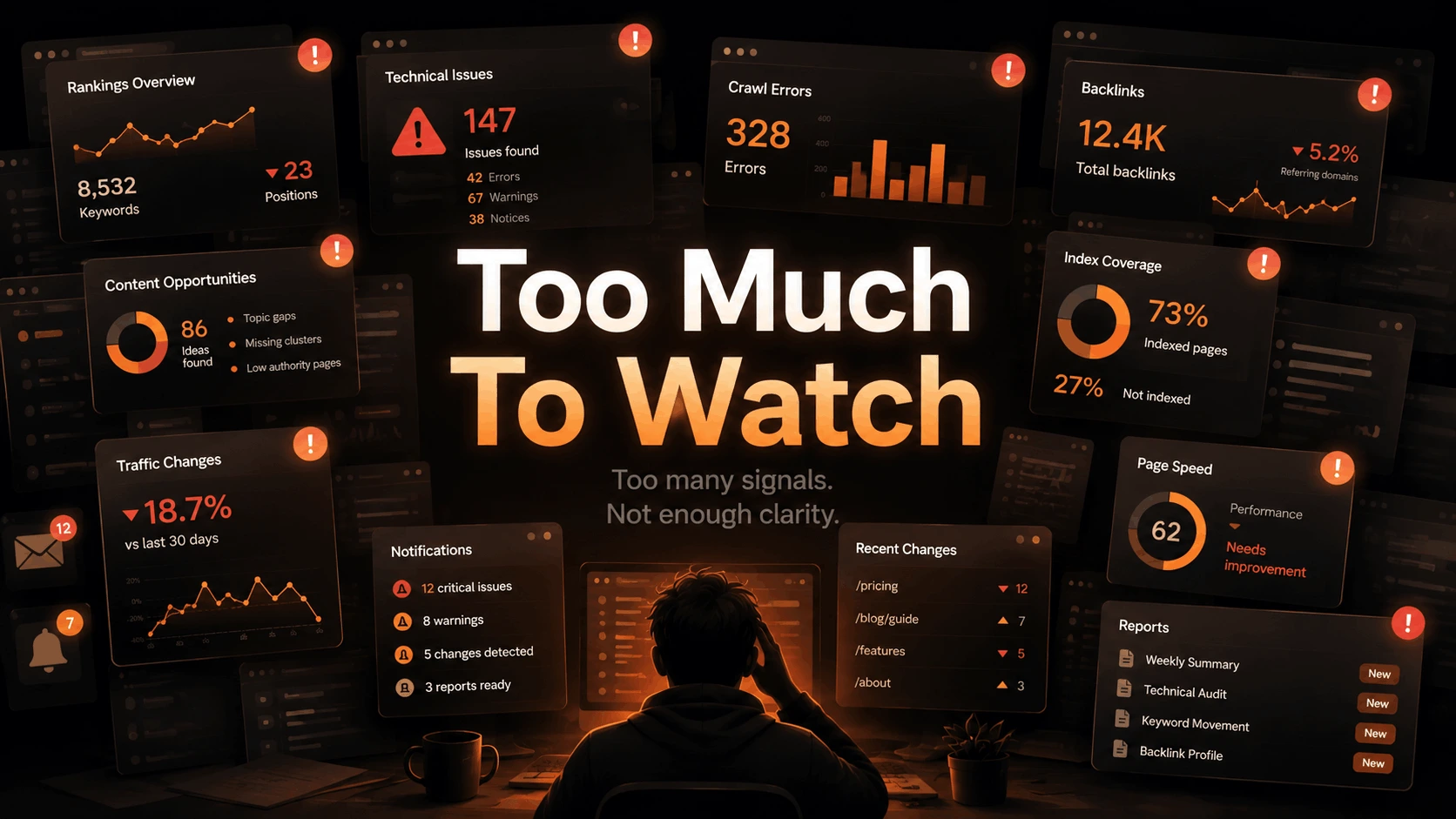 Too many simultaneous signals often reduce clarity instead of improving it.
Dashboards optimize for visibility, not restraint
Most SEO dashboards are designed around one core idea:
Show more information →
More rankings →
More graphs →
More changes →
More warnings →
More monitoring →
That is understandable because Dashboards are observation systems and their job is to surface activity. But observation alone does not reduce uncertainty and in many cases, it increases it.
Because once every issue becomes visible simultaneously, the user must personally decide:
- what matters now
- what can wait
- what is merely noise
- what is structurally important
- what deserves action first
That cognitive burden quietly accumulates over time.
Why SEO starts feeling mentally heavy
The problem is not only workload, but it's more of a context switching.
A typical SEO workflow often jumps between:
- rankings
- technical warnings
- content gaps
- page speed
- backlinks
- indexing issues
- analytics
- internal linking
- reporting
Each system introduces a new frame of attention and the human brain pays a cost every time focus changes. This creates what psychologists often call cognitive overload: too many simultaneous inputs competing for limited attention.
In practice, that looks like:
- uncertainty
- reactive work
- shallow prioritization
- endless monitoring
- low confidence in decisions
The result is strange... Teams stay busy while still feeling unclear.
The hidden pressure of “always monitoring”
Many SEO systems quietly train users to feel they should always be watching something.
something like...
Rankings or Traffic or Crawl changes or Visibility graphs or Technical reports
This creates an environment of perpetual vigilance. But good SEO rarely comes from constant monitoring alone
It usually comes from:
- identifying the right constraint
- making a focused decision
- implementing deliberately
- allowing time for outcomes to emerge
The workflow should not feel like air traffic control but it should feel calm and bounded.
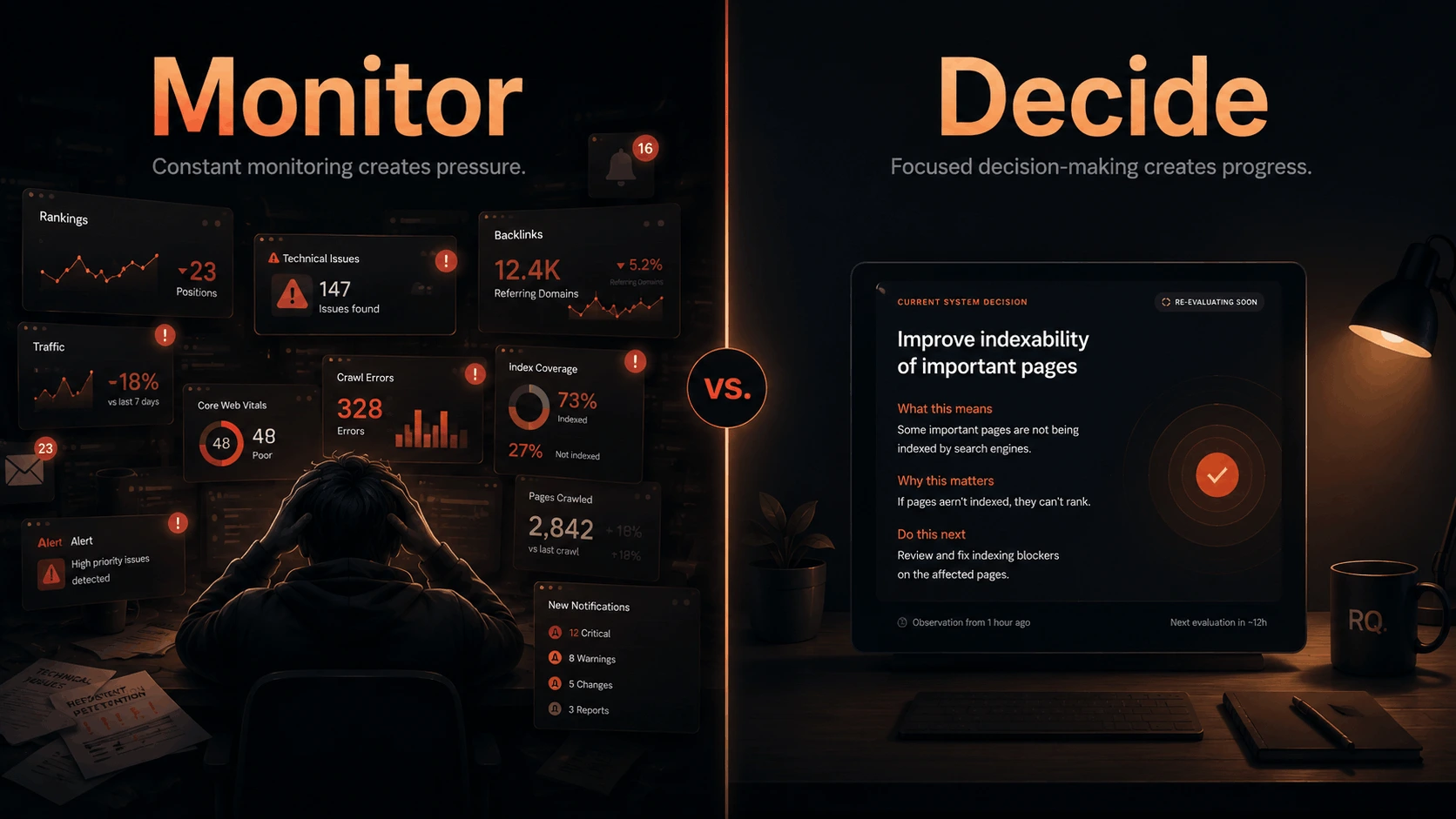 Constant monitoring creates pressure. Focused decision-making creates progress.
Visibility is not prioritization
One of the most important distinctions in SEO is this:
visibility does not automatically create judgment.
A dashboard can tell you:
- what changed
- what declined
- what improved
- what exists
But it usually does not tell you:
- which issue matters most
- which issue blocks progress
- which issue should wait
- which issue deserves action first
That gap matters enormously, because prioritization is where real SEO leverage usually appears. Without prioritization, every issue competes equally for attention and once everything feels important, teams often fall into reactive SEO instead of deliberate SEO.
This is explored more deeply in SEO Decisions vs SEO Tools.
Why “more data” eventually stops helping
At first, more SEO visibility feels empowering and then eventually it becomes noisy. After a certain point, additional information often produces diminishing returns, not because the data is wrong, but because human attention is finite.
Most teams do not realistically have the operational capacity to meaningfully act on:
- hundreds of technical warnings
- dozens of keyword movements
- constant monitoring fluctuations
- simultaneous optimization paths
Eventually, the system itself starts generating decision fatigue.
That is when people begin:
- reacting impulsively
- chasing minor changes
- treating every warning as urgent
- confusing activity with progress
Calm workflows usually make better decisions
One overlooked advantage of calmer systems is improved judgment quality.
When fewer things compete simultaneously:
- tradeoffs become clearer
- priorities become easier to defend
- execution becomes more focused
- uncertainty becomes easier to tolerate
This is one reason RankQuest intentionally avoids dashboard-centric architecture entirely.
The system is designed around:
Observation
→ Decision
→ Implementation
→ Re-evaluation
instead of continuous simultaneous monitoring.
The product itself intentionally limits active decision scope because cognitive overload reduces decision quality
SEO overwhelm often comes from unresolved prioritization
Most teams assume overwhelm comes from:
- too much SEO
- too much competition
- too many technical problems
But often the deeper problem is simpler:
unclear prioritization.
When there is no strong prioritization layer:
- every alert feels urgent
- every issue feels active
- every report competes for attention
- every stakeholder introduces new priorities
That creates fragmented execution and he problem is not merely "too much SEO", it is too many unresolved decisions happening simultaneously.
The difference between activity and movement
This is where many SEO workflows quietly stall.
People remain active:
- checking dashboards
- reviewing metrics
- exporting reports
- monitoring fluctuations
- discussing rankings
But activity alone does not necessarily move the system forward.
Meaningful movement usually requires:
- one justified priority
- bounded execution
- focused implementation
- enough time for evaluation
This is why One SEO Decision at a Time matters operationally, not just philosophically.
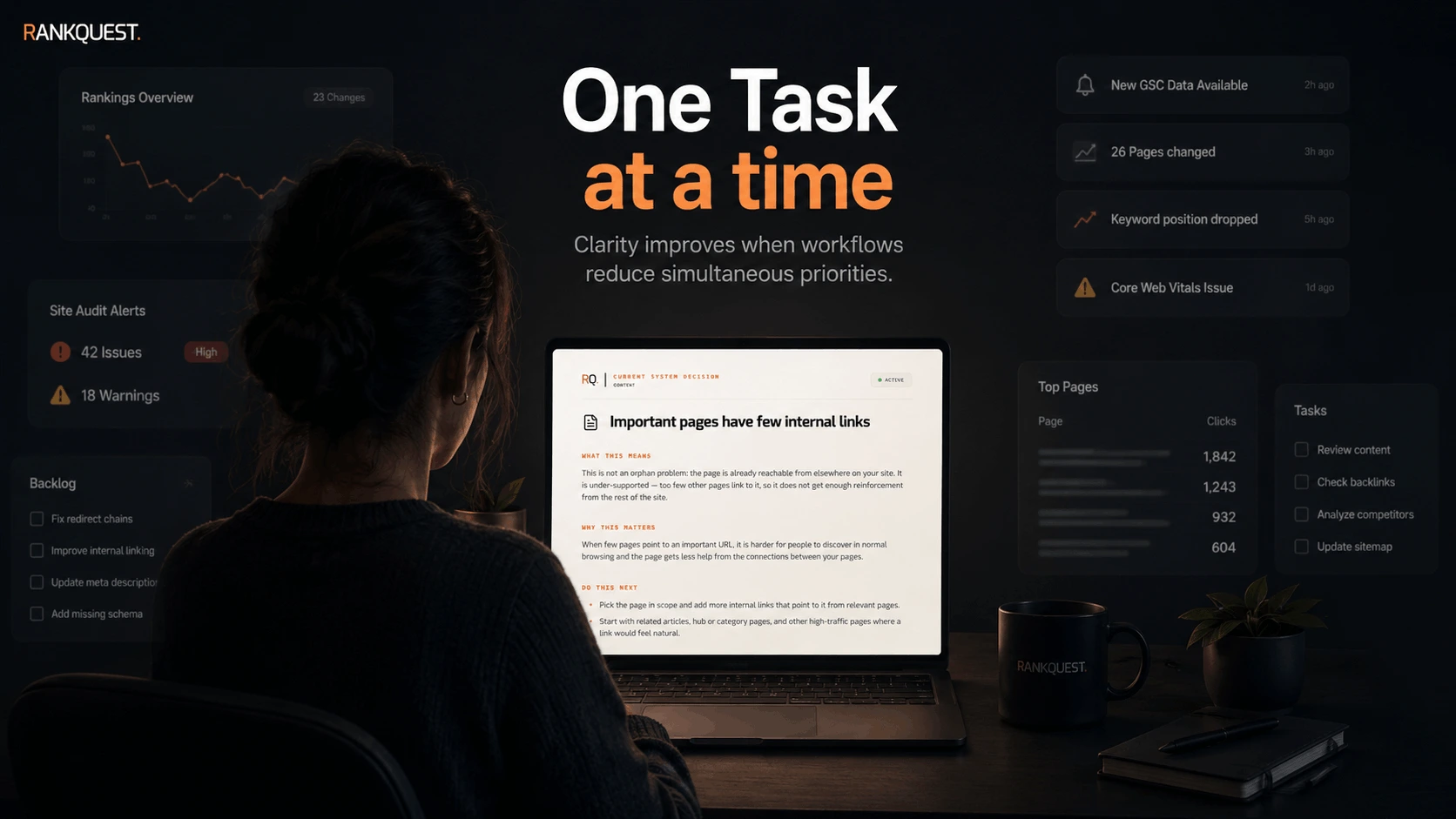 Clarity improves when workflows reduce simultaneous priorities.
Why calmer SEO systems feel different
Most software tries to create engagement through constant activity while RankQuest intentionally does the opposite.
The system is designed to feel:
- calm
- deliberate
- bounded
- non-urgent
- judgment-oriented
Its architecture intentionally suppresses simultaneous decision stacking and endless task queues and that matters because SEO does not usually improve through constant stimulation.
It improves through:
- clearer judgment
- better sequencing
- focused implementation
- patience
- iteration
Sometimes the best next state is simply:
Observation in progress.
No action required right now.
That is a valid system state in RankQuest itself.
What healthier SEO workflows usually look like
Healthier workflows are often surprisingly quiet.
They typically involve:
- fewer simultaneous priorities
- clearer sequencing
- calmer review cycles
- deliberate implementation windows
- less compulsive monitoring
That does not mean ignoring SEO.
It means separating observation from judgment
Google’s own documentation explains how crawling, indexing, and search systems work. Google Search Central
The challenge for most teams is no longer access to information, it is deciding what deserves action first.
Related guides
To continue exploring this framework:
- SEO Decisions vs SEO Tools
- What to Fix First in SEO
- One SEO Decision at a Time
- Low-Impact SEO Busywork
Or return to the main guide:
Conclusion
SEO becomes overwhelming when too many unresolved priorities compete simultaneously, Dashboards increase visibility.
But visibility alone does not create clarity, and at some point, better SEO depends less on seeing more things and more on narrowing focus deliberately.
That is why calmer systems often produce better decisions, not because they know less. But because they reduce noise enough for judgment to emerge.
Waiting is a valid state. Ignoring low-leverage noise is also a valid state. Not every signal deserves immediate attention.