SEO issue
Search Intent Mismatch: What It Is and How to Fix It
Updated September 2026
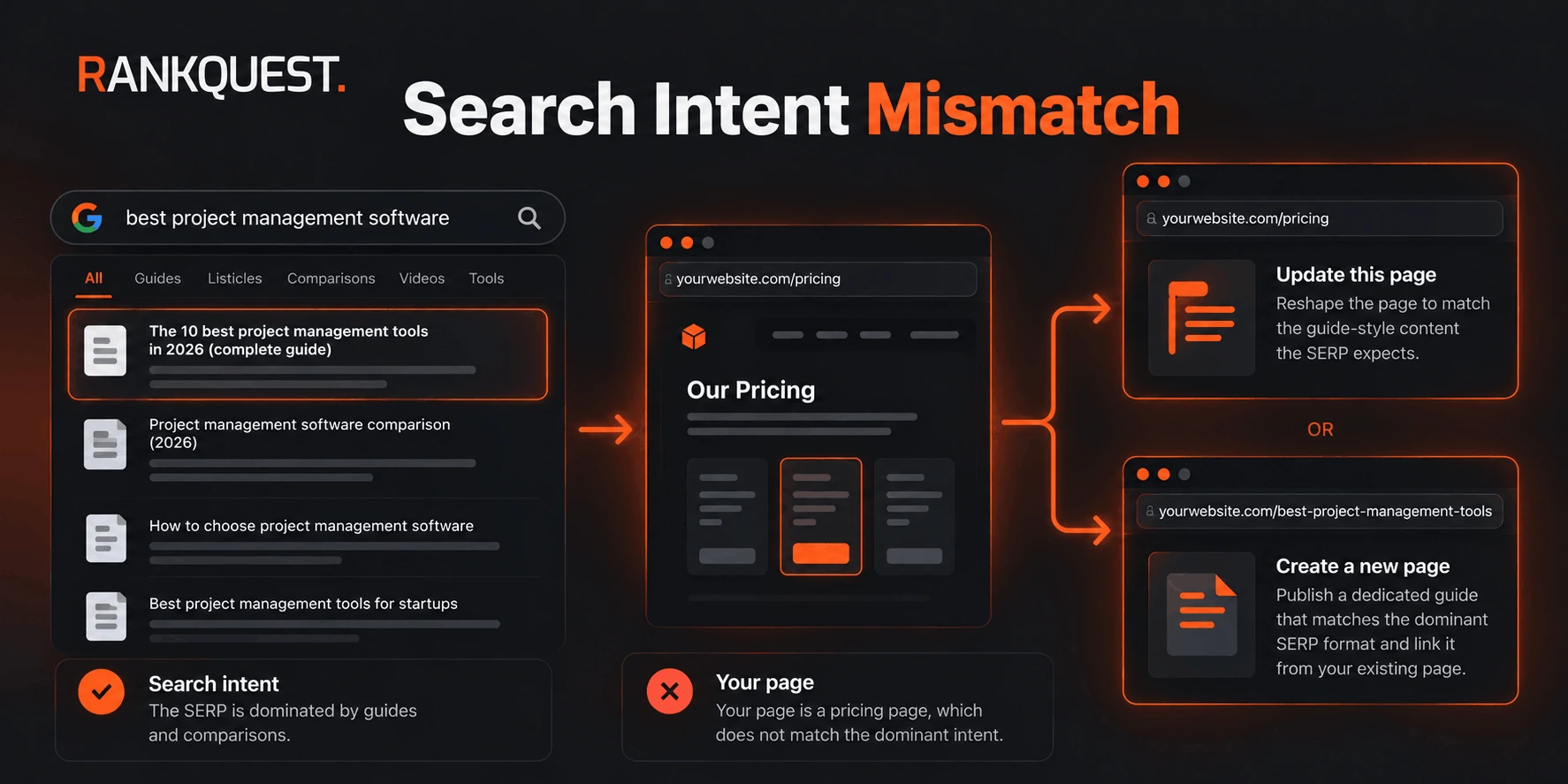 Search Intent Mismatch Example
Search intent mismatch means your page is about the query, but it is the wrong kind of page for what the results are showing.
People searching that query are choosing guides, product pages, comparisons, or tools. If you are ranking with a different format, relevance to the words is not the same as fit. The fix is to change the page's job, or to publish one page that has the job the results already reward. It is not to copy a competitor's article.
What is search intent?
Search intent is the job the searcher is trying to get done. The useful evidence is the results page itself: which kinds of pages occupy it, and what those pages help someone do.
Broad labels such as informational, navigational, commercial, and transactional are a rough map. They are not the diagnosis. A query can be "commercial" and still be won by comparisons, category pages, or a single product URL. Look at the format that actually shows up.
A guide answers a how or why and walks through the steps. A category or product page helps someone choose or buy. A comparison sets options side by side. A tool lets someone run a check. Those are different promises, even when they share a keyword.
What is search intent mismatch?
Your URL is associated with a query, often because it already ranks somewhere for it, but the page type does not match the type that dominates the results.
The topic can be right. The title can contain the query. The page can still be a poor fit because a searcher who clicked the surrounding results expected a different kind of document.
Mismatch is not "this page is badly written." A clear pricing page is the right page for a pricing query. It is the wrong page for a query whose results are tutorials. Adding another section of product copy will not turn it into the thing those results are.
What search intent mismatch looks like
The results for "how to fix broken internal links" are tutorials and checklists. The URL you have in those results is /pricing. The words "links" appear in a feature list. The searcher wanted a procedure.
The results for a product category, such as "running shoes", are grids of products and category pages. The URL you are showing is a 2,000-word essay on the history of cushioning. The essay may be good. It is not the page type the results are built from.
The results are comparisons: "tool A vs tool B", with tables and a recommendation. Your ranking URL is a generic features page that never names the alternative or helps someone choose.
In each case, write down three facts: the query, the kind of page that dominates the top results, and the kind of page you are ranking with. If those last two differ, you have a mismatch to judge. You do not yet have an instruction to rewrite.
What to fix first in SEO puts the same test in a wider order: a technically sound page can still be the wrong answer for the query.
Why search intent mismatch matters
Someone who clicks a result expects the format the rest of the page trained them to expect. A guide title in a row of guides is a different click from a product URL sitting in that same row. If they land on the wrong kind of page, they leave, and the visit does not do the job the query asked for.
For ranking, a results page that already favors one format is evidence of what is being selected for that query. Matching that format does not guarantee you will move up. A thin guide will not outrank a useful one just because both are guides. A mismatched URL is simply a harder fit, because you are offering a page type the results are not showing.
The page can still be the right URL for other queries. A pricing page that appears for a how-to query can keep ranking for pricing terms. The mismatch is about this query, not a verdict on the URL.
When search intent mismatch is NOT actually a problem
A different format is not always a defect.
Mixed results support more than one page type. If the top results are split between a few guides, a category page, and a tool, there is no single format to obey. Forcing your page into whichever type you counted first can throw away a format that already belongs there.
A page that already ranks well in a different format is not an emergency. If it earns the click and satisfies the people who arrive, "the other results look different" is not a reason to rebuild it. Look at whether those visitors are actually failing, not only at whether the layout matches a neighbor.
Branded queries often behave differently. Someone searching your product name may want the homepage, a login URL, or a docs page, even when unbranded variants of the same words bring up guides. Do not remodel the brand result to imitate a generic results page.
Wording changes the job. "Best running shoes" and "how to choose running shoes" can sit next to each other in keyword tools and still want different pages. Judge the query you are looking at, not the whole topic.
A page can serve the right goal with a different shape. A short comparison table on a product page may be enough when the searcher is choosing your product, even if some competitors published a long roundup. Alignment means the page does the job. It does not mean it clones the winner.
The costly version of "fix the mismatch" is turning a page that sells or explains the product into an informational article so it looks like the results. You can lose the commercial page and still not win the guide query. If both jobs are real, they belong on two URLs.
How to find search intent mismatch
Open the results for the query in a normal window. Ignore your own rank for a moment and list what the top results are: guide, category, product, comparison, tool, or a mix. Read titles and snippets. They usually announce the format before you click.
Then open the URL of yours that ranks for that query, or the URL you wish ranked. Name its job in the same terms. A features page is not a guide because it has a blog-style introduction.
Search Console shows queries, impressions, and clicks for a page. It does not label intent. Use it to see which queries a URL already appears for, then judge those queries in the results. Impressions alone do not prove the format is wrong.
Check a few close variants of the wording. If they all reward the same format, the mismatch is stable. If each variant rewards a different format, you are looking at several intents, not one broken page.
How to prioritize search intent mismatch
Work on a mismatch when the query or the page matters, the page is close enough that format is the plausible gap, one result type clearly dominates, and your page is obviously a different kind of document.
The query or the page matters. A flagship URL, or a query you already depend on, outranks a stray impression on an old post.
The page is close enough that format is a plausible constraint. It already appears in the results, or it is the obvious URL you would want there, and the gap is the kind of page rather than a missing site section.
One result type clearly dominates. A split page of guides and product URLs is a weaker case than a results page that is almost entirely tutorials.
Your page type is obviously something else. Pricing versus a guide is clearer than two articles that differ by a heading.
The mismatch sits on a page you cannot afford to misunderstand. If the URL's current job is still the one you need, the priority may be a second page, not a rewrite. That choice comes before the editing.
There is no numeric score for this. A loud mismatch on a page nobody needs can wait behind a quieter one on a page that should earn the query.
How to fix search intent mismatch
Two paths. Pick one and finish it before starting the other.
Reshape the existing page when this URL can honestly do the job the results are rewarding. A vague blog post that was supposed to be the guide can become the guide: the question answered early, the steps the results are built from, the comparisons or examples those pages use. Small title tweaks on a page with a different job will not do this.
Create one new page when this URL should keep its current job. Publish a single page in the dominant format, aimed at the query, and link it to the original URL in both directions where that helps the reader. The old page stays the product, pricing, or category page. The new page is the guide, comparison, or tool the results are showing.
Do not publish a near-duplicate that targets the same query with the same format as a page you already have. The new page has to be the one that fits, and the old page has to keep a different job or stop targeting that query.
Update the existing page or create a new one?
Update the page you have when its purpose can change without breaking something else. The URL was meant to be the answer and drifted into a feature summary. The format is clearly wrong. Changing it will not remove a pricing page, a signup page, or the only category URL for a product line.
Create a new page when the current URL has a commercial or product job you still need. The results want a guide, and this URL is the page that sells. Both intents deserve a URL. The guide should link to the product page for anyone ready to choose. The product page should not be emptied to make room for the tutorial.
Create a new page when the formats cannot share a document without confusing either reader. A calculator and a pricing page can mention each other. They should not be the same URL if the results for the query are tools and the pricing page must stay a pricing page.
If you are unsure, keep the page that already converts and add the missing format beside it. Rewriting a working commercial URL into an article is the change that is hardest to undo.
How to validate the fix
Confirm the URL you want associated with the query is indexable: it returns the page, it is not blocked or noindexed, and the internal links you added point at it rather than at the old format.
Reopen the results and check that your page's promise now matches the dominant job. A rewritten guide should read as a guide. A new comparison should be a comparison. Title and the first screen matter because that is what a result snippet can show.
Give rankings, impressions, and clicks time. A correct format can sit unchanged in the results for a while. Watch the query on the URL you intended, and watch that the commercial URL did not lose the queries it was supposed to keep.
If the new page is the one that should rank, links from the old page should use it for that query. If both URLs still target the same wording with the same format, the split is not finished.
How RankQuest handles search intent mismatch
RankQuest looks at a query a page already appears for and compares the kind of page you have with the kind that dominates the top results. The types it distinguishes include guides, category pages, product pages, and tools. When your type and the dominant type differ, it can surface that as a decision on that page.
The implementation guidance is one short document for that URL and query. It describes the mismatch and two ways forward: reshape this page into the dominant format, or leave the page and add one new page in that format, with a link between them. It recommends keeping a core product or pricing URL as it is and adding the other page, and reshaping only when this URL is not that core page.
That document does not choose a perfect outline, and it does not promise the ranking will move. It keeps the work to one page change or one new page.