Guide
AI SEO Software for Small-Team Prioritization
Updated August 2026
Rolling Out AI-Assisted SEO Prioritization in a Small Team
Which Ai SEO Software Fits Your Workflow?
Choose a monitoring and prioritization workflow when your main problem is deciding what to do next from a continuing stream of SEO findings. Choose a crawler-first workflow when your team needs deeper technical investigation and control over the underlying data. Choose an all-in-one suite when one workspace for research, optimization, reporting, and AI-search visibility matters more than keeping the process narrow.
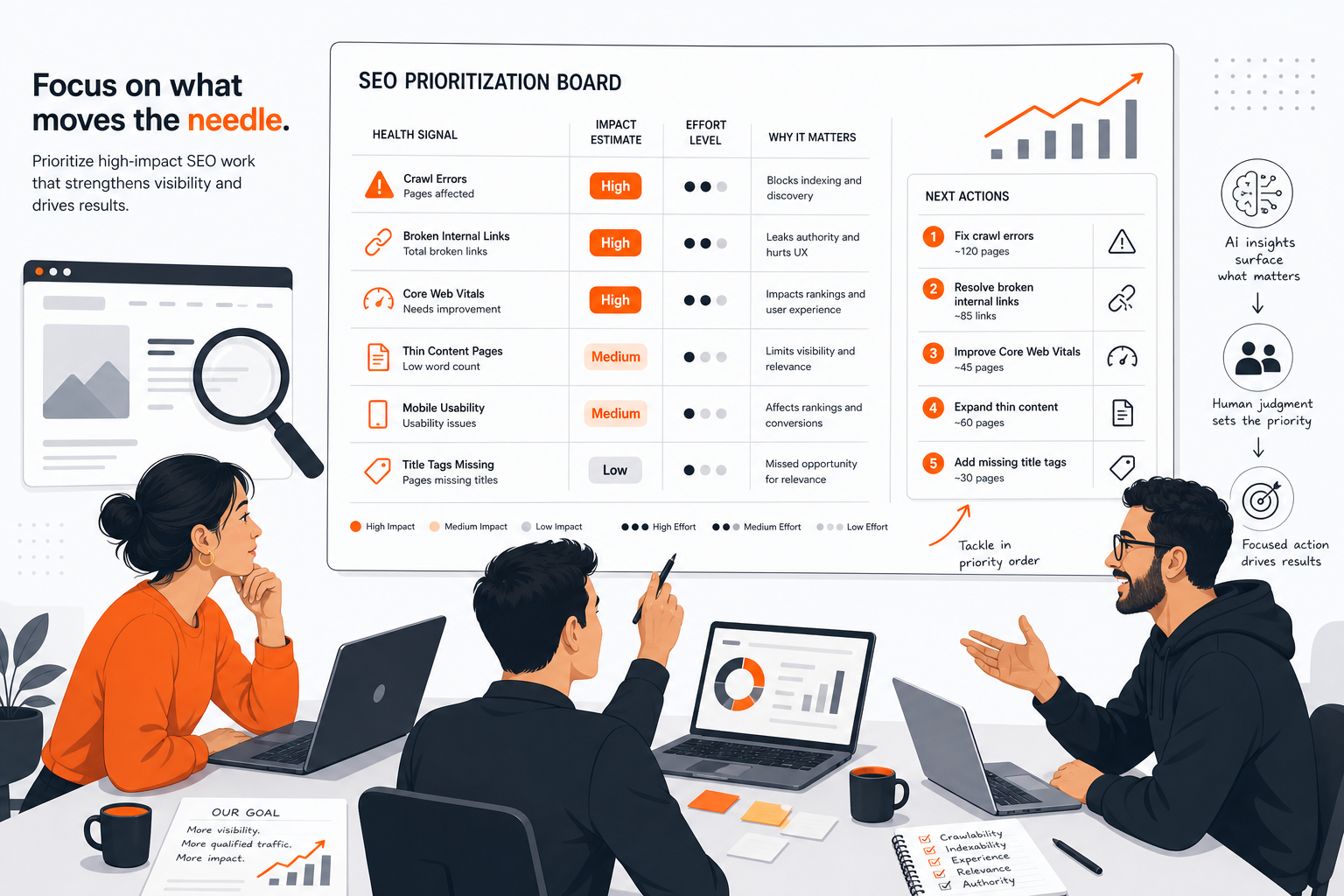 AI-Assisted SEO Prioritization for Small Teams
The choice changes most when you consider three things: who will review recommendations, how much technical detail the team needs, and whether approved actions can move directly into implementation. A small team should favor the workflow it can review and maintain consistently, not the tool with the longest list of possible checks.
How to prioritize technical issues
Detection is not prioritization
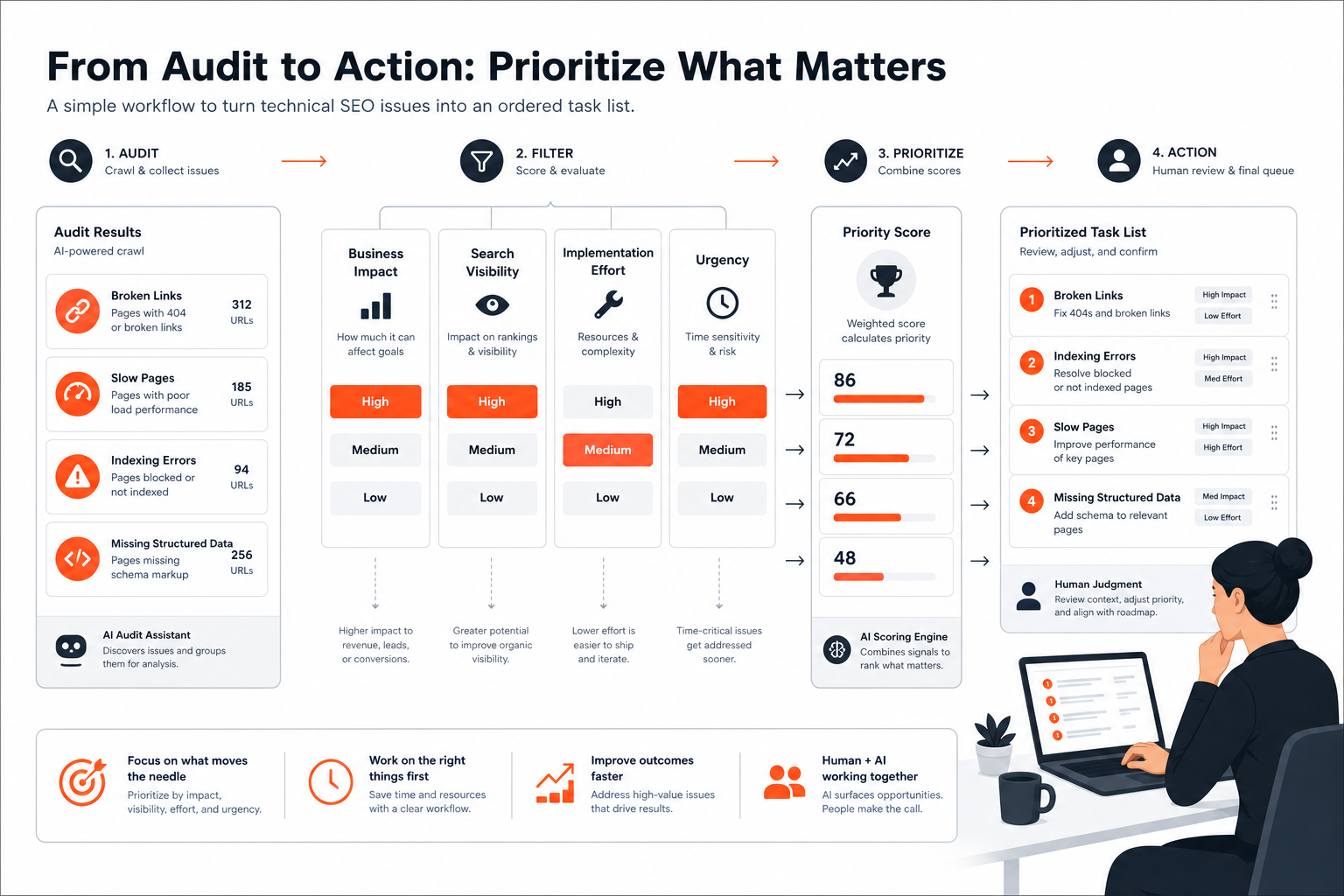 Technical SEO Prioritization Workflow
A technical audit can identify many conditions on a website. That does not mean every condition deserves equal attention or that the highest-severity label should automatically determine the fix order.
For example, a team may receive findings about redirects, duplicate pages, structured data, internal links, performance, or indexability. Those findings become useful only when the team can connect them to a practical decision:
- What is affected?
- How important is the affected page or page group?
- What could change if the issue is fixed?
- How difficult is the fix?
- Who can make the change?
- What should be checked before and after implementation?
This is why technical detection and technical prioritization are different jobs. Detection creates evidence. Prioritization decides which evidence should change the team’s work queue.
Use a consistent fix order
A small team needs a repeatable way to compare unlike tasks. A useful fix order considers the issue group, likely impact, effort, ownership, and clarity of the implementation.
| Review question | What to look for |
|---|---|
| What is affected? | A single page, a page group, or a site-wide condition |
| How important is it? | The role of the affected pages in the site’s search and business journey |
| What is the likely impact? | Whether the issue can limit access, understanding, discovery, or page usefulness |
| How much effort is required? | A simple change, a coordinated release, or specialist investigation |
| Who owns the fix? | Marketing, engineering, content, an external specialist, or an AI agent |
| Is the action clear? | Whether the recommendation explains what to change and how to verify it |
This order prevents a common failure: spending the week clearing easy warnings while a more important, clearly actionable issue remains untouched.
A useful recommendation should also group related findings. Instead of handing an engineer a long list of individual warnings, combine findings that share a cause or implementation path. A pattern involving several related page templates may be one engineering task rather than dozens of separate tickets. A group of page-level content issues may belong with the person responsible for those pages.
The group should still be specific enough to act on. “Fix technical SEO” is not a work item. “Review the affected page template and confirm how its canonical and indexability settings are generated” gives the owner a starting point without pretending that the implementation is already known.
Separate urgency from effort
Severity and effort answer different questions.
An urgent issue may need attention because it affects an important part of the site. A high-effort issue may still be worthwhile, but it should be planned differently from a change that one person can review and ship quickly. Treating effort as an afterthought creates queues that look useful but cannot be completed.
For each recommended action, record:
- The issue or opportunity in plain language.
- The pages or page group involved.
- The reason it should be considered now.
- The expected implementation owner.
- The smallest useful next action.
- The check that confirms the work was completed correctly.
This keeps prioritization connected to delivery. It also makes the work easier for an AI agent to handle because the agent receives a defined task rather than an unexplained score or a raw export.
Define who reviews the next actions
The review step needs one clear owner. In a small team, that may be the founder, marketing lead, technical lead, or the person responsible for coordinating an AI agent. It should not be an undefined group where everyone is expected to notice and approve the same recommendation.
The reviewer does not need to perform every fix. Their job is to decide whether the recommendation is:
- Ready to assign.
- Worth investigating further.
- Not relevant to the current site or business priorities.
- Blocked by a missing decision or technical dependency.
- Better handled by a specialist.
A practical weekly review can be short. Start with the highest-priority unassigned actions, confirm the owner, remove recommendations that no longer apply, and send approved work to the person or system that can implement it. The reviewer should also check whether previously shipped work produced the expected change in the next monitoring cycle.
This is the operating layer that scattered audit processes usually lack. The team is not merely collecting findings. It is maintaining a controlled flow from evidence to decision to implementation.
Know when deeper investigation is necessary
Prioritization should not hide uncertainty. Some recommendations can be assigned directly. Others need a technical review before anyone changes the site.
Deeper manual investigation or specialist tooling may be the better fit when the team needs to inspect raw page output, understand how a site is rendered, trace a complex redirect or canonical system, examine custom extraction rules, or validate a change across a complicated deployment process. In those cases, the right next action may be “investigate the cause” rather than “apply the fix.”
A focused prioritization workflow and a deeper crawler workflow can work together. The first helps decide which question deserves attention. The second may provide the control and evidence needed to answer it.
For a broader explanation of how smaller teams can assess these tradeoffs, see Site Audit Software: How Small Teams Should Evaluate Their Options.
Where RankQuest Fits
RankQuest fits teams that want website and search performance monitored continuously, with the next SEO actions prioritized and turned into implementation-ready work. Its focus is the decision between findings, not another dashboard or score for the team to interpret.
 RankQuest homepage
The product supports a workflow in which an ongoing stream of evidence becomes a manageable set of decisions:
| RankQuest capability | Practical buyer job |
|---|---|
| Website and search performance monitoring | Keep the team aware of changes that may require attention |
| AI-assisted SEO prioritization | Decide what to fix or build next instead of treating every finding equally |
| Technical SEO audit output and tooling | Give the review process technical evidence to work from |
| Implementation guidance for SEO work | Turn an approved decision into work a team member or AI agent can ship |
| Focus on decisions rather than dashboards or scores | Keep the process centered on action and ownership |
This approach is particularly useful when the founder or marketing lead needs to coordinate SEO without becoming the full-time investigator for every issue. The reviewer can use the prioritized actions to decide what belongs with marketing, engineering, content, or an AI agent, then keep the work moving without maintaining a separate task system for every audit output.
The key change is the handoff. A finding does not stop at “this page has a problem.” It moves toward a decision such as “review this page group,” “assign this implementation,” or “investigate the cause before changing anything.” That distinction matters for small teams because unfinished interpretation can consume as much time as the implementation itself.
RankQuest is a sensible fit when your team:
- Needs ongoing monitoring rather than an occasional one-off check.
- Wants help choosing the next action from multiple SEO signals.
- Needs implementation guidance alongside technical audit output.
- Has a person or AI agent who can review and ship approved work.
- Wants the workflow to focus on decisions rather than collecting scores.
The product should be evaluated against the team’s actual handoff process. It is not a universal answer for every SEO job, and the value depends on whether the team will review recommendations and give approved work a clear owner.
When RankQuest Is Not the Right Choice
A different approach may fit better when the primary buying job is deep raw investigation rather than prioritization. For example, a team may need granular crawl settings, raw and rendered HTML searches, or extensive page-level data before it can diagnose a complex technical system. A crawler-first product may be more suitable for that investigation.
A broader suite may also be the better choice when the team wants one workspace spanning traditional SEO research, competitive analysis, AI-search visibility, optimization, and reporting. Semrush One connects tracking, competitive research, website optimization, and reporting in the same platform and login. Ahrefs combines technical auditing with broader research across organic search, AI visibility, backlinks, and paid traffic.
An enterprise workflow may be more appropriate when SEO must support demand research, content optimization, technical auditing, performance measurement, and cross-team reporting. BrightEdge documents a workflow that combines these areas, including prioritized page-level recommendations and technical auditing through ContentIQ.
The issue is not that one approach is universally right or wrong. It is that a narrow prioritization workflow should not be selected when the team’s main requirement is a larger research, reporting, or controlled technical investigation system.
RankQuest may also be a poor fit for a buyer who wants only a free, one-off diagnostic and does not plan to maintain an ongoing review and implementation process. Continuous monitoring and prioritization are most useful when someone is prepared to review the next actions and decide what gets shipped.
Finally, consider the service model. If the team needs heavy agency-style program management, specialist execution, or another party to own the full SEO process, software alone may not match the requirement. Clarify whether you need decision support for your own team or an external service that manages the work.
FAQs
Who should review AI-recommended SEO actions?
One person should own the review, even if several people contribute expertise. This is often the founder, marketing lead, or technical lead in a small team. The reviewer decides whether an action is ready to assign, needs investigation, is blocked, or should not be pursued.
Should every technical warning become a task?
No. A warning should become a task only when it has a clear reason, an appropriate owner, and a practical next action. Group related findings where they share a cause, and leave uncertain items in an investigation queue rather than sending them directly to implementation.
Can an AI agent implement every recommended SEO action?
No assumption should be made that every action is safe to automate. An AI agent can help ship clearly defined work, but changes involving rendering, redirects, canonical rules, indexability, or deployment dependencies may need human or specialist review before implementation.
Is a crawler-first workflow better than prioritization software?
They solve different problems. A crawler-first workflow can support deeper investigation of technical data, while prioritization software helps a team decide which action deserves attention next. The right choice depends on whether the current bottleneck is discovering detail or choosing and shipping work.
What should a small team do when it has more findings than capacity?
Set a capacity boundary and select only the actions that can be reviewed and owned in the current work period. Keep the remaining findings available for later review, but do not let a large backlog decide priorities by itself. The goal is a short, defensible queue that the team can actually move forward.
Related guides
- AI SEO Software for Faster Site Audits and Prioritization
- Site Audit Software: How Small Teams Should Evaluate Their Options
- Signs Your Team Has Outgrown Manual SEO Audits
- SEO Audit Examples: Turning Findings Into Implementation-Ready Work
- Common SEO Audit Mistakes That Create More Work