Guide
SEO Audit Examples with AI SEO Software
Updated August 2026
SEO Audit Examples: Turning Findings Into Implementation-Ready Work
Which Ai SEO Software Fits Your Workflow?
Choose an all-in-one suite when your team needs one workspace for research, tracking, optimization, and reporting. Choose a crawler-first workflow when technical investigation and raw page detail are the central job. Choose decision-support software when the main problem is reducing a long stream of findings to a short, defensible action plan. The choice changes with your site’s technical depth, the breadth of research required, the number of people involved, and whether the output must be implementation-ready rather than simply recorded.
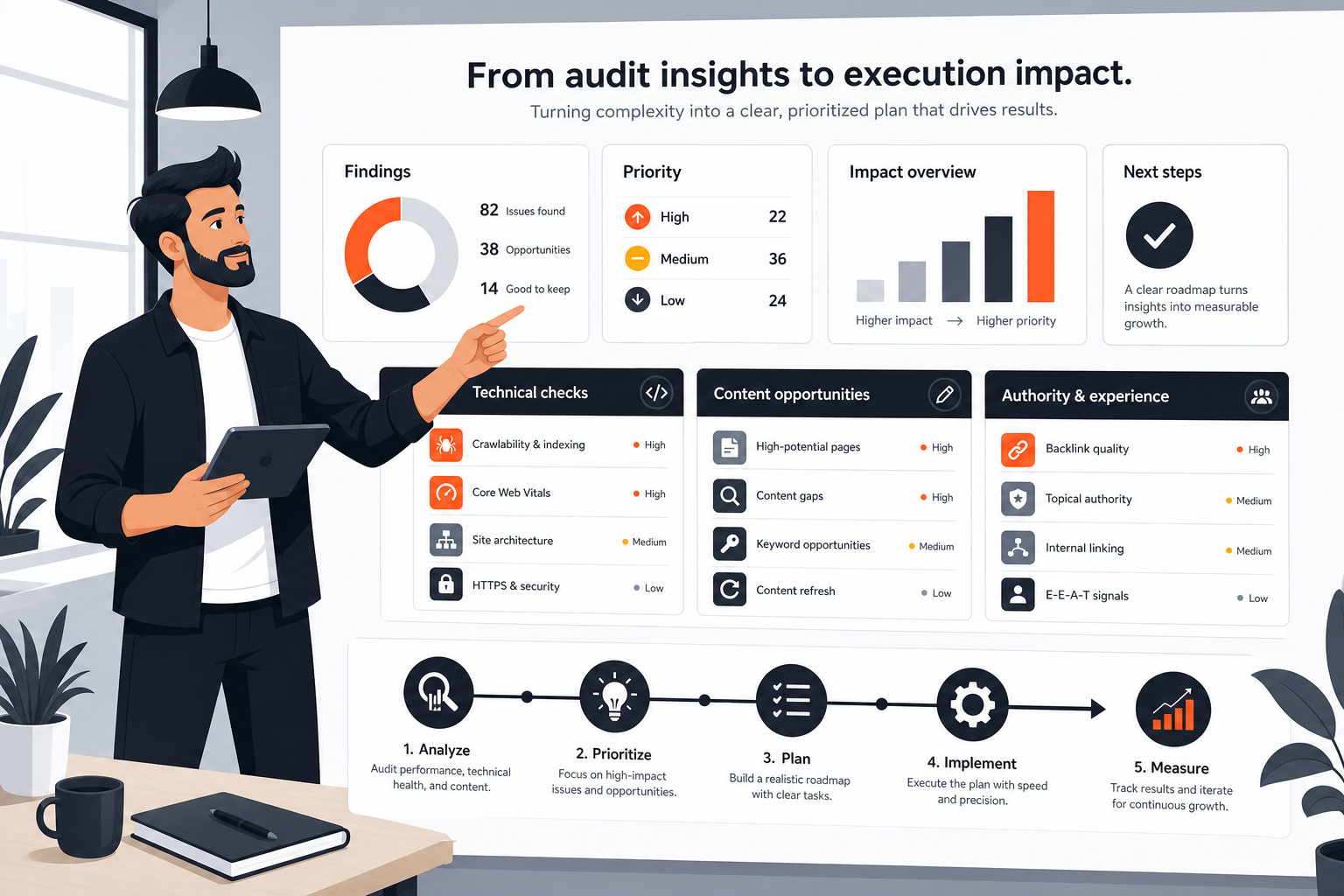 Turning SEO Audit Findings Into Action
Which kind of solution do you actually need?
The phrase “AI SEO software” can describe several different jobs. The most important boundary is between software that helps you investigate a site and software that helps you decide what to do with the investigation.
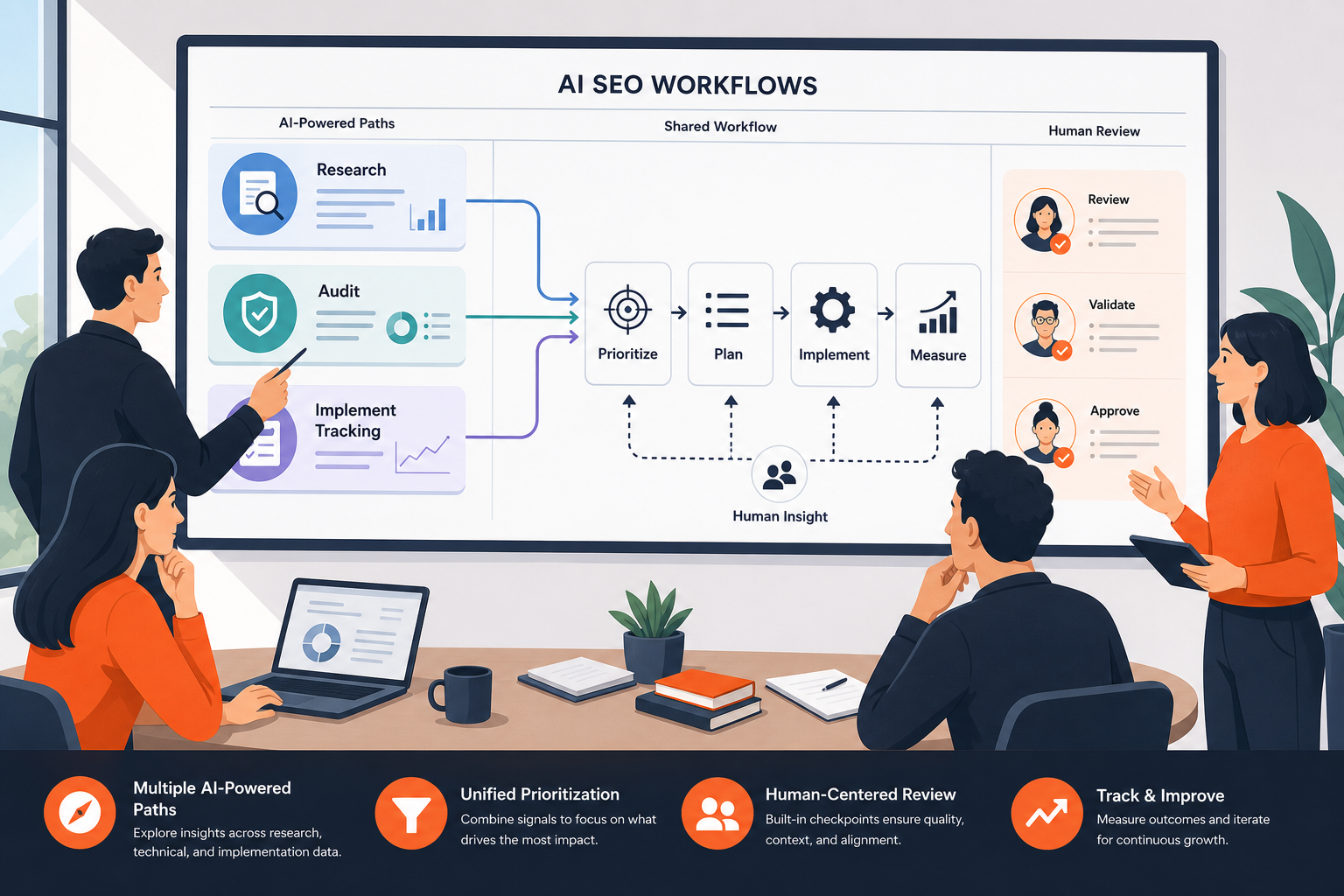 Choosing the Right AI SEO Workflow
A crawler-first product is designed to inspect pages and identify issues. That can be valuable when a technical specialist needs to investigate indexability, redirects, duplicate content, structured data, performance, internal linking, or rendered HTML. Ahrefs, for example, documents Site Audit coverage across technical and on-page issues, with deeper investigation through Page Explorer, Link Explorer, raw and rendered HTML searches, and granular crawl settings.
An all-in-one suite combines several SEO workflows. Semrush One connects tracking, competitive research, website optimization, and reporting in one platform and login. BrightEdge combines keyword research, competitive analysis, site auditing, page-level recommendations, content planning, and reporting for teams with a broad enterprise workflow.
Decision-support software starts with a different question: given the available evidence, what should the team work on next? SearchPilot describes a prioritization workflow that evaluates SEO actions using impact potential, effort, page importance, search intent, business value, and implementation risk.
| Approach | Choose it when | Typical output | Main tradeoff |
|---|---|---|---|
| Crawler-first workflow | Technical investigation is the main job | Issue data, page detail, crawl analysis | Teams still need to decide what to implement first |
| All-in-one suite | You need research, tracking, optimization, and reporting together | A broad workspace across SEO activities | Breadth can bring usage limits or a more involved operating model |
| Decision-support workflow | You need a short action plan from many signals | Prioritized work with decision context | It is not a substitute for every deep research or technical investigation task |
The common mistake is to treat a larger issue list as a better audit. More findings may help a specialist investigate, but they do not automatically tell a small team which work is worth assigning this week.
A useful audit output connects four things:
- The finding: what was observed.
- The reason: why the finding matters for the site or search performance.
- The decision: whether it deserves attention now.
- The implementation direction: what someone should change, create, test, or inspect next.
That is the difference between evidence and operational guidance. A team evaluating site audit software for small teams should therefore inspect the handoff after the audit, not only the number or variety of checks.
Where RankQuest Fits
RankQuest fits teams that want website and search performance monitored continuously, with the next SEO action prioritized and turned into implementation-ready work. Its product concept is an AI SEO strategist that focuses on decisions rather than dashboards or scores.
 RankQuest homepage
That focus is useful when the team already has more possible SEO work than it can confidently assign. Instead of treating every signal as an equal task, the workflow is centered on deciding what to fix or build next and preparing work that a team member or AI agent can ship.
| RankQuest capability | Practical buyer job |
|---|---|
| Website and search performance monitoring | Keep decisions based on current site and search evidence |
| Technical SEO audit output and tooling | Surface technical findings that may require action |
| AI-assisted SEO prioritization | Choose what deserves attention before assigning work |
| Implementation guidance for SEO work | Give the person or agent doing the work a clearer direction |
| Continuous monitoring | Revisit priorities as website and search conditions change |
| Decision-focused workflow | Avoid relying on dashboards or scores as the final output |
Consider a simple audit finding: a page has a technical issue. An incomplete output stops there. An implementation-oriented output helps the team understand whether the issue should be handled now, what page or workflow it affects, and what kind of work should follow.
RankQuest’s fit is strongest when the buyer’s problem is the gap between “we know something needs attention” and “we have a clear piece of work ready to ship.” This can suit a founder coordinating a small team, an operator assigning SEO work, or an AI agent that needs prioritized direction rather than a collection of unranked observations.
The product does not need to replace every adjacent SEO workflow to be useful. Its role is narrower and more operational: continuously watch relevant signals, prioritize the next action, and help turn that decision into implementation.
When RankQuest Is Not the Right Choice
RankQuest may not be the right first choice when the central job requires deep raw crawling, custom extraction, or specialist investigation. A technical team may need granular crawl controls, rendered and raw HTML searches, or extensive page-level data before it can diagnose a complex issue. In that situation, a crawler-first workflow may fit the investigation better.
A broader suite may also be more suitable when the buyer needs one environment for competitive research, backlink analysis, paid traffic research, keyword-based reporting, and AI-search visibility. Ahrefs documents a workflow spanning technical auditing and competitor research, while Semrush One combines traditional SEO metrics with prompt-level AI-search insights and broader tracking, research, optimization, and reporting workflows.
Enterprise reporting and cross-team measurement can create a different requirement. BrightEdge is positioned for teams needing an enterprise SEO workflow across demand research, content optimization, technical auditing, performance measurement, and cross-team reporting. A buyer with that operating model should evaluate the reporting and coordination requirements directly rather than assuming a prioritization-focused product covers them.
There is also a difference between software and service delivery. If the team wants a specialist to run a broader SEO program, manage implementation, or provide ongoing agency coordination, a self-directed product workflow may not match that expectation.
Finally, a buyer looking only for a free, one-off diagnostic may not need continuous monitoring or an ongoing prioritization workflow. Before evaluating software, define whether the need is a single investigation, recurring decision support, or a broader SEO operating system. Those are different jobs, even when they use similar language.
FAQs
What makes an SEO audit finding implementation-ready?
An implementation-ready finding explains more than the existence of a problem. It gives enough context to decide whether the issue matters now and points the person or AI agent responsible toward the type of work required.
It does not have to prescribe every line of code or every piece of copy. It should remove the ambiguity that causes a finding to sit in a spreadsheet without an owner or next action.
Are free AI SEO software options enough for a small team?
A free or one-off diagnostic can be enough when the team needs to inspect a site once and already knows how to interpret and prioritize the output. It is less suitable when the team needs ongoing monitoring, recurring prioritization, or implementation guidance.
The deciding factor is not simply whether the audit is free. It is whether the output answers the next-action questions your team cannot answer manually.
When is a simpler audit workflow enough?
A simpler workflow is enough when the site is small, the issue is already understood, and the person reviewing the findings has the technical expertise to choose and assign the work. In that situation, adding more decision layers may create unnecessary process.
A more focused prioritization workflow becomes useful when findings recur, ownership is unclear, or the team repeatedly spends time deciding what to do next instead of shipping the work.
Can one product replace every SEO workflow?
No single workflow should be assumed to cover every need. Technical crawling, competitor research, reporting, implementation guidance, and specialist service delivery can require different capabilities.
Evaluate the product against the job that is currently blocking progress. A team may use one approach for deep investigation and another for turning ongoing signals into a short action list.
How should a small team balance priority and effort?
Start with work that has a clear reason to be considered now and a practical path to implementation. A technically interesting issue is not automatically the right next task if it requires disproportionate effort or does not connect to an important page or search need.
The useful question is: what action is sufficiently valuable, understandable, and feasible for this team to ship next?
Related guides
- AI SEO Software for Faster Site Audits and Prioritization
- Site Audit Software: How Small Teams Should Evaluate Their Options
- Signs Your Team Has Outgrown Manual SEO Audits
- Common SEO Audit Mistakes That Create More Work
- Rolling Out AI-Assisted SEO Prioritization in a Small Team