Guide
Signs You Need AI SEO Software for Audits
Updated August 2026
Signs Your Team Has Outgrown Manual SEO Audits
Which Ai SEO Software Fits Your Workflow?
Choose a workflow that matches the decision your team is trying to make. A broad all-in-one suite can suit teams that want tracking, research, optimization, and reporting together. A crawler-focused workflow can suit teams that need deeper technical investigation. A decision-support workflow can suit teams that need a short list of actions ranked by impact, effort, business value, and implementation risk.
 Team Outgrowing Manual SEO Audits
The choice changes mainly with site complexity, the depth of raw investigation required, and whether your immediate problem is finding issues or deciding what to do next. Small teams often need less time spent collecting warnings and more clarity about the next worthwhile action.
How to prioritize technical issues
Detection and prioritization are different jobs
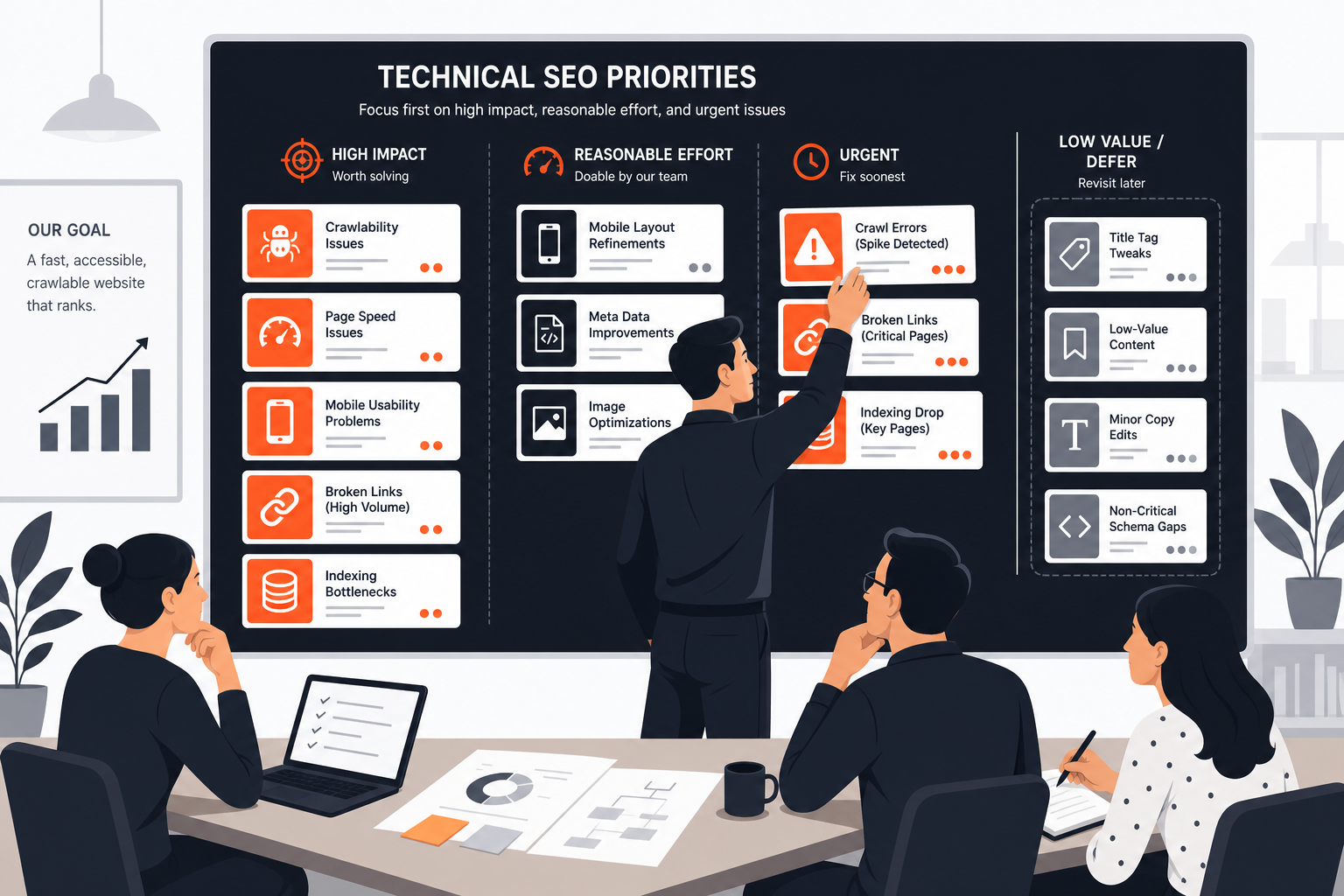 Prioritizing Technical SEO Issues
A manual audit is usually good at collecting observations. Someone checks pages, records problems, adds notes to a document, and creates tasks for later. That process can reveal useful information, but it does not automatically tell the team which task should move to the front of the queue.
Detection asks:
- What appears to be wrong?
- Which pages or templates are affected?
- Is the issue technical, content-related, or related to search performance?
Prioritization asks different questions:
- How much of the site or an important workflow does this affect?
- What is the likely value of addressing it?
- How difficult or risky is the change?
- Who can implement it?
- Is the recommendation clear enough to ship?
Treating these as the same job is one of the main reasons audit documents grow while implementation stays slow.
Sign one: audits happen too infrequently
A quarterly or occasional review may describe the site at one point in time. It does not reliably support decisions between reviews.
A technical issue can appear after a release, a template change, a migration, or a change to how pages are generated. If the next review is weeks away, the team may continue working from an outdated list. The audit becomes a report to file rather than an operating process that helps decide what to do this week.
A stronger workflow keeps watching performance and site conditions, then revisits priorities as the evidence changes. This does not mean every warning requires immediate action. It means the team has a current basis for deciding which work should move forward.
Sign two: every warning looks equally important
Audit tools and checklists often produce many findings. A long list can create the impression that the team has a large amount of urgent work, even when several findings are duplicates, low-impact warnings, or symptoms of one underlying problem.
Group related findings before assigning work. For example, several page-level warnings may come from one shared template. Fixing the template could address the underlying issue more efficiently than creating separate tasks for every URL.
Useful grouping methods include:
- By shared template or page type
- By technical cause
- By affected section of the site
- By owner, such as engineering, content, or product
- By whether the issue blocks another task
- By whether the issue is recurring or newly detected
The objective is not to make the list look smaller. It is to give the team a unit of work that someone can understand and complete.
Sign three: severity is mistaken for business priority
A tool may label an issue as severe, but severity alone does not determine the correct fix order. An issue affecting a highly important page type may deserve attention before a more technically serious issue affecting a small, low-value area. The reverse may also be true when an issue blocks crawling or prevents other work from being evaluated properly.
Assess each grouped issue across a few practical dimensions:
| Dimension | Question to ask |
|---|---|
| Scope | How many important pages, templates, or workflows are affected? |
| Impact | What decision or user experience could this affect? |
| Effort | What level of work is required to address it? |
| Ownership | Which person or team can make the change? |
| Risk | Could the fix create regressions or require careful testing? |
| Clarity | Is the recommendation specific enough to implement? |
This is where a prioritized action plan becomes more useful than a raw audit export. The team can compare work that is important but difficult with work that is relatively simple and removes a meaningful source of friction.
Sign four: no one can explain why a task comes first
When the order of work is based on whoever reviewed the latest document, priorities will change with every meeting. That makes planning difficult and encourages the team to choose tasks that are familiar rather than tasks that are valuable.
A defensible priority should include a short reason. For example:
Address the shared page template before editing individual pages because the same technical condition affects the whole group, and the template owner can resolve it in one implementation.
The explanation does not need to promise a particular search outcome. It needs to connect the evidence to the action, identify the owner, and make the sequence understandable to someone who did not perform the audit.
Sign five: recommendations stop at the finding
“Fix duplicate titles” is a finding, not a complete work item. An implementation-ready task should make the next step clearer:
- Which page group is affected?
- What pattern caused the issue?
- What should change?
- Who should review or implement it?
- What should be checked afterward?
The level of detail depends on the task, but the standard should remain consistent. If the team has to repeat the investigation before work can begin, the audit has not finished the job.
For examples of how findings can be turned into clearer work items, see SEO Audit Examples: Turning Findings Into Implementation-Ready Work.
Sign six: recurring problems keep returning to the list
A manual audit often treats each review as a fresh project. That makes it easy to rediscover the same issues without creating a durable way to monitor them.
Recurring problems deserve a different treatment from one-off findings. The team should know:
- How the problem is detected.
- What conditions make it important.
- Which owner is responsible.
- What action resolves it.
- How the team will know whether it has returned.
Continuous monitoring is useful here because it changes the process from periodic rediscovery to ongoing awareness. The goal is not to react to every change. It is to make recurring conditions visible early enough that they can be considered alongside other work.
For a closer look at how smaller teams can compare workflows, read Site Audit Software: How Small Teams Should Evaluate Their Options.
Where RankQuest Fits
RankQuest is designed for teams and AI agents that need to monitor website and search performance, decide what SEO work to implement next, and turn that decision into work the team can ship. Its fit is strongest when the central problem is the gap between an ongoing stream of findings and a confident next action.
 RankQuest homepage
The product combines AI-assisted SEO prioritization, website and search performance monitoring, technical SEO audit output and tooling, and implementation guidance. In practical terms, that supports a workflow in which the team does not have to begin each planning conversation by rebuilding the full context from separate documents.
| Buyer need | How RankQuest fits |
|---|---|
| Ongoing awareness of site conditions | Continuously watches website and search performance. |
| A clearer fix order | Prioritizes what to fix or build next. |
| Less time spent interpreting dashboards or scores | Focuses on decisions rather than dashboards or scores. |
| Work that can move beyond a recommendation | Turns SEO decisions into implementation that teams or AI agents can ship. |
| Technical evidence to support the decision | Provides technical SEO audit output and tooling. |
The operating difference is important. RankQuest is not positioned as a larger place to store every possible SEO observation. It is intended to help move from evidence to a decision and from that decision to implementation-ready work.
That makes it a sensible option when your team performs audits but struggles with sequencing, when site and search conditions need to be watched between formal reviews, or when the person who finds an issue is not the person who will implement the fix.
This is also the practical connection to the broader guide on AI SEO Software for Faster Site Audits and Prioritization: the value of the workflow is not just faster detection. It is the ability to identify the next worthwhile action and give the team enough clarity to act on it.
When RankQuest Is Not the Right Choice
RankQuest may not suit every SEO workflow. A different approach may be more appropriate when the buyer needs deep raw crawling controls, custom extraction, or specialist investigation before deciding what any finding means.
It may also be a weaker fit when the main requirement is a broad research suite covering areas outside the verified RankQuest scope, such as extensive competitor research, backlink research, rank tracking, or enterprise reporting. Those are separate workflow needs and should be evaluated on their own terms rather than assumed to be covered by an implementation-focused prioritization product.
A manual review or specialist tool may still be necessary when:
- An unusual technical issue requires direct inspection of raw or rendered page output.
- The team needs custom crawl settings or extraction rules.
- A migration, major template change, or other high-risk release requires specialist oversight.
- Several systems must be reconciled before an action can be approved.
- The business needs a service-led program rather than software for an internal team or AI agent.
These are not reasons to keep every SEO decision manual. They are boundaries around the job being evaluated. A prioritization workflow can help decide what should happen next, but it does not remove the need for technical judgment when the underlying investigation is complex or the implementation carries substantial risk.
The right question is therefore not whether one product replaces every audit, research, reporting, and implementation workflow. Ask whether it solves the specific bottleneck your team is experiencing: turning changing evidence into an agreed, actionable order of work.
FAQs
How do I know whether my team has outgrown manual SEO audits?
You have likely reached that point when audits produce long task lists but not a stable fix order. Other signs include reviews that happen too infrequently, repeated findings, unclear ownership, and recommendations that require another round of investigation before implementation can start.
Should every technical issue be fixed immediately?
No. Technical findings need to be grouped and weighed against scope, impact, effort, ownership, risk, and clarity. A lower-severity issue affecting an important shared template may deserve attention before a more severe issue affecting a small, isolated area.
Can AI SEO software replace specialist technical investigation?
Not in every situation. A workflow focused on monitoring and prioritization can help identify and sequence work, but deeper manual investigation may still be appropriate for custom extraction, raw or rendered page analysis, migrations, or high-risk technical changes.
Is a manual spreadsheet enough for a small team?
It can be enough when the site changes slowly, reviews are simple, and one person can keep the evidence current. It becomes harder to manage when findings recur, ownership is unclear, or the team needs to make decisions between scheduled audits.
What should happen after an audit finding is prioritized?
The team should assign an owner, define the implementation clearly, and record what should be checked after the change. If the task still requires the team to rediscover the cause or scope, it needs more context before it is ready to ship.
Related guides
- AI SEO Software for Faster Site Audits and Prioritization
- Site Audit Software: How Small Teams Should Evaluate Their Options
- SEO Audit Examples: Turning Findings Into Implementation-Ready Work
- Common SEO Audit Mistakes That Create More Work
- Rolling Out AI-Assisted SEO Prioritization in a Small Team