Guide
SEO Software for Small Business: A Simple Guide
Updated August 2026
Choosing SEO Software When You Have Limited Time and SEO Experience
Which SEO Software for Small Business Fits Your Workflow?
Choose a broad suite when your team needs research, audits, tracking, content work, and reporting in one place. Choose a crawler-first workflow when technical investigation and detailed site data are the main job. Choose an implementation-focused product when the central problem is deciding which SEO action to take and turning that decision into work someone can complete. The choice changes with your available time, SEO knowledge, site complexity, and whether one person must handle the work from discovery through implementation.
 SEO Software for Small Business
How this fits into an ongoing workflow
SEO software becomes useful when it supports a habit, not just a first report. A small team needs a way to move from evidence to a decision, assign the work, verify what changed, and return to the site without starting the investigation from the beginning.
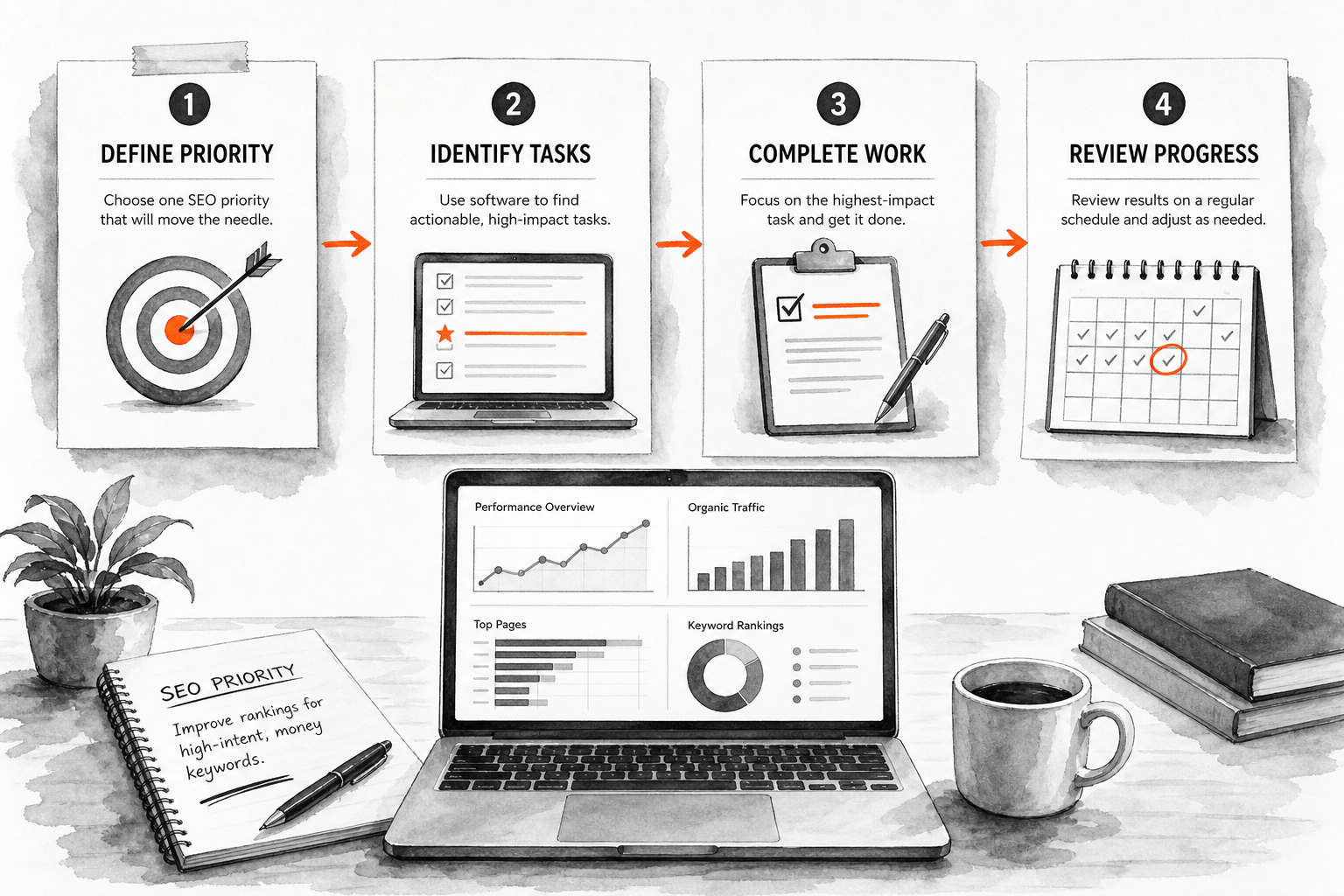 A Practical SEO Software Workflow
A practical recurring workflow looks like this:
- Review the latest website findings or opportunities.
- Select one priority based on likely value, effort, and ownership.
- Turn the priority into a technical fix, content task, or implementation prompt.
- Assign the work to the person or system that can complete it.
- Verify the change after implementation.
- Review the next priority during the following cycle.
The software does not remove the need for judgment. It reduces the amount of judgment required before work can begin.
First use versus repeat use
During the first use, the team needs enough context to understand the site and decide whether the findings are relevant. That may involve checking technical issues, reviewing search demand, or identifying an opportunity worth pursuing.
On repeat visits, the workflow should become narrower. The team should not have to re-read every report or reconsider every possible issue. It needs to see what changed, what remains unfinished, and what action now deserves attention.
This is where information-heavy tools can become difficult for a small business. A report may be accurate but still create a new task: someone must interpret it, decide its importance, write instructions, explain the work to another person, and check whether the result was implemented correctly. If the same interpretation happens every week, the tool is adding an operating burden.
The five questions to ask during evaluation
How much setup does the workflow require?
A useful evaluation starts with the first task, not the full feature list. Ask what the team must configure before it can reach a relevant recommendation.
Setup effort includes more than connecting a website. It also includes deciding which reports to use, learning the terminology, choosing priorities, and establishing who owns the output. A product that requires extensive configuration may suit a team with dedicated SEO knowledge, but it can be difficult for a founder who needs a clear starting point.
How much interpretation is left to the team?
Raw data can support good decisions, but it does not make the decision automatically. Look for the amount of translation required between a finding and an assigned task.
For example, “a page has a technical issue” is evidence. “Fix this page first, apply this change, then verify these conditions” is an actionable instruction. The distance between those two statements is the interpretation burden.
A product that surfaces many possible issues may be valuable for investigation. It may be less suitable when the team has limited time to determine which issue matters most.
Does the recommendation identify one practical next action?
Small teams usually need a priority, not another queue. The recommendation should make clear what the team is being asked to do and what type of work it represents.
That work might be a technical fix, a content task, or a prompt that helps an operator carry out the implementation. Clear recommendations also make it easier to say no to lower-priority work instead of allowing every new finding to interrupt the current task.
Can someone else take over the work?
Handoff quality matters when the person who reviews SEO findings is not the person who implements them. A recommendation should contain enough context for another operator, developer, or AI agent to understand the intended change.
A weak handoff sounds like, “Review the page and fix the issue.” A stronger handoff identifies the page, the problem, the intended action, and what should be checked afterward. The team still needs to review the work, but it does not need to reconstruct the original reasoning from scratch.
Can the team maintain the workflow each week?
A weekly process is only useful if it fits the team’s real capacity. Consider whether the product helps the team select a manageable amount of work or encourages an ever-growing backlog.
A maintainable process has a clear owner, a repeatable review point, and a simple way to verify completion. It does not require the founder to become a full-time SEO specialist before the first useful task can be completed.
For a more detailed view of where work can begin, see small business SEO use cases. It helps connect website problems with recurring actions rather than treating an audit as the end of the process.
When more data is not the answer
A team is probably receiving too much information and too little direction when:
- Reports are reviewed repeatedly without producing an assigned task.
- Several issues appear equally urgent, with no clear reason to start with one.
- The founder must translate technical language before work can begin.
- A developer receives findings without reproduction details or acceptance criteria.
- Content suggestions produce drafts but no decision about which topic to publish.
- The team collects reports but cannot say what changed since the last review.
- New findings regularly displace unfinished work.
The answer is not always a simpler product. Some teams genuinely need broad research, technical depth, backlink analysis, rank tracking, or reporting. The important question is whether those capabilities match the job the team is trying to perform now.
Where RankQuest Fits
RankQuest fits the workflow-focused side of SEO software for small business. It is designed for founders and growing businesses that need to prioritize and execute SEO work before hiring a dedicated SEO team.
 RankQuest homepage
RankQuest monitors a website, identifies the next priority SEO action, and turns that recommendation into implementation prompts, technical fixes, and publish-ready content. The practical difference is that the product is organized around the next move rather than presenting dashboard-heavy data for the team to interpret on its own.
| Verified capability | Buyer job it supports |
|---|---|
| Website SEO monitoring | Keep reviewing the site for issues and growth opportunities instead of relying on a one-time check. |
| Prioritized SEO recommendations | Decide which SEO action deserves attention before spending time on lower-priority findings. |
| Technical SEO audit guidance | Give a small team direction when technical findings require interpretation. |
| Technical SEO fixes | Move from a diagnosed problem toward a concrete implementation task. |
| AI-agent prompts for SEO implementation | Provide instructions that can support handoff to an AI agent or another operator. |
| Publish-ready weekly SEO articles | Turn a selected content opportunity into an article that is ready for review and publication. |
This makes RankQuest a sensible fit when the bottleneck is prioritization and execution capacity. It is particularly relevant when one person is responsible for reviewing SEO, deciding what matters, and getting the work moving.
The operating model is straightforward: monitor the website, identify the next priority, convert it into a task or prompt, complete the work, and return for the next review. That approach gives the team a defined unit of progress without requiring it to manage every possible SEO question at once.
RankQuest is not a universal replacement for every adjacent SEO workflow. A team may need a broader or more controlled-deployment product when its primary job is deep raw investigation, extensive research, large-scale reporting, or specialist-led service delivery. Those needs should be evaluated separately from the question of whether a team can turn one website finding into an action this week.
When RankQuest Is Not the Right Choice
RankQuest may not fit a buyer whose first requirement is a broad research suite rather than prioritized execution. If the team needs to investigate many areas in depth, compare extensive raw data, or build a specialist reporting process, a different approach may be more suitable.
It may also be the wrong starting point when the buyer wants a one-time diagnostic with no ongoing workflow. RankQuest is built around website monitoring and recurring recommendations, so its value depends on returning to the work, implementing a priority, and checking what should happen next.
A different service model may fit when the business expects an external specialist or agency to own the SEO program from research through delivery. RankQuest supports founders and growing businesses that need to execute work before hiring a dedicated SEO team. It should not be treated as a promise of hands-on service delivery.
The same boundary applies when the main need is a capability outside the verified product scope. For example, a buyer should assess a broader product if deep backlink research, extensive rank tracking, enterprise reporting, or custom data extraction is the central requirement. The decision should follow the job the team needs done, not the appeal of adding another tool.
FAQs
Are free SEO software options enough for a small business?
A free option can be enough for a one-time check or a narrowly defined diagnostic. It may be less suitable when the business needs recurring monitoring, prioritization, handoff, and verification. The deciding question is whether the free workflow helps the team complete work or only provides more information to interpret.
When is a simpler option enough?
A simpler option is enough when the team has one clearly defined task and already knows how to evaluate the result. For example, a single technical check may not require an ongoing operating system. A recurring site with changing priorities needs more structure if the team wants to keep acting after the first result.
Can one product replace every SEO workflow?
Usually, the buyer should not assume that one product will cover every research, technical, reporting, content, and service requirement equally. Start with the bottleneck that prevents work from happening. If the bottleneck is choosing and executing the next action, an implementation-focused workflow may be appropriate; if it is specialist research or large-scale reporting, another approach may fit the job better.
What should a small team prioritize when comparing products?
Prioritize the path from finding to completed action. Check how much setup and interpretation the product requires, whether recommendations can be handed off clearly, and whether the team can repeat the process with its available time. A long feature list is less useful if nobody can maintain the workflow.
Related guides
- SEO Software for Small Business: Compare Tools That Turn SEO Work Into Action
- SEO Software for Small Business vs. Hiring SEO Help: Which Work Belongs In-House?
- Small Business SEO Use Cases: From Website Problems to Weekly Actions
- A Lightweight SEO Software Rollout for Founders and Small Teams
- Common SEO Software Mistakes That Waste a Small Team’s Time