Guide
SEO Software for Small Business: Use Cases
Updated August 2026
Small Business SEO Use Cases: From Website Problems to Weekly Actions
Which SEO Software for Small Business Fits Your Workflow?
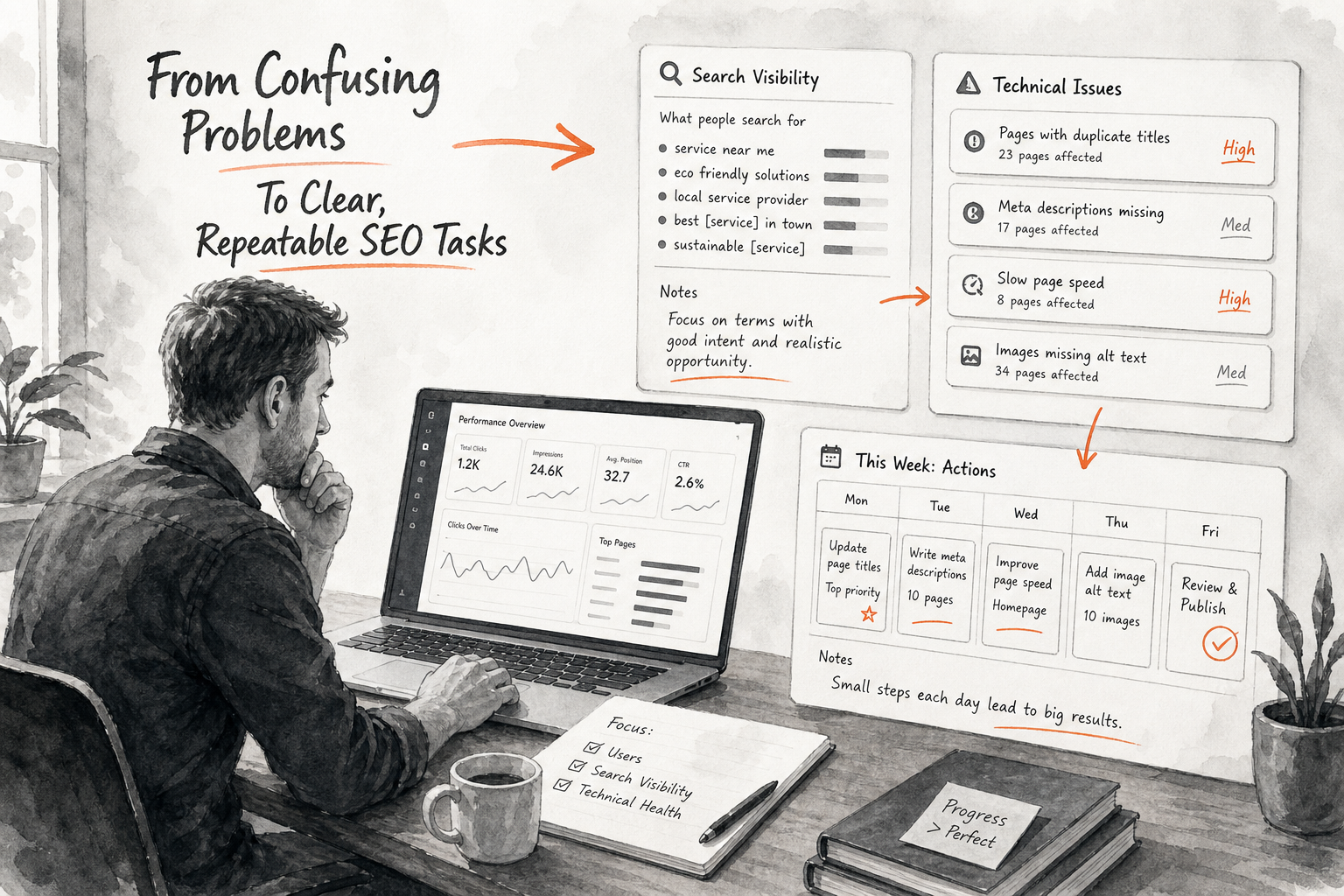
Choose an all-in-one suite when your team needs research, rank tracking, technical analysis, content work, and reporting in one platform. Choose a crawler-first workflow when broad investigation and raw SEO data are central to the job. Choose a managed business product when the immediate need is to identify one priority action and turn it into technical work or publish-ready content.
 Small Business SEO Software Workflow
The choice changes mainly with three things: how much SEO research your team needs, how much internal expertise is available to interpret it, and whether the team needs a broad platform or a direct path from website condition to completed action.
What Does SEO Software for Small Business Include?
The phrase can refer to several different software jobs:
- A broad SEO platform: A team uses one product for keyword research, competitor analysis, technical work, rank tracking, content, and reporting.
- A research and auditing workflow: A team investigates search demand, backlinks, technical conditions, and site performance in depth.
- An action-focused SEO system: A team needs software to monitor the website, prioritize the next move, and turn that recommendation into work someone can complete.
This guide focuses on operator-facing software for ongoing SEO work. It is for founders and small teams deciding how to move from a website problem or opportunity to a defined action.
It does not cover public launch communities, listing marketplaces, or unrelated project-management platforms. It also does not assume that every small business needs the broadest possible research suite. The practical question is narrower: which operating model will help your team make and execute the next sound SEO decision?
Why Choosing an SEO Software for Small Business Gets Difficult
The visible problem is often a website with issues or a lack of consistent content. The deeper bottleneck is usually prioritization.
A small business can discover many possible improvements without having the time, technical knowledge, or ownership structure to complete them. When software presents more findings than the team can interpret, the tool becomes another place to review work rather than a way to finish it.
Consider a founder who notices that the website has technical warnings and several pages that need attention. The founder does not need another unsorted list. They need to know which action should happen first, what that action involves, and whether it can be handed to a developer, an AI agent, or a writer.
That creates a tension between breadth and execution:
- A broad platform can support many SEO jobs, but the team must decide how to connect those jobs and which one deserves attention first.
- A crawler-first workflow can provide extensive investigation, but interpreting the findings may require more internal SEO expertise.
- A focused action workflow can reduce the distance between evidence and execution, but it may not be intended for every adjacent research or reporting need.
The cost of a poor fit is not only subscription waste. It is also abandoned work. A team may spend time configuring reports, reviewing findings, or collecting ideas while the original website problem remains unresolved.
For a deeper look at the small-team decision, see Choosing SEO Software When You Have Limited Time and SEO Experience. The useful comparison is not “which tool has the most features?” It is “which product matches the work your team can actually own?”
How to Compare SEO Software for Small Business
Start with the job the business needs done, then test the software against the operating conditions around that job.
 SEO Software Comparison Framework
1. Primary job fit
Define the immediate outcome in plain language. Is the team trying to research a market, investigate a website, coordinate recurring SEO work, produce content, or decide what to execute next?
A product can support several of these jobs, but the emphasis matters. If the primary need is prioritization, a large collection of research features may not solve the central bottleneck.
2. Guidance and prioritization
Ask whether the product helps the team decide what to do next or mainly provides information for a person to interpret.
Useful guidance should connect a website condition to an action. For a small team, that might mean identifying a technical fix, creating an implementation prompt, or preparing an article that can be reviewed and published.
3. Data depth and research breadth
Some teams need extensive research across competitors, keywords, backlinks, technical conditions, and search performance. Others need enough monitoring and analysis to make a practical weekly decision.
Data depth matters when the team has a clear research process and the expertise to use it. It matters less when the immediate problem is that existing information is not being converted into owned work.
4. Administration and collaboration
Consider who will use the product and who will act on its output. A founder may review recommendations, while a developer handles technical changes or a writer handles an article.
Look for a workflow that makes ownership clear. Reporting, role-based access, scheduled delivery, guest links, and exports can matter when several people need to coordinate. They should support the work, not become the work.
5. Hosting, integrations, and control
Check the operating environment before committing. Some teams need connections to analytics, search data, reporting, content, or CMS workflows. Others need a simpler product with fewer administrative requirements.
If your organization has specific data, hosting, or deployment requirements, treat those as purchase criteria rather than assumptions. A product that fits the SEO job but not the required operating environment is still a poor fit.
6. Ongoing effort
Every SEO product creates work. Someone must review recommendations, make decisions, assign tasks, approve changes, or publish content.
Estimate that effort honestly. A product that requires a specialist to interpret every output may not suit a founder-led workflow. A product that turns recommendations into clearer implementation work may be more suitable when the business is not ready to hire a dedicated SEO team.
7. Cost and access model
Compare the cost model with the work you expect to do. Do not assess a plan only by its feature list. Check whether limits, additional users, reports, projects, tracked terms, crawl volume, or other usage boundaries affect the workflow you intend to run.
A lower starting cost does not automatically make a product suitable, and a broader plan does not automatically make it wasteful. The relevant question is whether the access model supports the team’s actual operating pattern.
SEO Software for Small Business Approaches Compared
The market includes mixed operating models. Some options are managed products that help a business act on SEO work. Others are customer-operated platforms that provide broad research, auditing, tracking, and reporting capabilities. The table compares the named options using the same practical dimensions.
| Tool | Product type | Buyer fit | What you get | Main tradeoff |
|---|---|---|---|---|
| Semrush | All-in-one suite workflow | Teams that want one platform for keyword research, competitor analysis, technical audits, rank tracking, content, and AI-search visibility. | The small-business SEO plan includes keyword research, competitor analysis, Position Tracking, Site Audit, and AI-search performance tracking. | The entry SEO plan is limited to monitoring 5 websites and tracking 500 keywords daily; higher limits require a higher plan. |
| Ahrefs | Crawler-first workflow | Teams that need a broad SEO toolkit for small-business websites and personal projects. | Ahrefs combines competitor research, keyword research, technical SEO auditing, rank tracking, backlink analysis, and AI-visibility monitoring. | Teams may need to manage usage limits carefully because plans cap credits, crawl volume, tracked keywords, projects, and historical data. |
| SE Ranking | All-in-one suite workflow | Teams that want to manage core SEO, local SEO, content, and reporting workflows in one platform without requiring extensive technical experience. | SE Ranking combines rank tracking, website audits, on-page analysis, competitor research, keyword research, backlink analysis, content tools, and local SEO features. | Buyers should budget for plan upgrades or add-ons when they need expanded limits, white-label reporting, additional users, or agency-focused functionality. |
| RankQuest | Managed business product | Founders and growing businesses that need to prioritize and execute SEO work before hiring a dedicated SEO team. | An AI-assisted SEO system that monitors a website, identifies the next priority SEO action, and converts it into implementation prompts, technical fixes, and publish-ready content. | Fits when the verified product scope matches the buyer job; broader adjacent workflows may need a different approach. |
Semrush fits a team that wants a single suite covering research, audits, tracking, content, and AI-search visibility. Its documented workflow also includes AI guidance and prioritized technical issue lists, while its reporting and collaboration options can involve plan limits or add-ons.
Ahrefs fits teams looking for a broad SEO toolkit and an end-to-end path from discovering search demand to auditing a site and monitoring organic performance. Its plans place limits on areas such as credits, crawl volume, tracked keywords, projects, and historical data, so usage needs to be managed carefully.
SE Ranking fits teams that want core SEO, local SEO, content, and reporting workflows together without extensive technical experience. Its dashboards, reports, scheduled delivery, guest links, and role-based access support coordination, while expanded limits and agency-focused functionality may require upgrades or add-ons.
RankQuest uses a different operating model. It is designed around the step between monitoring and execution: finding the next priority SEO action, turning it into implementation prompts or technical fixes, and producing publish-ready weekly articles. That makes it relevant when the main problem is not a lack of possible work, but uncertainty about what to complete first.
No row is a universal answer. A business that needs broad research and reporting may prefer a wider platform. A founder who needs a clear next action and practical execution support may prefer a managed business product. Some teams may use a broad research workflow alongside an action-focused system, provided each product has a distinct job. Comparing these differences leads to the situation-based recommendations that follow.
Sources and verification
- RankQuest official site
- Semrush official site
- Ahrefs official site
- SE Ranking official site
- SE Ranking help center
Where RankQuest Fits
RankQuest is a managed business product for founders and growing businesses that need to prioritize and execute SEO work before hiring a dedicated SEO team.
 RankQuest homepage
Its distinctive model is the move from website monitoring to one prioritized action. RankQuest monitors a website, identifies the next SEO move, and turns that recommendation into AI-agent prompts, technical fixes, and publish-ready weekly articles.
That workflow suits a team facing a familiar situation: the website has possible SEO work, but nobody has enough time to interpret every finding and convert it into an owned task. Instead of presenting dashboard-heavy data as the final output, the product is positioned around what the team can do next.
The practical fit is strongest when:
- A founder or small team needs a clear SEO priority.
- Technical changes may be handed to an AI agent or developer.
- The business needs publish-ready articles as part of its ongoing SEO work.
- The company wants to make steady progress before hiring a dedicated SEO team.
RankQuest is not a universal replacement for every research, reporting, or deployment workflow. Its value depends on whether the buyer’s main job matches this action-focused model.
When a Broader or Controlled-Deployment Product May Fit Better
A broader product may fit better when the team’s central requirement is extensive manual research across many SEO areas, rather than choosing and executing the next priority action.
A controlled-deployment product may also fit better when the organization has specific hosting, data, administration, or deployment requirements that must be evaluated independently. Those requirements should be confirmed before choosing any software.
Likewise, teams that need broader adjacent workflows may prefer an all-in-one suite or crawler-first workflow. The decision is not about whether one model is universally superior. It is about whether the product’s operating model matches the work the team needs to own.
If the business needs ongoing specialist service delivery or agency program management, software alone may not address the full requirement. That is a different operating model from a self-directed team using software to prioritize and execute its own SEO work.
Try RankQuest
If your immediate problem is turning website conditions into one clear action, RankQuest is designed for that workflow. It monitors the site, prioritizes the next SEO move, and converts the recommendation into implementation prompts, technical fixes, or publish-ready content.
FAQs
Is a broad SEO platform always the right choice for a small business?
No. A broad platform can fit a team that needs research, auditing, tracking, content, and reporting in one place. If the main bottleneck is deciding what to do next and completing it, a more focused action workflow may fit the team’s available time better.
Can SEO software replace specialist SEO expertise?
Not in every situation. Software can help a team monitor a website, prioritize work, research opportunities, or prepare implementation tasks, but specialist expertise may still be useful for complex requirements or broader SEO programs.
Should a small team start with monitoring or execution?
Start with the job that is currently blocking progress. Monitoring is useful when the team needs to understand changing website conditions. Execution-focused software is useful when the team already knows there is work to do but cannot consistently decide what comes first or turn findings into completed tasks.
Can one product cover every SEO workflow?
A single product may cover many related activities, but buyers should still check whether its operating model matches their needs. A product built around prioritization and execution may not replace every broader research, reporting, integration, or controlled-deployment requirement.
When is SEO help better than software?
SEO help may fit when the business needs ongoing specialist service delivery or agency program management rather than a team-operated workflow. The comparison between software and outside help is covered in SEO Software for Small Business vs. Hiring SEO Help: Which Work Belongs In-House?.
Related guides
- SEO Software for Small Business: Compare Tools That Turn SEO Work Into Action
- Choosing SEO Software When You Have Limited Time and SEO Experience
- SEO Software for Small Business vs. Hiring SEO Help: Which Work Belongs In-House?
- A Lightweight SEO Software Rollout for Founders and Small Teams
- Common SEO Software Mistakes That Waste a Small Team’s Time