Guide
SEO Software for Small Business: A Lean Rollout
Updated August 2026
A Lightweight SEO Software Rollout for Founders and Small Teams
Which SEO Software for Small Business Fits Your Workflow?
Choose a lightweight, action-focused workflow when one person needs a clear next move and the team has limited time for interpretation. Choose a broader all-in-one or crawler-first workflow when you need extensive research, technical investigation, competitor analysis, rank tracking, or reporting across several people and sites. The choice changes most when you consider how much raw data your team needs, who will turn findings into work, and whether that work can be maintained every week.
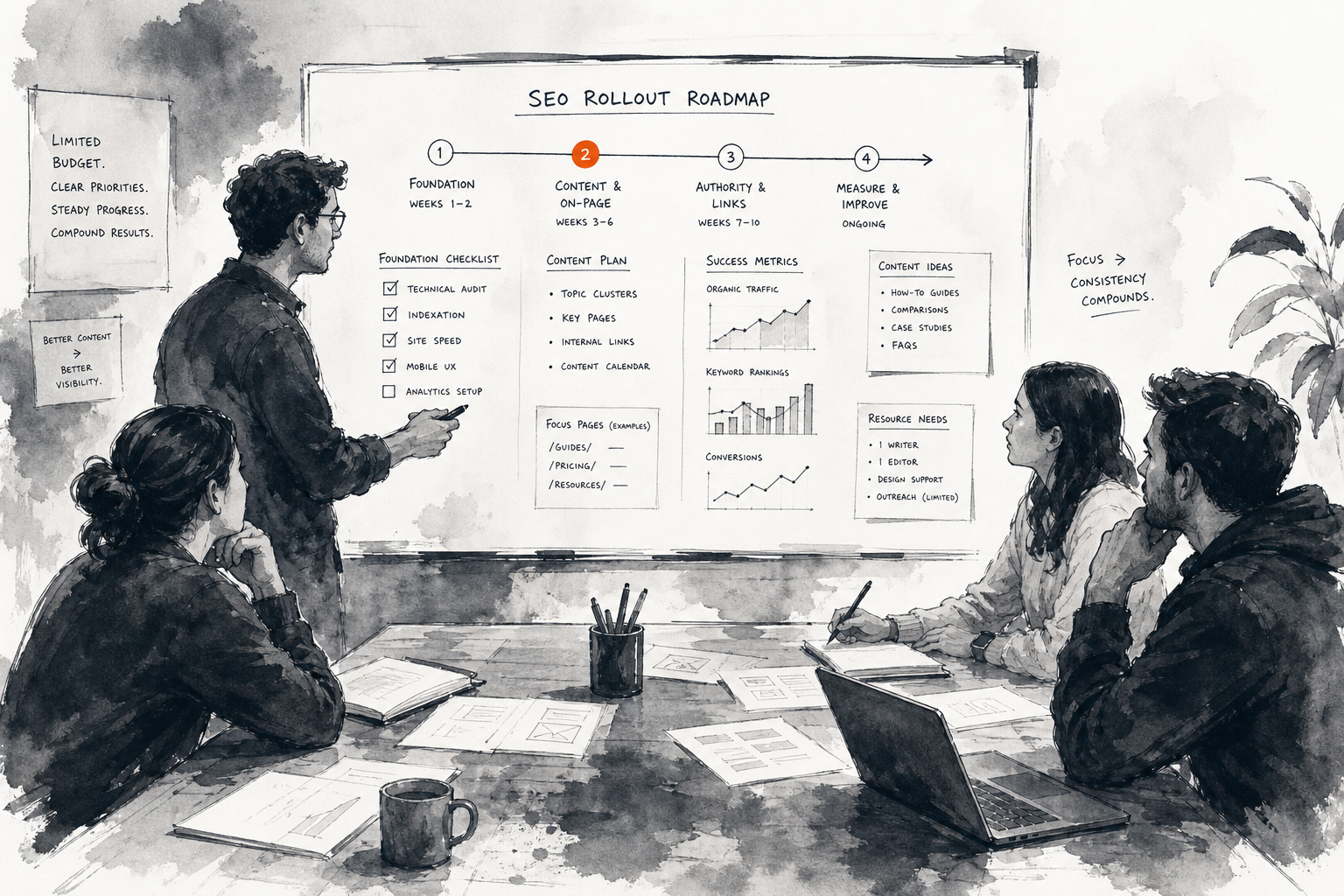 SEO Software Rollout for Small Teams
What this audience needs from the decision
Founders and growing businesses often do not have a person whose only responsibility is SEO. The work may sit with a founder one week, a marketer the next, and a developer when a technical issue appears. That makes ownership more important than a long list of possible tasks.
 A Practical SEO Workflow for Small Teams
A useful tool for this audience should answer four practical questions:
- What changed on the website?
- Which issue or opportunity should we handle first?
- What does the person responsible need to do?
- When should we review the result?
If the software only answers the first question, the team inherits the hardest part of the work. It must decide whether a technical issue matters more than a new article, whether a recommendation is safe to implement, and whether someone has the time and access to complete it.
The first rollout should therefore have one named owner. That person does not need to be an SEO specialist. They need enough authority to review recommendations, assign the work, and keep the cycle moving. A developer, writer, or outside adviser can contribute, but one person should remain responsible for the decision.
This is different from buying for a specialist team. An experienced SEO operator may want broad research options, detailed crawl controls, historical data, backlink analysis, or the ability to investigate many questions at once. Those capabilities can be valuable, but they also create more decisions for a team that may only have capacity for one useful action each week.
A simple test is to describe your current situation:
- No one owns SEO from week to week.
- Website issues are discovered, but not consistently resolved.
- Recommendations are difficult to translate into tasks.
- Several people may need to contribute to one change.
- The team wants a repeatable review habit rather than a large initial project.
If those statements fit, prioritize clarity and handoff over the volume of information presented.
The practical constraints that should shape your choice
Time available for interpretation
The main cost of SEO software is not always setup. It is the time required to understand what the software is showing and decide what deserves attention.
A crawler-first product can be useful when the team needs detailed investigation. Ahrefs, for example, combines competitor research, keyword research, technical auditing, rank tracking, backlink analysis, and AI-visibility monitoring. Its Site Audit checks for more than 170 predefined technical and on-page issues.
That breadth can support a careful investigation, but a small team should ask whether it has a defined use for the information. If the answer is no, a larger issue list may simply make the weekly decision harder.
A broader all-in-one suite can also suit teams that want several SEO activities in one place. Semrush documents workflows covering keyword research, competitor analysis, technical audits, rank tracking, content, and AI-search visibility. SE Ranking combines core SEO, local SEO, content, reporting, audits, on-page analysis, competitor research, and backlink analysis.
These approaches are sensible when the team needs those workflows and has someone able to coordinate them. They are less suitable when the immediate problem is choosing one action from a changing set of findings.
Ability to assign and complete work
A recommendation is only useful when it can become an owned task. Before choosing software, identify who can make each type of change:
- A founder or marketer may own a page update.
- A writer may handle a publish-ready article.
- A developer may handle a technical SEO fix.
- An external specialist may need to review a high-risk change.
The tool should make that handoff understandable. A list of issues without an explanation of the next action leaves the owner to translate technical language into instructions.
This is where implementation-focused software can fit a small team. RankQuest monitors a website, identifies the next priority SEO action, and converts recommendations into AI-agent prompts, technical fixes, and publish-ready content. The practical value is not simply finding an issue. It is reducing the distance between finding it and giving someone useful work to complete.
Tolerance for setup and maintenance
A rollout becomes fragile when it requires too many rules before the team has completed its first cycle. Start with one website, one owner, one priority, and one review point.
More flexible products often require more decisions about projects, tracked terms, crawl volume, reports, users, or permissions. Those controls matter for larger or more specialized operations. They are less important when the team is still establishing a basic habit.
Usage limits can also shape the choice. Ahrefs notes that plans cap credits, crawl volume, tracked keywords, projects, and historical data. Semrush documents limits on websites and daily keyword tracking in its entry SEO plan, while some collaboration and reporting workflows use add-ons. SE Ranking notes that expanded limits, additional users, white-label reporting, and agency-focused functionality may require upgrades or add-ons.
The lesson is not that limits are inherently bad. It is that the team should pay for control it will actually use. A small business can overbuy by selecting a system designed around reporting and research volume before it has a reliable way to complete basic fixes.
Need for reporting and collaboration
Reporting becomes more important when several people need a shared view of the work or when an adviser needs regular updates. Semrush lists scheduled delivery and PDF export through its Base Report add-on. Ahrefs includes Report Builder in higher-tier plans, and SE Ranking supports custom or template-based reports, scheduled delivery, guest links, and role-based access.
For a founder-led rollout, reporting should not become the main output. A short record of the selected action, owner, status, and review date may be more useful than a polished report that no one uses to make a decision.
Choose a heavier reporting workflow when communication across roles is the constraint. Choose a lighter workflow when the constraint is execution.
Depth versus a repeatable weekly cycle
A small team should not treat every possible SEO issue as equally urgent. A broken page that blocks users, a clear technical problem, and a useful publishing opportunity may all be valid findings, but the team still needs to select one.
A practical priority should satisfy three conditions:
- The team understands what needs to change.
- Someone has the access and time to make the change.
- The result can be reviewed after implementation.
If a recommendation fails one of these tests, it may be interesting but not ready to be the next action. This prevents the rollout from becoming a research exercise with no completed work.
For a deeper look at the time and experience side of this decision, see Choosing SEO Software When You Have Limited Time and SEO Experience.
Where RankQuest Fits
RankQuest fits founders and growing businesses that need to prioritize and execute SEO work before hiring a dedicated SEO team. Its role is to help the team move from website evidence to a specific next action, rather than presenting a large set of findings that must be coordinated manually.
 RankQuest homepage
The workflow is designed around a short operating cycle:
- RankQuest monitors the website for SEO issues and growth opportunities.
- It identifies the next priority SEO action.
- The recommendation becomes an implementation prompt, technical fix, or publish-ready article.
- The owner completes or assigns the work.
- The team reviews what should happen next.
That sequence supports a team that has enough willingness to act but not enough time to interpret every possible finding.
| RankQuest capability | Practical buyer job |
|---|---|
| Website SEO monitoring | Keep a regular view of changing website conditions without starting a new investigation each time. |
| Prioritized SEO recommendations | Choose one next action instead of sorting through an unranked issue list. |
| AI-agent prompts for SEO implementation | Give an operator or agent clearer instructions for carrying out the recommended work. |
| Technical SEO fixes | Turn technical findings into work that can be reviewed and assigned. |
| Technical SEO audit guidance | Help a non-specialist understand what a technical issue requires before acting. |
| Publish-ready weekly SEO articles | Support a consistent publishing action when the priority is creating a new article. |
The strongest fit is a team where SEO work is currently shared across roles and tends to stall between discovery and implementation. For example, a founder may review the recommendation, ask a developer to handle a technical fix, and then return to the system for the next priority. The workflow gives each person a defined part without requiring the founder to become a full-time SEO operator.
The product also fits a business that wants to start small. The first cycle does not need a large backlog. Select the recommendation that is understandable, assignable, and feasible to complete. Once that work is finished, use the next review to decide whether to continue the same type of work or move to a different priority.
This is a different operating model from collecting every possible issue. It treats SEO as a sequence of decisions and completed actions. That distinction matters for small teams because an unfinished list does not create a process. A completed priority, reviewed at a regular cadence, does.
When RankQuest Is Not the Right Choice
RankQuest may not fit a buyer whose main requirement is deep raw investigation across many SEO questions. A broader research or crawler-first product may be more suitable when the team needs extensive competitor research, backlink analysis, technical auditing, rank tracking, historical data, or detailed control over a larger investigation.
It may also be the wrong starting point when several users need advanced reporting, role controls, or a tightly managed agency workflow. In that situation, choose an approach built around the reporting and collaboration requirements rather than adding those requirements after the rollout has begun.
A different approach may be appropriate when the team only wants a one-off diagnostic. RankQuest is positioned around ongoing website monitoring, prioritization, implementation prompts, technical fixes, and publish-ready articles. If the buyer does not intend to review and act on recommendations repeatedly, an ongoing workflow may be more than the immediate job requires.
Finally, RankQuest is not a substitute for heavy service delivery or specialist judgment where the work requires expertise the internal team does not have. The useful question is whether the product can help the team own and execute the next action, not whether one product should replace every adjacent SEO role.
FAQs
Should a small team start with one SEO task or a complete audit?
Start with one priority that the team can understand and complete. A complete audit can be useful when a specialist needs a broad view, but it should not become a requirement to act. The first rollout should prove that findings can move into owned work.
Does SEO software replace an SEO specialist?
Not in every situation. A focused product can help founders and small teams monitor a website, prioritize work, and turn recommendations into implementation tasks, while deeper research, complex technical decisions, or managed service delivery may still require specialist support.
When is a dashboard-heavy workflow worth the effort?
It is worth considering when the team needs broad research, detailed controls, recurring reports, multiple users, or coordination across many websites. If one owner mainly needs to decide what to do next, the extra interpretation may outweigh the additional flexibility.
Who should own the weekly SEO review?
Choose one person with enough access to review recommendations and assign work. That person can be a founder, marketer, developer, or another operator. Ownership should be explicit even when implementation is shared.
Related guides
- SEO Software for Small Business: Compare Tools That Turn SEO Work Into Action
- Choosing SEO Software When You Have Limited Time and SEO Experience
- SEO Software for Small Business vs. Hiring SEO Help: Which Work Belongs In-House?
- Small Business SEO Use Cases: From Website Problems to Weekly Actions
- Common SEO Software Mistakes That Waste a Small Team’s Time