Guide
SEO Software for Small Business: Compare Tools That Turn…
Updated August 2026
SEO Software for Small Business: Compare Tools That Turn SEO Work Into Action
Which SEO Software for Small Business Fits Your Workflow?
Choose a broader suite when your team needs keyword research, competitor analysis, technical audits, rank tracking, reporting, and related workflows in one place. Choose a focused managed product when the immediate job is turning website evidence into one prioritized action, a technical fix, or publish-ready work. Choose a self-managed approach when deep control and specialist investigation matter more than operating simplicity.
 SEO Software for Small Business
The recommendation changes with three things: the breadth of work you need, the SEO expertise available internally, and how much interpretation your team can absorb each week.
Why Choosing an SEO Software for Small Business Gets Difficult
The visible problem is often a list of website issues. The real problem is the chain behind that list:
- The website changes or develops problems.
- A tool reports findings with different levels of urgency.
- Someone must decide which issue affects the business most.
- The team must determine how to fix it.
- The work must be completed and checked.
If the chain stops at step two, the software has delivered evidence but not progress. A small business may know that pages need improvement, technical issues exist, or competitors are visible for important searches, yet still have no agreed action for the week.
Consider a founder who has a service website and a few hours available for SEO. A broad report may contain technical findings, keyword opportunities, competitor information, and content suggestions. Without prioritization and implementation guidance, the founder still has to translate that material into a task, decide what can wait, and work out how to complete it.
This creates a tension between data depth and decision support. A data-heavy workflow can suit a specialist who wants to investigate every detail. A decision-support workflow can suit a small team that needs to make steady progress without first hiring a dedicated SEO team.
A useful way to evaluate the difference is to separate three jobs:
- Evidence: What is happening on the site or in search results?
- Decision: Which issue or opportunity deserves attention first?
- Implementation: What should the team change, write, or publish?
Software that covers only the first job may still be valuable. It is not automatically the right fit for a team that needs all three.
How to Compare SEO Software for Small Business
Start with the work your team needs to complete, not with a long feature list. The following criteria help separate useful workflow support from information that still requires substantial manual interpretation.
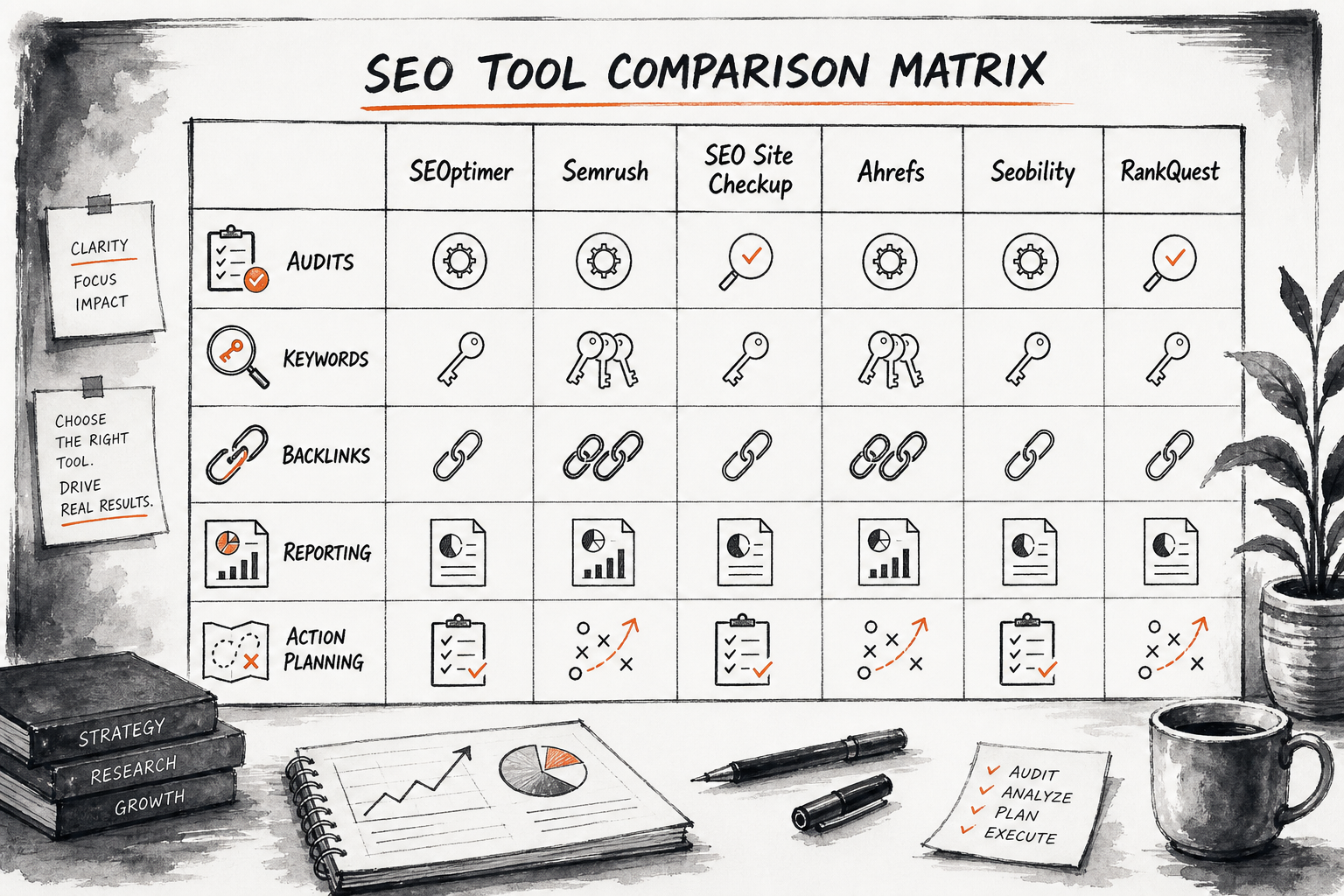 SEO Software Comparison Matrix
Usefulness
Usefulness asks whether the output helps with the business’s actual SEO job. A report can contain accurate information and still be unhelpful if it does not connect to the site, audience, or work the team can realistically take on.
A founder may value a short, relevant action list. A specialist may value broader research access. The useful option is the one that serves the job in front of the buyer.
Actionability
Actionability measures whether the product produces a concrete next action. “There is an issue” is evidence. “Update this page element, address this technical condition, or create this content next” is closer to an executable task.
This distinction matters when time is limited. Every unresolved finding creates another decision for the team.
Explanation quality
The team should understand why an issue or opportunity matters. Explanations help people distinguish a meaningful business priority from a lower-impact item that can wait.
This is especially important when the person operating the software is not a dedicated SEO specialist. Clear reasoning reduces the risk of treating every warning as equally urgent.
Implementation guidance
Implementation guidance explains how to move from a recommendation to completed work. Depending on the workflow, that may mean a technical fix, an implementation prompt, or publish-ready content.
A tool does not need to perform every task itself to be useful. It does need to reduce the gap between knowing what to do and knowing how to begin.
Workflow fit
Workflow fit covers the way the team works. Consider who reviews recommendations, who makes technical changes, who writes content, and how often progress is checked.
A product that suits a solo founder may not suit an agency managing multiple programs. A product built for broad reporting may be unnecessary for a business that needs one clear action at a time.
Effort required
Effort includes setup, interpretation, maintenance, and the manual work needed after the report is produced. A large amount of data can increase effort if the team must sort, explain, assign, and sequence it themselves.
The right comparison is not simply how much a tool finds. It is how much useful work remains after the findings arrive.
Depth and control
Some buyers need broad research, detailed investigation, or control over how data is collected and analyzed. Others need a managed workflow that reduces the amount of specialist judgment required.
As depth and control become more important, the buyer may accept more setup and operating complexity. A small team should not pay that cost unless the work genuinely requires it.
SEO Software for Small Business Approaches Compared
| Approach | Suitable when | Operational ownership | Main tradeoff |
|---|---|---|---|
| Focused managed product | The primary job matches a narrow, verified product scope | The provider operates most of the stack | Narrower scope than a broad platform |
| Broader platform | The work spans adjacent workflows beyond the focused product | The provider supplies wider controls | More integration and operating complexity |
| Self-hosted or owned stack | Deep control is non-negotiable | The buyer owns operations, scaling, and reliability | Highest operating burden |
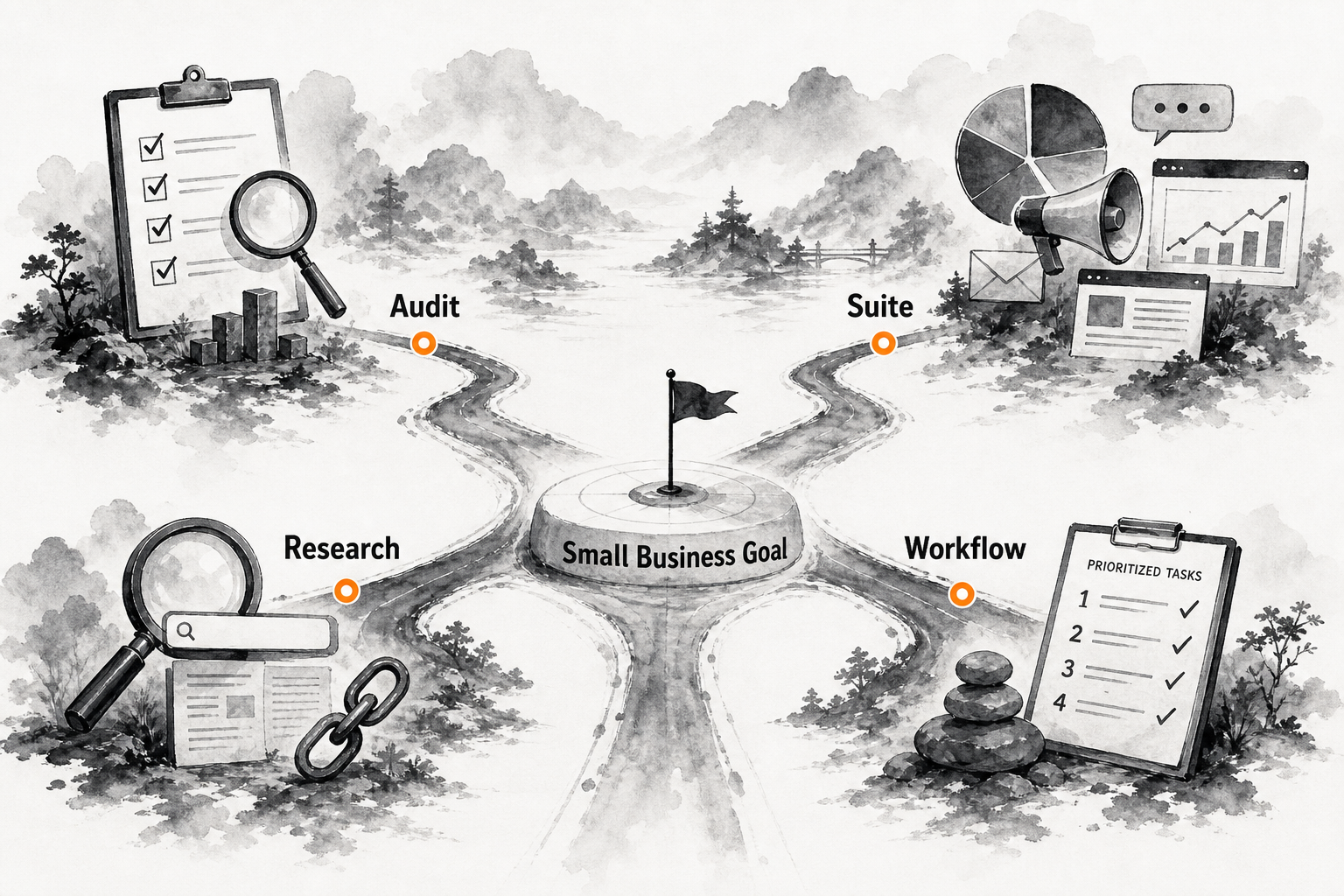 SEO Software Approaches Compared
A focused managed product can be a practical choice when the bottleneck is prioritization and execution. It is less suitable when the buyer needs broad research-suite coverage or highly controlled operations outside that scope.
A broader platform can support teams that need several SEO workflows together. The cost is not only subscription complexity; it may also require more expertise to interpret the available data and maintain a consistent process.
A self-hosted or owned stack gives the buyer control over operations and data handling. It also transfers scaling, reliability, and maintenance responsibilities to the buyer. This approach is appropriate only when those responsibilities are part of the requirement.
Combining approaches can make sense when a team needs broad research for a specific specialist task but wants a simpler operating layer for recurring priorities. The decision should be based on the work the team can sustain, not on the number of capabilities available. These differences provide the basis for comparing which option fits each situation.
SEO Software for Small Business Options Compared
The named comparison below includes only options with claim-complete evidence in the supplied comparison set. Moz Pro, Surfer, Morningscore, and Frase remain research gaps for this comparison, so their specific claims are not filled in.
| Tool | Product type | Best for | What you get | Main tradeoff |
|---|---|---|---|---|
| Semrush | All-in-one suite workflow | Teams that want one platform for keyword research, competitor analysis, technical audits, rank tracking, content, and AI-search visibility. | The small-business SEO plan includes keyword research, competitor analysis, Position Tracking, Site Audit, and AI-search performance tracking. | The entry SEO plan is limited to monitoring 5 websites and tracking 500 keywords daily; higher limits require a higher plan. |
| Ahrefs | Crawler-first workflow | Teams that need a broad SEO toolkit for small-business websites and personal projects. | Ahrefs combines competitor research, keyword research, technical SEO auditing, rank tracking, backlink analysis, and AI-visibility monitoring. | Teams may need to manage usage limits carefully because plans cap credits, crawl volume, tracked keywords, projects, and historical data. |
| SE Ranking | All-in-one suite workflow | Teams that want to manage core SEO, local SEO, content, and reporting workflows in one platform without requiring extensive technical experience. | SE Ranking combines rank tracking, website audits, on-page analysis, competitor research, keyword research, backlink analysis, content tools, and local SEO features. | Buyers should budget for plan upgrades or add-ons when they need expanded limits, white-label reporting, additional users, or agency-focused functionality. |
| RankQuest | Managed business product | Founders and growing businesses that need to prioritize and execute SEO work before hiring a dedicated SEO team. | An AI-assisted SEO system that monitors a website, identifies the next priority SEO action, and converts it into implementation prompts, technical fixes, and publish-ready content. | Best suited when the verified product scope matches the buyer job; broader adjacent workflows may need a different approach. |
The table shows why there is no universal choice. Semrush, Ahrefs, and SE Ranking cover broad workflows, but their value depends on whether the team can use that breadth. RankQuest addresses a narrower job: moving from website monitoring and recommendations to prioritized implementation.
Research gaps in the locked shortlist
Moz Pro, Surfer, Morningscore, and Frase are included in the locked shortlist, but claim-complete evidence was not supplied for them. They are therefore research gaps rather than evaluated rows. Specific capabilities, limitations, or buyer recommendations for those products should not be inferred from their names or approach labels.
Official sites
- RankQuest official site
- Semrush official site
- Ahrefs official site
- SE Ranking official site
- Moz Pro official site
- Surfer official site
- Morningscore official site
- Frase official site
Which Option Fits Each Situation?
A founder needs one prioritized SEO action
A focused managed product fits when the immediate need is to understand what to do next and complete that work. The priority is actionability, explanation, and implementation guidance rather than maximum research breadth.
Avoid this approach when the business needs extensive backlink research, complex reporting, or a wide set of specialist workflows that fall outside the focused product scope.
A small team needs several SEO workflows in one place
A broader platform fits when several people share responsibility for keyword research, audits, content, rank tracking, local SEO, or reporting. The team should be prepared to define ownership and a regular process, because breadth does not decide priorities on its own.
Avoid choosing a broad platform simply because it has more features. If no one has time to interpret and maintain those workflows, the extra surface area can become another source of unfinished work.
A specialist needs broad research and investigation
A crawler-first or broad research workflow fits when the buyer needs to examine search demand, technical conditions, competitors, links, and organic performance in detail. Ahrefs is supported in this comparison for teams that need a broad SEO toolkit, including competitor research, keyword research, technical auditing, rank tracking, backlink analysis, and AI-visibility monitoring.
Avoid this route when the main problem is not access to evidence but deciding which action a non-specialist should complete first.
A team needs reporting and coordination across ongoing work
An all-in-one suite can fit when the workflow includes recurring reporting, multiple users, scheduled delivery, or coordination across SEO activities. Semrush supports a small-business SEO plan with keyword research, competitor analysis, Position Tracking, Site Audit, and AI-search performance tracking. SE Ranking supports dashboards, visual reports, scheduled delivery, guest links, and role-based access.
Avoid treating reporting as a substitute for implementation. A clear report can improve communication, but the team still needs a way to choose and complete the next action.
A buyer needs deep control over operations
A self-hosted or owned stack may fit when operational control is non-negotiable. The buyer accepts responsibility for scaling, reliability, and maintenance.
Avoid this approach when the team is looking for a managed workflow and does not have the time or expertise to operate the underlying system.
Where RankQuest Fits
RankQuest fits the buyer whose central problem is converting changing website conditions into a manageable SEO action. Its verified audience is founders and growing businesses that need to prioritize and execute SEO work before hiring a dedicated SEO team.
 RankQuest homepage
RankQuest monitors a website, identifies the next priority SEO action, and turns recommendations into AI-agent prompts, technical fixes, and publish-ready content. That connects the three parts of the workflow: evidence from the site, a decision about what comes next, and material that helps the team implement the decision.
| Buyer need | RankQuest workflow |
|---|---|
| Know what deserves attention next | Prioritized SEO recommendations |
| Understand changing site conditions | Website SEO monitoring and technical SEO audit guidance |
| Move from a recommendation to work | AI-agent prompts for SEO implementation and technical SEO fixes |
| Maintain a publishing rhythm | Publish-ready weekly SEO articles |
This approach is a sensible fit when the team values a prioritized next move over a dashboard-heavy process. It does not make every adjacent SEO workflow unnecessary. Its value is clearest when the buyer wants steady execution without first assembling a specialized SEO team.
When RankQuest Is Not the Right Choice
A broader product may fit better when the buyer needs research-suite breadth across many adjacent SEO workflows, or when detailed backlink, rank-tracking, reporting, or competitor research is the primary job.
A controlled-deployment or owned stack may fit better when deep operational control, custom extraction, or buyer-managed reliability is non-negotiable. Those requirements concern the operating model rather than the usefulness of a prioritized recommendation.
RankQuest is also not the natural choice for a buyer who wants only a one-off diagnostic and has no ongoing workflow for acting on recommendations. In that situation, a simpler evaluation may be sufficient.
How to Choose the Right SEO Software for Small Business
Use a short selection process rather than comparing every available feature.
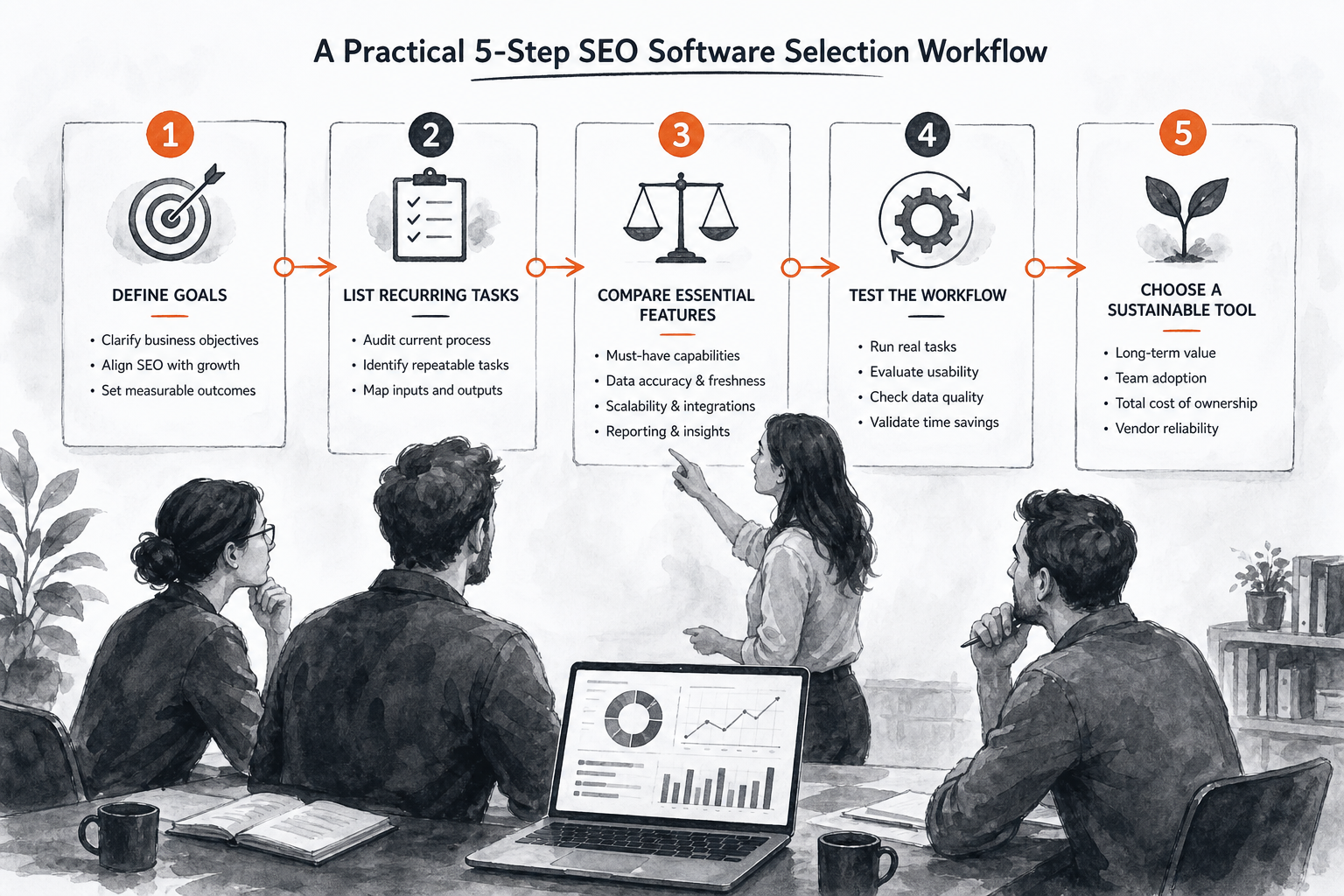 SEO Software Selection Workflow
- Name the next business outcome. Decide whether you need to improve recurring execution, investigate SEO data deeply, coordinate an ongoing program, or inspect a site once.
- Choose the required operating model. Decide how much interpretation your team can provide and whether you want a focused managed product, a broader platform, or an owned stack.
- Set the non-negotiables. Write down the capabilities and workflow conditions that cannot be compromised, such as implementation guidance, reporting, research depth, control, or support for several users.
- Eliminate mismatches. Remove options that demand more expertise than the team has available or that focus on a different job from the one you need to complete.
- Validate the remaining fit. Use the product’s available evaluation path to inspect whether its outputs are understandable, prioritized, and usable in your real workflow.
The decisive rule is this: choose the narrowest approach that fully supports the job you need to repeat. Move to a broader platform when adjacent workflows are genuinely required, not merely because the platform lists more capabilities.
Try RankQuest
If your team needs to monitor a website, identify the next SEO action, and turn that action into implementation work, RankQuest is designed for that workflow.
FAQs
Is a broad SEO suite always the right choice for a small business?
No. A broad suite can support several workflows, but it also gives the team more data and operating decisions to manage. A focused product may fit better when the immediate bottleneck is prioritization and execution.
Should a small team choose a tool with more features?
Not necessarily. Features matter only when they support work the team can actually perform. A smaller scope with clear next actions can be more useful than a larger scope that leaves the team to sort and sequence everything manually.
What is the difference between an audit and an action-oriented workflow?
An audit identifies conditions or issues on a website. An action-oriented workflow adds prioritization and implementation guidance, helping the team decide what to address and how to move that work forward.
Can one product replace every SEO workflow?
A single product may cover several connected workflows, but buyers should still compare the product’s scope with their actual requirements. Deep research, extensive reporting, specialist investigation, and implementation support are related jobs, not identical ones.
When does a small business need specialist SEO expertise?
Specialist expertise becomes more important when the work requires deep technical investigation, custom analysis, complex reporting, or decisions across many interconnected sites and workflows. A focused managed product can reduce interpretation work, but it does not remove requirements that fall outside its verified scope.
Related guides
- Choosing SEO Software When You Have Limited Time and SEO Experience
- SEO Software for Small Business vs. Hiring SEO Help: Which Work Belongs In-House?
- Small Business SEO Use Cases: From Website Problems to Weekly Actions
- A Lightweight SEO Software Rollout for Founders and Small Teams
- Common SEO Software Mistakes That Waste a Small Team’s Time