Guide
SEO Task Management: How to Organize and Execute SEO Work
Updated September 2026
SEO task management is the system you use to turn SEO work into something that can actually be executed.
It starts after an issue, opportunity, or recommendation exists.
Instead of leaving work scattered across audit exports, Search Console tabs, spreadsheets, Slack messages, docs, and vague tickets, task management gives each piece of work enough structure to move from:
“We should probably fix this.”
into:
“This is the exact work, this is its scope, this is who or what will execute it, and this is how we will verify it.”
That distinction matters because SEO work is unusually easy to collect and unusually easy to lose.
A crawl can create hundreds of findings in minutes. Keyword research can produce dozens of content ideas. Search Console can reveal pages that deserve attention. A strategist can add recommendations faster than a developer or writer can ship them.
Without a task-management layer, all of that evidence turns into backlog.
With one, SEO becomes executable work.
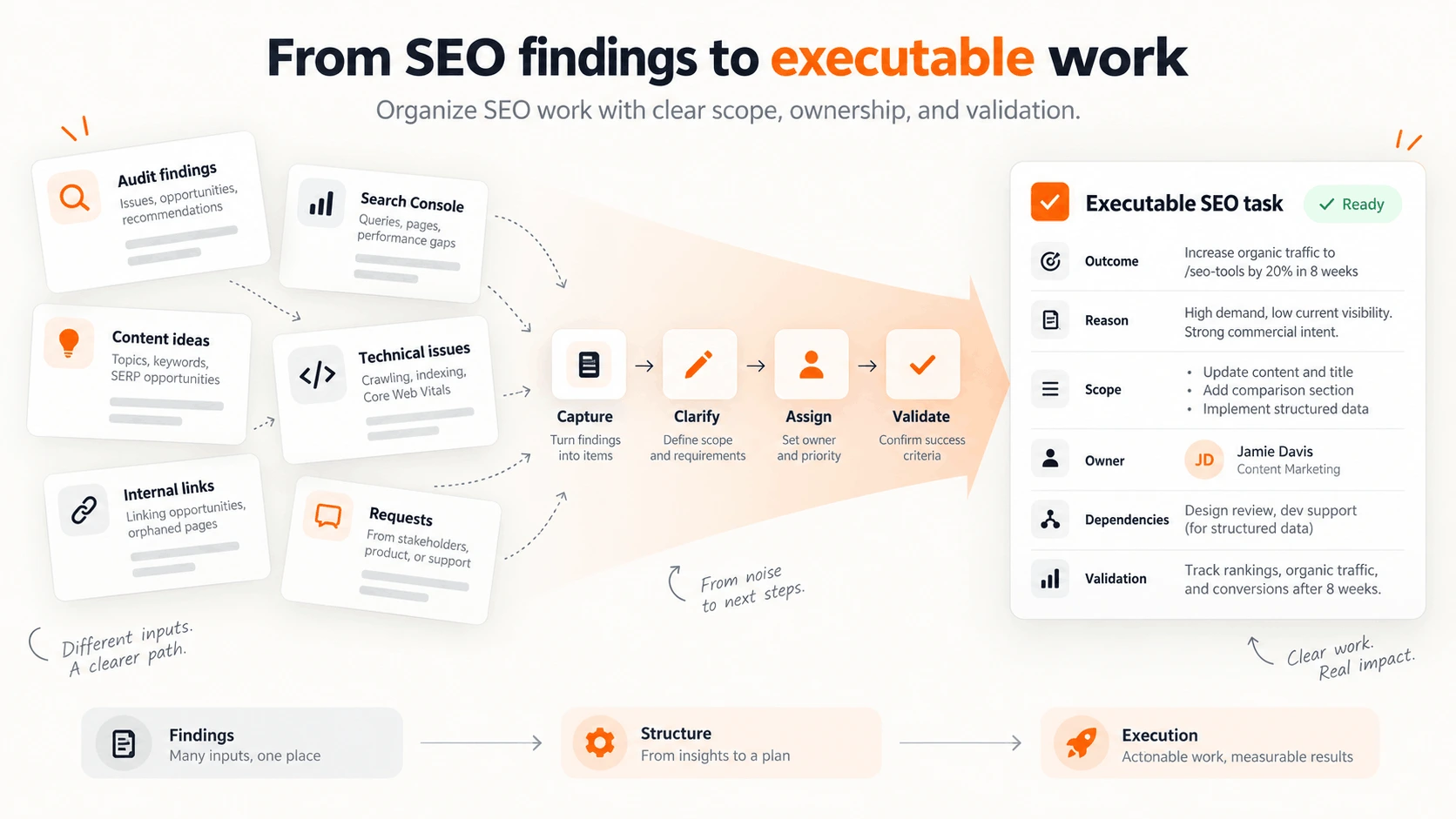 From SEO findings to organized, executable work
What is SEO task management?
SEO task management is the process of capturing, structuring, assigning, executing, and validating SEO work.
That work can include:
- fixing technical crawl or indexation problems
- updating important pages
- improving internal links
- refreshing outdated content
- implementing schema
- resolving redirects
- creating new pages
- reviewing search opportunities
- validating changes after deployment
The task itself is only one part of the system.
Good SEO task management also preserves the context needed to execute the task correctly:
- why the task exists
- what evidence supports it
- which page, template, or content cluster it affects
- what the expected change is
- who owns the decision
- who or what will execute the work
- what dependencies must be resolved first
- how completion will be verified
A task like:
Fix internal linking
is not properly managed.
A task like:
Add contextual links from the three technical-audit supporting guides to
/guide/technical-seo-audit-toolusing descriptive anchors, without changing global navigation, then recrawl the four pages and confirm each new link is rendered and crawlable.
is much closer.
The second version can actually be handed to someone.
That is the point.
SEO task management vs SEO workflow vs SEO prioritization
These topics overlap, but they solve different problems.
SEO workflow
An SEO workflow describes the whole operating loop:
Observe → Interpret → Prioritize → Execute → Validate → Re-evaluate
It explains how SEO evidence becomes action and how the system updates after work is completed.
SEO prioritization
SEO prioritization decides which work deserves attention first.
It asks questions such as:
- Is anything blocking crawling or indexing?
- Which issue has meaningful impact?
- How strong is the evidence?
- What dependencies exist?
- What is the effort or implementation risk?
SEO task management
Task management begins once work is concrete enough to organize.
It asks:
- What exactly is the task?
- What is in scope?
- Who owns it?
- What depends on it?
- What state is it in?
- What counts as done?
- How will it be validated?
A useful mental model is:
SEO workflow
    ↓
Prioritization chooses the work
    ↓
Task management organizes the work
    ↓
Execution changes the site
    ↓
Validation confirms the result
This separation matters.
A perfectly organized task board can still contain the wrong work.
And a brilliant SEO recommendation can still fail if nobody can execute it cleanly.
Why SEO tasks become chaotic
SEO work usually enters the team from several different places.
Technical findings may come from:
- crawlers
- Search Console
- PageSpeed Insights
- log analysis
- manual QA
Content work may come from:
- keyword research
- content decay
- competitor analysis
- search-intent reviews
- internal-link gaps
Business requests may come from:
- product launches
- founders
- marketing
- sales
- customer questions
Then the work gets copied into different systems.
One issue lives in a spreadsheet.
Another becomes a Linear ticket.
A content refresh is in Notion.
Someone mentions an internal-link fix in Slack.
An AI agent generated a patch, but nobody recorded whether it was applied.
A developer marked a ticket done, but nobody checked the rendered page.
This creates four recurring problems:
- context disappears
- ownership becomes ambiguous
- dependencies are discovered too late
- “done” means different things to different people
The solution is not necessarily another SEO tool.
It is a better task contract.
What every SEO task should contain
A useful SEO task should carry enough information that the executor does not need to rediscover the strategy.
At minimum, include these seven fields.
1. The outcome
State what should be true when the task is complete.
Bad:
Fix sitemap.
Better:
Publish a valid XML sitemap containing the site's canonical indexable pages and expose it through
robots.txt.
The outcome gives the work a destination.
2. The reason
Explain why the task exists.
This should be short.
For example:
The site contains indexable pages but no reliable sitemap discovery structure, which weakens structured page discovery.
The executor should understand the purpose without reading a 40-page audit.
3. The scope
Define what is affected.
This may be:
- one URL
- a page group
- a template
- a content cluster
- a sitewide rule
For example:
Scope: parameterized
/shopfilter URLs only. Product-detail pages are excluded.
Scope protects the rest of the site from accidental changes.
4. The required change
Specify the actual work.
For example:
Update canonical generation for filtered shop URLs so they point to the canonical
/shopURL. Preserve self-referencing canonicals on product pages.
This is the implementation contract.
5. The constraints
Record what must not change.
Examples:
- do not change unrelated templates
- preserve current URL structure
- do not remove intentionally canonicalized filter pages
- use existing design components
- do not create a new article if the existing page should be updated
Constraints are especially useful when work is delegated to developers, writers, agencies, or AI agents.
6. The owner and executor
These may be the same person.
They may not be.
The owner is accountable for the outcome.
The executor performs the work.
For example:
Owner: SEO lead
Executor: developer
or:
Owner: founder
Executor: AI coding agent + founder review
Separating ownership from execution prevents the common situation where a task technically has an assignee but nobody owns the SEO judgment behind it.
7. The validation rule
Define what proves the work was completed correctly.
Examples:
- recrawl the affected URLs
- inspect rendered HTML
- verify HTTP status and redirect destination
- confirm canonical output
- check that internal links appear in the DOM
- verify the page remains indexable
- review the published article against the intended query and internal-link plan
Without validation, “done” often means:
somebody changed something.
That is not enough.
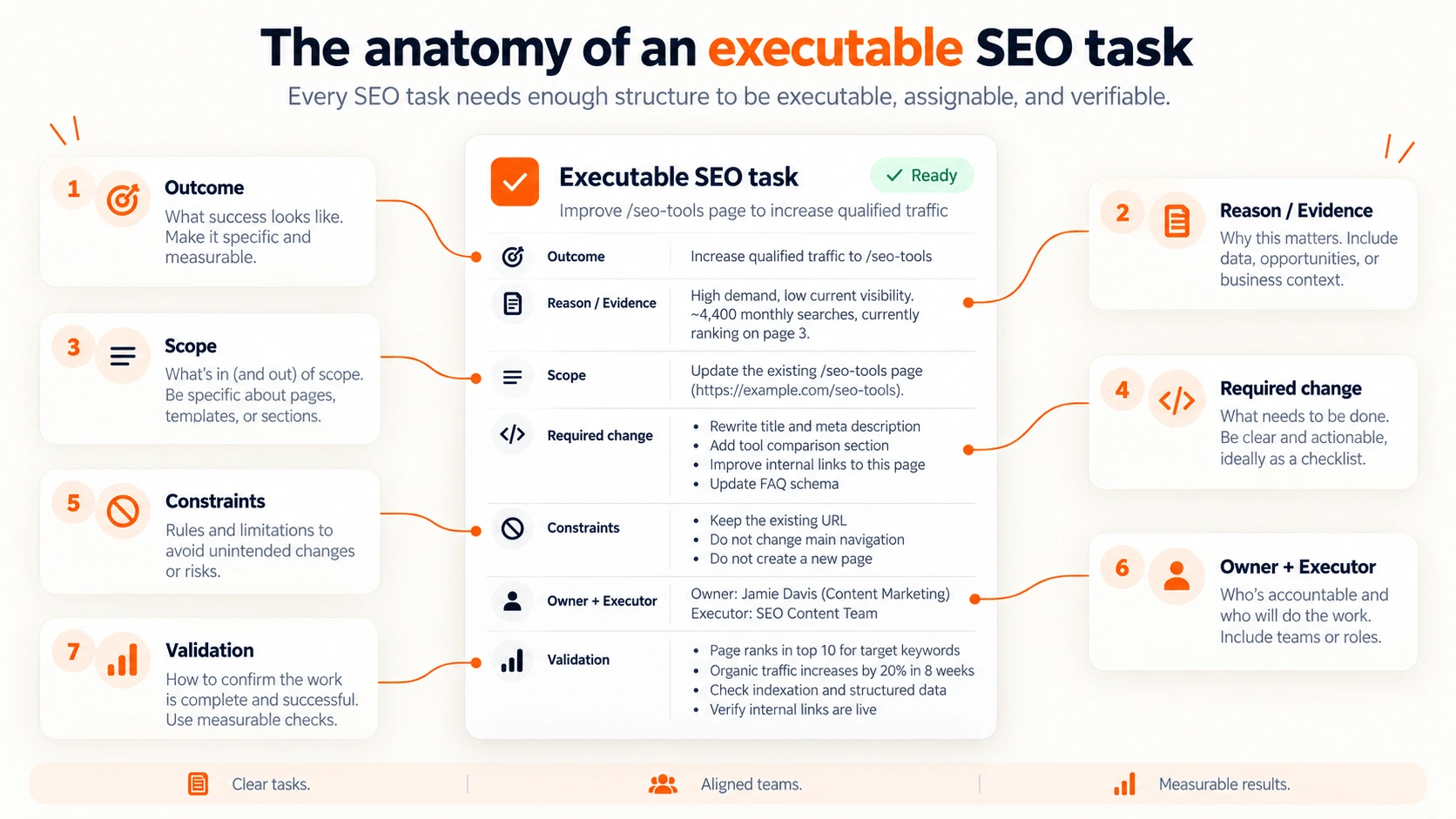 The anatomy of an executable SEO task
A practical SEO task management workflow
Once SEO work exists, use this six-stage sequence:
Capture → Clarify → Prioritize → Assign → Execute → Validate
It is deliberately simple.
Task management should reduce coordination cost, not create a second job managing the system itself.
1. Capture tasks from real signals
Tasks should come from evidence or strategy, not from an endless idea bucket.
Useful task sources include:
- a verified crawl finding
- Search Console performance
- a confirmed search-intent mismatch
- a content opportunity
- an internal-link gap
- a release or migration requirement
- an explicit strategic initiative
Capture the task before all implementation detail is known.
But do not immediately treat every observation as committed work.
For example:
Observation:
17 important pages receive almost no contextual internal links.
That can enter the task system as a candidate.
It should not automatically become 17 independent tickets.
First determine what the real unit of work is.
2. Clarify the task before execution
Turn the candidate into a bounded task.
Ask:
- What outcome are we trying to create?
- What is the actual affected scope?
- Is this one task or several?
- What evidence supports it?
- What should remain unchanged?
- What would an executor need to know?
- How will we validate the result?
This is where vague recommendations become executable.
Example: broken internal links
Vague:
Fix broken links.
Clarified:
Update the 14 internal links currently pointing to four removed guide URLs. Redirect two moved pages to their new equivalents, remove links to two intentionally retired pages, and verify no internal links remain to the four old URLs.
One task can contain multiple affected URLs if they belong to the same judgment and implementation pattern.
You do not need one ticket per URL.
3. Prioritize before work enters active execution
A task can be valid without being current.
This is where task management must stay connected to prioritization.
Use the broader prioritization framework:
Blockers → Impact → Evidence → Dependencies → Effort
Then distinguish between:
- candidate work
- next work
- active work
- deferred work
Do not label every valid SEO issue “high priority.”
If everything is high, task management has stopped preserving judgment.
For a deeper backlog-sorting method, see How to prioritize SEO tasks when everything feels urgent.
4. Assign accountability, not just a username
Most task systems let you assign a person.
That is useful, but SEO often needs two kinds of accountability:
Decision owner
The person responsible for whether the recommendation is correct and properly scoped.
Executor
The person or system responsible for implementation.
For a content task:
Decision owner: SEO strategist
Executor: writer
Reviewer: editor
For a technical fix:
Decision owner: founder / SEO lead
Executor: developer or coding agent
Reviewer: developer / founder
For a small team, one person may hold all three roles.
The important thing is to avoid invisible ownership.
5. Execute with the context attached
The executor should not need to reconstruct the SEO reasoning from scratch.
Keep the relevant context with the task:
- affected URLs
- examples
- screenshots
- acceptance criteria
- internal-link targets
- expected canonical behavior
- target query
- required page sections
- approved product claims
- implementation constraints
This is especially important when work moves between disciplines.
An SEO ticket that reaches engineering as:
“Canonical issue — high priority”
creates unnecessary back-and-forth.
A ticket that shows the URL pattern, current behavior, expected behavior, exclusions, and validation rule can move immediately.
6. Validate before marking SEO work complete
A useful SEO status model distinguishes implementation from validation.
For example:
Ready
↓
In progress
↓
Implemented
↓
Validation
↓
Done
Why include Implemented separately from Done?
Because the site may not behave as expected after implementation.
A developer can merge the correct code into the wrong template.
A CMS can rewrite metadata.
An internal link can exist in source data but fail to render.
A writer can publish the requested article but miss the intended search angle.
The validation step prevents task completion from becoming an assumption.
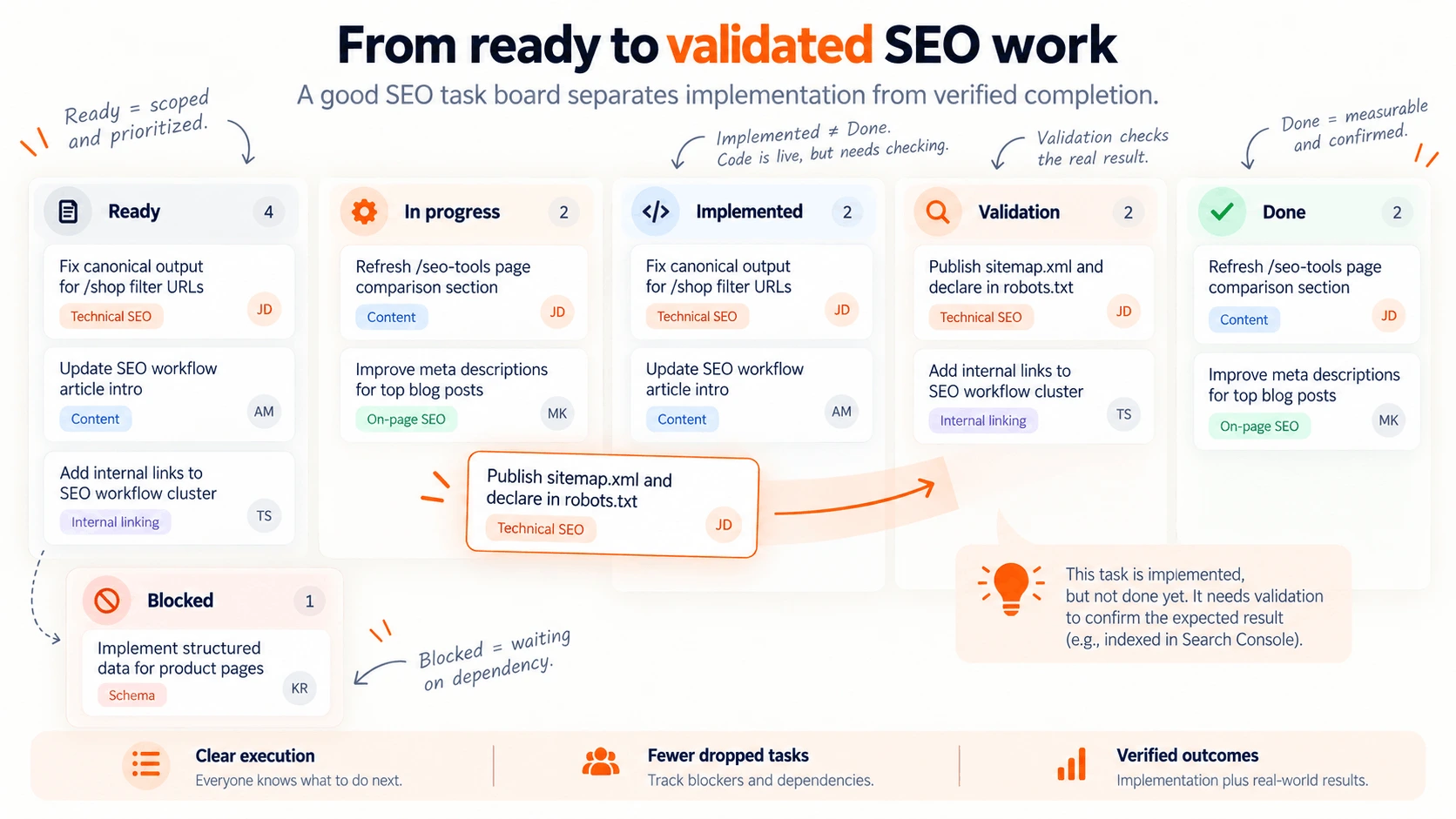 An SEO task board should separate implementation from validated completion
How to organize an SEO task board
You do not need twenty statuses.
In most cases, use five.
Ready
The task is scoped, prioritized, and ready for execution.
It should have enough context for the executor to begin.
In progress
Someone or something is actively working on it.
Keep work-in-progress low enough that the team can actually finish what it starts.
Blocked
The task cannot progress because of a concrete dependency.
Examples:
- waiting for engineering access
- design component not available
- content dependency unpublished
- migration not complete
- product decision unresolved
“Too busy” is not a useful blocked reason.
Validation
Implementation is complete, but SEO acceptance checks have not finished.
This is where you recrawl, inspect, test, or review.
Done
The intended state has been verified.
Done should mean:
The task was implemented and the completion criteria were satisfied.
Not simply:
The assignee clicked Done.
Organize SEO work by scope, not only by discipline
Teams often organize SEO tasks into categories such as:
- Technical
- Content
- On-page
- Links
- Performance
Those labels are useful.
But scope is often even more important.
A better task should make clear whether it affects:
One page
Example:
Rewrite the SEO workflow article introduction to better answer the primary query.
A page group
Example:
Add contextual links from six supporting guides to the SEO workflow pillar.
A template
Example:
Correct canonical output for filtered collection pages.
A sitewide rule
Example:
Add the sitemap URL to
robots.txt.
A content cluster
Example:
Build and interlink a pillar plus three supporting pages around SEO workflow.
This helps the executor understand whether the work should be treated as one bounded system change or many unrelated edits.
Manage dependencies explicitly
SEO work has hidden dependencies everywhere.
A content task may depend on:
- a pillar page
- product evidence
- keyword mapping
- screenshots
- design components
- another article being published first
A technical task may depend on:
- deployment access
- template ownership
- redirect rules
- CMS behavior
- routing changes
- a migration
If a task depends on another task, record it.
Do not rely on the executor discovering the relationship halfway through implementation.
A useful dependency note is simple:
Blocked by:
New `/guide/seo-workflow` pillar must be live before internal links are added.
or:
Must ship before:
Bulk publication of new filtered category pages.
Dependencies help you preserve sequence.
Limit work in progress
One of the easiest ways to make SEO task management fail is to start too much work.
A board can look productive with:
- 8 technical tickets in progress
- 5 content drafts
- 3 refreshes
- 2 schema tasks
- 4 internal-link projects
But unfinished SEO work does not create value.
WIP limits are useful because they force the team to finish, validate, and learn before opening more work.
For a solo founder, this might mean:
one active technical task + one active content task
For a larger team, it may mean a small limit per execution lane.
The exact number is less important than the rule:
Starting work should consume capacity. Finishing work should restore it.
Do not let the backlog become a permission slip for parallel chaos.
Should SEO teams use Kanban or sprints?
Both can work.
They solve slightly different coordination problems.
Kanban works well for continuous SEO work
Use a flow-based board when work arrives continuously and has different sizes.
Good examples:
- internal-link improvements
- page refreshes
- technical fixes
- Search Console opportunities
- broken-link cleanup
- schema updates
A simple:
Ready → In progress → Validation → Done
works well.
Sprints work well for bounded initiatives
Time-boxed planning can be useful for work such as:
- site migrations
- structured-data rollouts
- large content-cluster launches
- template rebuilds
- coordinated release work
A sprint gives a temporary boundary around a known initiative.
Do not force all SEO into one methodology
SEO contains both continuous operational work and project-shaped work.
Choose the coordination method that matches the work.
The mistake is turning the project-management method itself into the strategy.
How to manage technical SEO tasks
Technical SEO tasks need especially clear implementation boundaries.
A useful technical task contains:
Observed condition
Affected scope
Expected behavior
Implementation constraint
Examples
Validation method
Example
Title
Fix canonical output for filtered shop URLs
Observed condition
Parameterized filter URLs are canonicalizing inconsistently.
Scope
/shop?filter_* URLs only.
Expected behavior
Filtered URLs should canonicalize to the primary /shop URL unless the filtered page is intentionally indexable.
Constraint
Do not change product-page canonicals.
Validation
Test representative filter combinations, inspect rendered canonical tags, and recrawl the affected pattern.
That task is far more useful than:
Fix canonical errors.
How to manage SEO content tasks
Content work needs a different contract.
A useful content task contains:
Target search intent
Existing page or new page
Primary topic
Reader question
Required sections
Internal links
Evidence / source requirements
CTA role
Validation
Example
Title
Update SEO prioritization pillar around seo prioritization
Page
/guide/how-to-prioritize-seo-work
Intent
Practical informational guide for deciding what SEO issue to fix first.
Required change
Rewrite the opening around the query, add a clear prioritization framework, preserve distinct supporting-guide intents, and update the RankQuest product bridge.
Internal links
Link to SEO task prioritization, what-to-fix-first, SEO decisions vs tools, and SEO workflow.
Validation
Confirm title/H1/search intent, internal links, canonical, indexability, and absence of a competing new page.
Again, the task preserves strategy for the person doing the work.
Humans and AI agents in the same task system
AI changes execution capacity.
It does not remove the need for task management.
A coding agent can:
- inspect templates
- modify metadata generation
- add schema
- repair internal links
- create redirects
- implement sitemap logic
A writing agent can:
- draft a new article
- update an existing page
- restructure content
- add internal links
- create meta copy
But AI agents are much more reliable when the task contains:
- bounded scope
- explicit constraints
- verified context
- examples
- acceptance criteria
- validation instructions
A weak AI task:
Fix our SEO.
A stronger one:
Inspect canonical generation for parameterized
/shopURLs, update only the filter-page branch so those URLs canonicalize to/shop, preserve product-page self-canonicals, and return the changed files plus test cases for three sample filter URLs.
The task-management requirement gets more important when execution becomes faster.
Otherwise you simply automate vague work faster.
Do you need SEO-specific task management software?
Not necessarily.
You can manage SEO work in:
- Linear
- Jira
- Asana
- ClickUp
- Notion
- Trello
- GitHub issues
- a spreadsheet
The important question is whether your system preserves the SEO context.
A generic task manager is usually enough if every task contains:
- evidence
- scope
- owner
- dependency
- completion criteria
- validation
SEO-specific task software becomes useful when you need tighter integration between search data and work, especially across many clients, sites, or specialists.
But adding another tool does not solve vague recommendations or bad prioritization.
The task system can organize work.
It cannot decide whether the work is strategically correct.
The minimum SEO task template
If you want the shortest practical template, use this:
TASK
What should change?

WHY
Why does this matter?

SCOPE
Which pages, templates, or content are included?

DO
What exactly should the executor implement?

DO NOT
What must remain unchanged?

OWNER / EXECUTOR
Who owns the outcome and who performs the work?

DEPENDENCIES
What must happen first?

VALIDATION
What proves this task is complete?
That is enough for most SEO work.
You can add:
- due date
- estimate
- labels
- comments
- sprint
- client visibility
when they help coordination.
Do not let optional metadata obscure the execution contract.
A complete SEO task management example
Suppose a crawl finds that an important group of guide pages receives almost no contextual internal links.
Here is how that work should move through the system.
Capture
Signal
Several priority guides have weak internal support.
Clarify
Outcome
Increase contextual internal links to the SEO workflow pillar and its supporting pages.
Scope
Six existing guides in the decision-first/workflow cluster.
Required change
Add one or two natural contextual links from each relevant page to the most appropriate pillar/supporting page.
Constraint
Do not add generic sitewide footer links as a substitute for contextual links.
Prioritize
The pages are strategically important and already indexable.
There is no more urgent crawl/indexation blocker.
The task is approved for active work.
Assign
Owner
SEO strategist / founder
Executor
Writer or content agent
Execute
Update the six pages according to the agreed link map.
Validate
Recrawl the pages.
Confirm:
- links render
- destinations return 200
- anchors are descriptive
- links are contextually relevant
- no accidental duplicates were added
Complete
Move the task to Done only after validation.
This is task management doing its actual job:
preserving the decision all the way through implementation.
Where RankQuest fits — and where it does not
RankQuest is not trying to become a giant SEO task manager.
It does not exist to give you another board containing fifty open recommendations.
That would recreate the same prioritization problem in a nicer interface.
RankQuest operates earlier in the chain.
It continuously observes the site, evaluates the current signals, and surfaces the SEO decision that deserves action.
That decision then opens into a bounded Implementation Room, where the execution scope and permitted actions stay tied to that decision.
Depending on the work, RankQuest can produce implementation guidance, structured outputs, or AI-agent-ready prompts.
After the change, the site is re-observed.
The distinction is:
Task management organizes work that exists. RankQuest reduces the amount of work competing for attention in the first place.
That means RankQuest can work alongside your existing task system.
A team can still use Linear, Jira, GitHub, Notion, or another workspace for broader coordination.
RankQuest's job is to keep SEO judgment and execution scope from dissolving into another endless backlog.
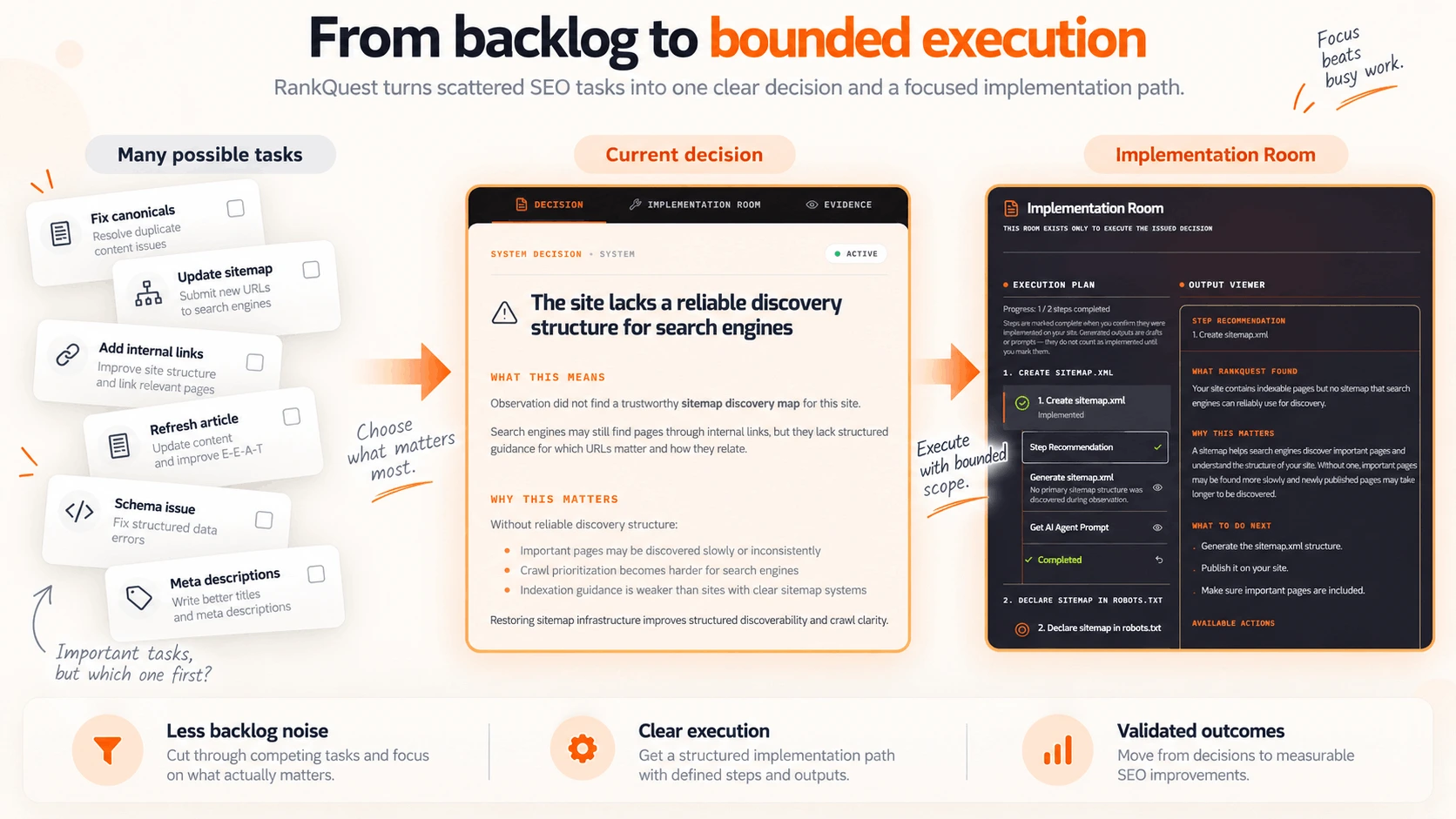 From one SEO decision to bounded execution in RankQuest
Turn SEO findings into one clear next action
RankQuest continuously observes your site, identifies what matters most, and gives you a bounded path to execute it.
Start with your site →
Common SEO task management mistakes
Creating a task for every audit finding
One audit finding does not always equal one task.
Group work according to the real implementation unit.
A template problem affecting 300 pages may be one task.
Writing tickets without the reason
“Fix this” is fragile.
The executor needs enough context to avoid solving the wrong problem.
Confusing priority with status
“High priority” does not tell you whether something is ready, blocked, in progress, or validating.
Keep priority and workflow state separate.
Assigning work without defining scope
Ambiguous scope creates rework.
Be explicit about included and excluded pages, templates, and behaviors.
Keeping too much work active
A board full of “In progress” SEO tasks is usually a queue with optimistic labels.
Limit WIP.
Finish and validate.
Letting Done mean deployed
Deployment is an implementation event.
SEO completion requires verification.
Using the board as the prioritization system
A task manager can sort tasks.
That does not mean the highest item is the right SEO decision.
Keep prioritization grounded in current evidence.
SEO task management checklist
Before moving an SEO task into active execution, confirm:
- the task has a clear outcome
- the reason is understood
- the affected scope is explicit
- the required change is specific
- constraints are recorded
- the task has a real owner
- dependencies are known
- the executor has the necessary context
- validation criteria exist
- it deserves attention now
Before marking it Done, confirm:
- the work was implemented
- the affected pages/templates were checked
- completion criteria were satisfied
- no obvious regression was introduced
- the next SEO priority should be chosen from current evidence
Frequently asked questions
What is the best way to manage SEO tasks?
Use a small workflow with clear task contracts.
For most teams:
Ready → In progress → Blocked / Validation → Done
is enough.
The quality of each task matters more than the complexity of the board.
What information should an SEO task include?
At minimum:
- outcome
- reason
- scope
- required change
- constraints
- owner/executor
- dependencies
- validation criteria
Should every SEO issue become a task?
No.
An issue is an observation.
Create or activate a task only when the issue is understood, relevant, scoped, and worth acting on.
How many SEO tasks should be in progress?
There is no universal number.
Keep the active set small enough that work can finish and be validated.
For a solo operator, one or two active SEO tasks may be enough.
What is the difference between SEO task management and SEO project management?
Task management deals with individual pieces of work and their execution state.
Project management covers a broader initiative with multiple tasks, milestones, resources, timelines, and stakeholders.
A site migration is an SEO project.
Fixing the canonical behavior of one template is an SEO task within that project.
Can AI agents execute SEO tasks?
Yes, when the work is suitable for automation and the task is properly bounded.
AI agents are strongest when they receive explicit scope, context, constraints, expected output, and validation requirements.
They should not be asked to make unbounded SEO decisions from vague instructions.
What to read next
If you need the full operating model that connects SEO evidence to execution, read SEO Workflow: How to Turn SEO Data Into Action.
If your problem is deciding which task deserves attention first, read SEO Prioritization: How to Decide What to Fix First.
If your backlog feels urgent and you need a narrower sorting process, read How to prioritize SEO tasks when everything feels urgent.
If your tools keep producing findings without resolving action, read SEO Decisions vs SEO Tools.
If you are trying to execute too much SEO simultaneously, read What “one SEO decision at a time” looks like in practice.
Good SEO task management preserves the decision
The purpose of SEO task management is not to build the most sophisticated board.
It is to prevent important work from losing its meaning between diagnosis and execution.
A strong task preserves:
why the work exists → what is in scope → who owns it → how it gets executed → how completion is verified
That makes SEO work easier to delegate to a teammate, developer, writer, agency, or AI agent without forcing them to reconstruct the strategy.
The board is just the container.
The real system is the clarity attached to the work.